

 fetchpriority=”high” width=”702″ height=”395″ decoding=”async” data-nimg=”1″ class=”Banner-sc-dde1a594-8 cgsQTC” style=”color:transparent” srcSet=”/_mfes/post/_next/image/?url=https%3A%2F%2Fassets.beincrypto.com%2Fimg%2FN7SOnkUKIVZFkO8yMLI4xIRhROw%3D%2Fsmart%2F51efd39ba6574a8290fd226684673ad7&w=750&q=75 1x, /_mfes/post/_next/image/?url=https%3A%2F%2Fassets.beincrypto.com%2Fimg%2FN7SOnkUKIVZFkO8yMLI4xIRhROw%3D%2Fsmart%2F51efd39ba6574a8290fd226684673ad7&w=1920&q=75 2x” src=”/_mfes/post/_next/image/?url=https%3A%2F%2Fassets.beincrypto.com%2Fimg%2FN7SOnkUKIVZFkO8yMLI4xIRhROw%3D%2Fsmart%2F51efd39ba6574a8290fd226684673ad7&w=1920&q=75″/>
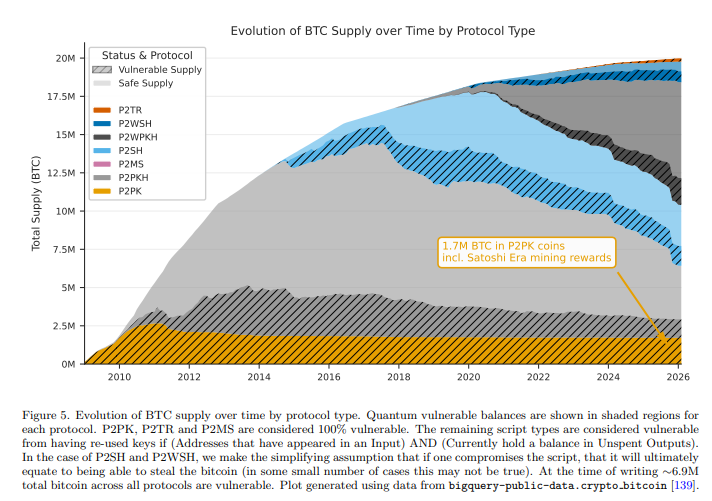
- Google Quantum AI has identified approximately 6.7 million Bitcoin residing in addresses susceptible to quantum at-rest attacks.
- A significant portion of these vulnerable Bitcoins are held in legacy P2PK addresses, which permanently expose public keys, making them prime targets for quantum decryption.
- The immutability of dormant Bitcoin holdings presents a challenge, as these funds cannot be upgraded to quantum-resistant cryptography and may necessitate intervention through regulatory or protocol-level solutions.
Recent on-chain analysis indicates that nearly 6.7 million Bitcoin are currently held in addresses vulnerable to quantum computing attacks. These holdings have remained inactive for extended periods, with some dating back over a decade. Notably, a portion of these dormant assets is believed to have originated from early Bitcoin transactions, potentially including those by Satoshi Nakamoto.
These untransacted coins represent a significant potential target within the evolving landscape of financial security.
The Bitcoin Exposure Unaddressed
A comprehensive whitepaper released by Google Quantum AI on March 30, 2026, provides the first detailed assessment of Bitcoin’s quantum vulnerability. The research highlights approximately 100,000 Bitcoin addresses at risk from “at-rest” attacks. Such attacks, leveraging advanced quantum computing capabilities, could potentially derive private keys from these addresses without any on-chain transaction occurring.
The aggregate value held within these identified addresses amounts to roughly 6.7 million BTC.
Vulnerability of Early Bitcoin Addresses
The highest concentration of exposed Bitcoin is found in Pay-to-Public-Key (P2PK) scripts originating from Bitcoin’s nascent mining phase, specifically the Satoshi era of 2009-2010. These early script types embed the public key directly onto the blockchain, rendering it permanently accessible.
A quantum computer employing Shor’s algorithm could potentially exploit this permanently visible public key to compute the corresponding private key, thereby gaining control over the funds within the address.
Analysis reveals a cluster of 50 Bitcoin addresses, each containing one early mining reward, located around address rank 6,000. Many of these addresses have remained untouched since Bitcoin’s initial years.
“Progress on quantum from Bitcoin core developers is important, because there are parts of the Bitcoin community — whether they should be or not — that are worried about quantum and want to see it taken seriously and addressed. As more information comes out and people see it being worked on, that will be positive,” said Matt Hougan, Chief Investment Officer at Bitwise, BeInCrypto Expert Council.
An Unpatchable Dilemma
Unlike actively managed wallets, dormant Bitcoin addresses cannot be updated or migrated to post-quantum cryptography standards. These addresses present a static and perpetually exposed attack surface that will become increasingly perilous as quantum computing technology advances.
Google’s research estimates that approximately 1.7 million BTC are currently secured by P2PK scripts. Factoring in the impact of address reuse, the total quantum-vulnerable Bitcoin supply could extend to nearly 6.9 million BTC.
The Google paper posits that the cryptocurrency community and regulatory bodies will soon confront a significant challenge: determining the disposition of these Bitcoin holdings should a quantum computer gain the capability to seize them. Potential solutions under consideration range from protocol-level mechanisms for rendering vulnerable coins unusable to establishing legal frameworks for the regulated recovery of these assets, a concept termed “digital salvage.” The available timeframe for proactive preparation is diminishing.
Source: : beincrypto.com