


The notion that cheap power alone suffices for Bitcoin mining is being re-evaluated. While off-grid solar farms offer near-zero marginal electricity costs, their limited capacity factors have historically deterred widespread adoption by miners. Unreliable uptime undermines the fundamental profitability calculations necessary for large-scale operations.
However, a paradigm shift is emerging with the prospect of space-based operations. In Low Earth Orbit (LEO), solar arrays can achieve utilization rates approaching 95%, a stark contrast to terrestrial constraints. The primary hurdle now lies in the capital expenditure required to establish such extraterrestrial infrastructure. A growing cohort of companies believes the economics are beginning to align.
Key Takeaways:
- Starcloud-1: Launched in November 2025 via a SpaceX Falcon 9 rideshare, this mission included the first H100 GPU deployed in orbit.
- Starcloud-2: Targeting an October 2026 launch, this mission will carry Bitcoin ASICs and Nvidia Blackwell chips, boasting 100 times the energy generation capacity of Starcloud-1, potentially marking the first instance of Bitcoin mining in space.
- Orbital Power Economics: Estimated power costs are below $0.01/kWh, with solar utilization 5–8 times greater than ground-based panels. Passive radiative cooling eliminates the need for fans, pumps, and water.
- Bitcoin’s Role in Space Infrastructure: ASICs are considered an ideal foundational load for orbital infrastructure due to their cost-effectiveness per kW compared to GPUs, minimal latency requirements, and a consistent, permissionless revenue stream.
- Economic Catalyst: Bitcoin mining could serve as a catalyst for funding orbital infrastructure development. Monetizing space-based solar power through mining may finance future satellite generations and potentially other extraterrestrial applications.
The concept of orbital compute infrastructure is gaining traction, underscored by significant developments in semiconductor manufacturing and AI hardware. The Terafab initiative, a joint venture between Tesla, SpaceX, and xAI, plans a substantial semiconductor fabrication plant in Texas, with a focus on chips hardened for space. This aligns with the growing consensus among startups like Starcloud, Intercosmic Energy, and Aetherflux that terrestrial power limitations necessitate off-planet solutions. Nvidia CEO Jensen Huang’s remarks at GTC 2026 further support this, emphasizing that competitive advantage in AI infrastructure hinges on efficient power conversion into high-value output.
Starcloud’s CEO, Philip Johnston, has articulated ambitions to conduct Bitcoin mining in space. Following a successful 2025 demonstration involving Nvidia H100 GPUs performing AI tasks in LEO, Starcloud-2 is set to integrate Bitcoin ASIC miners with advanced GPU platforms. This satellite aims for significantly increased energy generation, positioning the company to potentially become the first to mine Bitcoin from orbit. Complementary ventures like Intercosmic Energy and Aetherflux are exploring similar orbital compute models, while companies such as Terawatt Space are developing lightweight, radiation-hardened solar panels specifically for satellite deployment, driving down the cost per watt.
The challenge for space-based solar power (SBSP) initiatives has long been energy transmission back to Earth. Concepts involving microwave or laser beaming face significant hurdles in terms of efficiency, atmospheric losses, and ground infrastructure requirements. This has historically resulted in prohibitive upfront capital costs and uncertain returns. Bitcoin mining offers a potential solution by creating value directly at the source of energy generation, negating the need for complex transmission systems.
By integrating Bitcoin mining as an initial revenue-generating load, orbital infrastructure projects can become more financially viable. Mining converts energy into a liquid digital asset (BTC) that can be sold to the network. This concept, termed the “lossless value pipeline” by Intercosmic Energy, allows for immediate monetization of generated power. Metrics like Luxor’s Hashprice Index quantify the revenue potential of hashrate, with the Energy Hashprice specifically translating this into revenue per watt-hour. This mirrors terrestrial mining strategies where mining operations often provide baseload power, supporting more complex computational workloads like AI inference and stabilizing energy infrastructure investment.
Solar Utilization
The operational environment in Low Earth Orbit presents significant advantages for solar energy generation. Unlike terrestrial installations subject to diurnal cycles, weather phenomena, and atmospheric scattering, solar panels in LEO experience near-continuous exposure to unfiltered sunlight. This results in a capacity factor estimated to be 5–8 times higher than that of comparable ground-based arrays, even in optimal terrestrial locations like northern Chile. While West Texas solar farms operate at around 25% capacity factor and even optimal ground sites rarely exceed 30-33%, LEO arrays can achieve 90-95% utilization. This dramatically increases energy output per unit of installed capacity, driving down the all-in cost of power to potentially below $0.01/kWh, a significant reduction from the average industrial rate of $0.05/kWh for terrestrial miners.
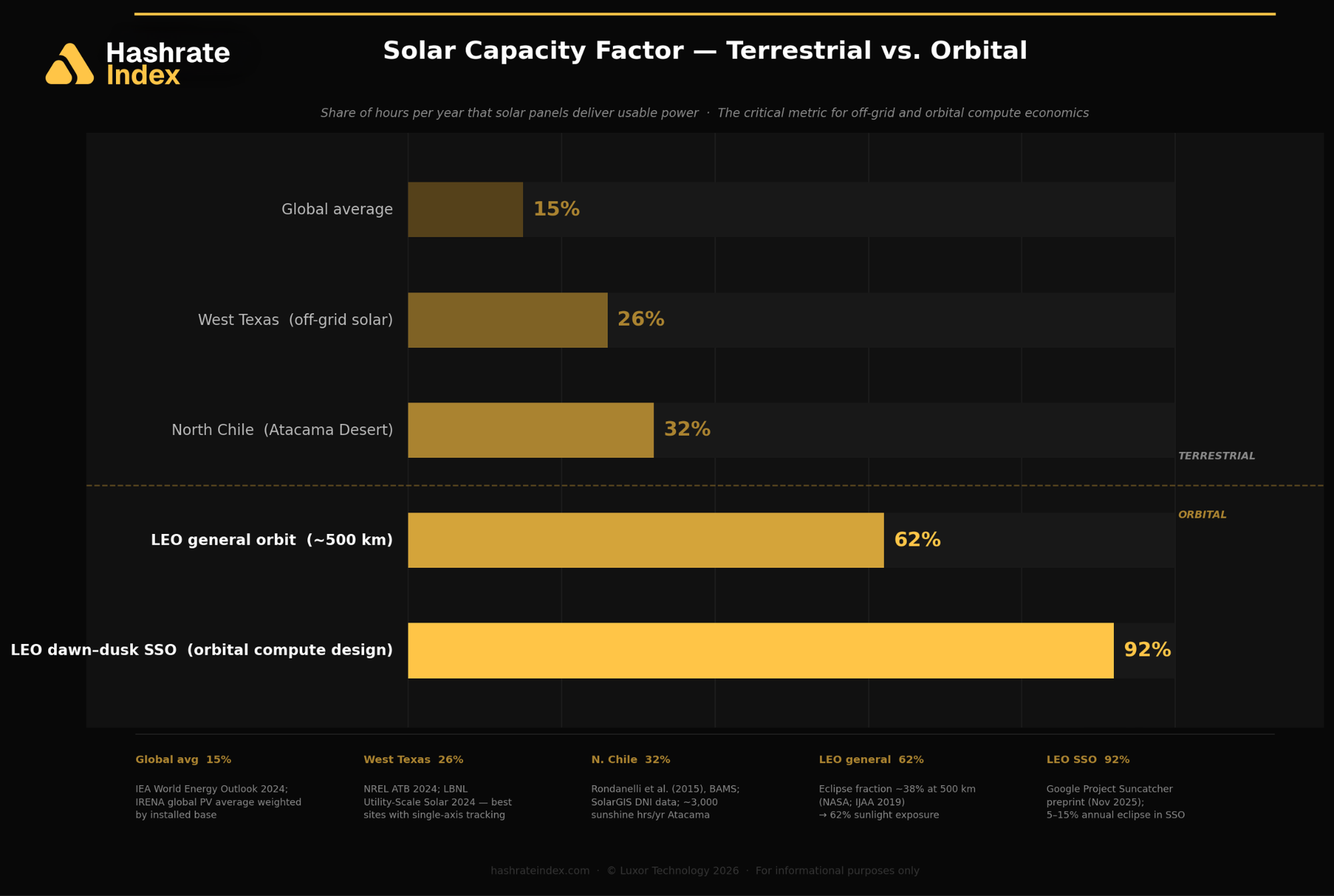
Nvidia CEO Jensen Huang’s observation at GTC 2026 highlights that “tokens per watt” is the critical metric for AI infrastructure. As demand for AI inference grows and power availability becomes a limiting factor, the economic case for deploying compute resources beyond Earth intensifies.
Passive (Radiative) Cooling
Chip cooling represents a significant operational expense for terrestrial mining operations, often involving substantial water consumption and energy-intensive fan systems. In the vacuum of space, heat dissipation relies on passive radiative cooling, where heat is emitted as infrared radiation into deep space. This method obviates the need for active cooling components like fans, pumps, and water, presenting a substantial operational advantage. However, thermal management in space is complex. The efficiency of heat transfer from chips to radiator panels is constrained by conduction, particularly through thermal interface materials and structural pathways. Satellites experience extreme temperature fluctuations between orbital sunlight and shadow phases, necessitating robust radiator designs capable of handling peak heat loads without excessive mass penalties.
Advanced firmware solutions, such as Luxor’s LuxOS with its Advanced Thermal Management (ATM) feature, can dynamically adjust ASIC frequencies and voltages to maintain optimal operating temperatures. In an orbital environment where physical maintenance is impossible, such firmware-level thermal control becomes critical for extending hardware lifespan over multi-year missions. Even minor temperature deviations can significantly impact the longevity of sensitive electronics.
Hardware and Infrastructure Redesign for Space
Standard commercial mining hardware requires significant redesign to withstand the rigors of the orbital environment. Cumulative radiation damage to silicon is a primary concern, necessitating extensive radiation qualification processes for all components. This adds considerable development time and cost compared to terrestrial deployments. The absence of atmospheric pressure and the extreme temperature variations demand specialized thermal management systems, moving away from conventional airflow cooling. Furthermore, any hardware failure in orbit is permanent for the mission’s duration, underscoring the need for extreme reliability.
Launch Costs
The economic feasibility of orbital mining is intrinsically linked to launch costs. Current estimates place the cost at $1,500–$3,000 per kilogram for missions utilizing vehicles like SpaceX’s Falcon 9. For orbital mining to become competitive, these costs need to decrease substantially, ideally to the $200–$500 per kilogram range. A fleet of Antminer S21 XP Hyd units, for example, weighing approximately 27 metric tons for 1 EH/s of hashrate, would incur launch costs of $40.5 million to $81 million at the current rate, before accounting for the additional mass of the satellite bus, solar arrays, and other essential orbital systems. This orbital system mass can add 1.5–3 times the weight of the bare hardware, escalating launch expenses significantly compared to terrestrial deployments.
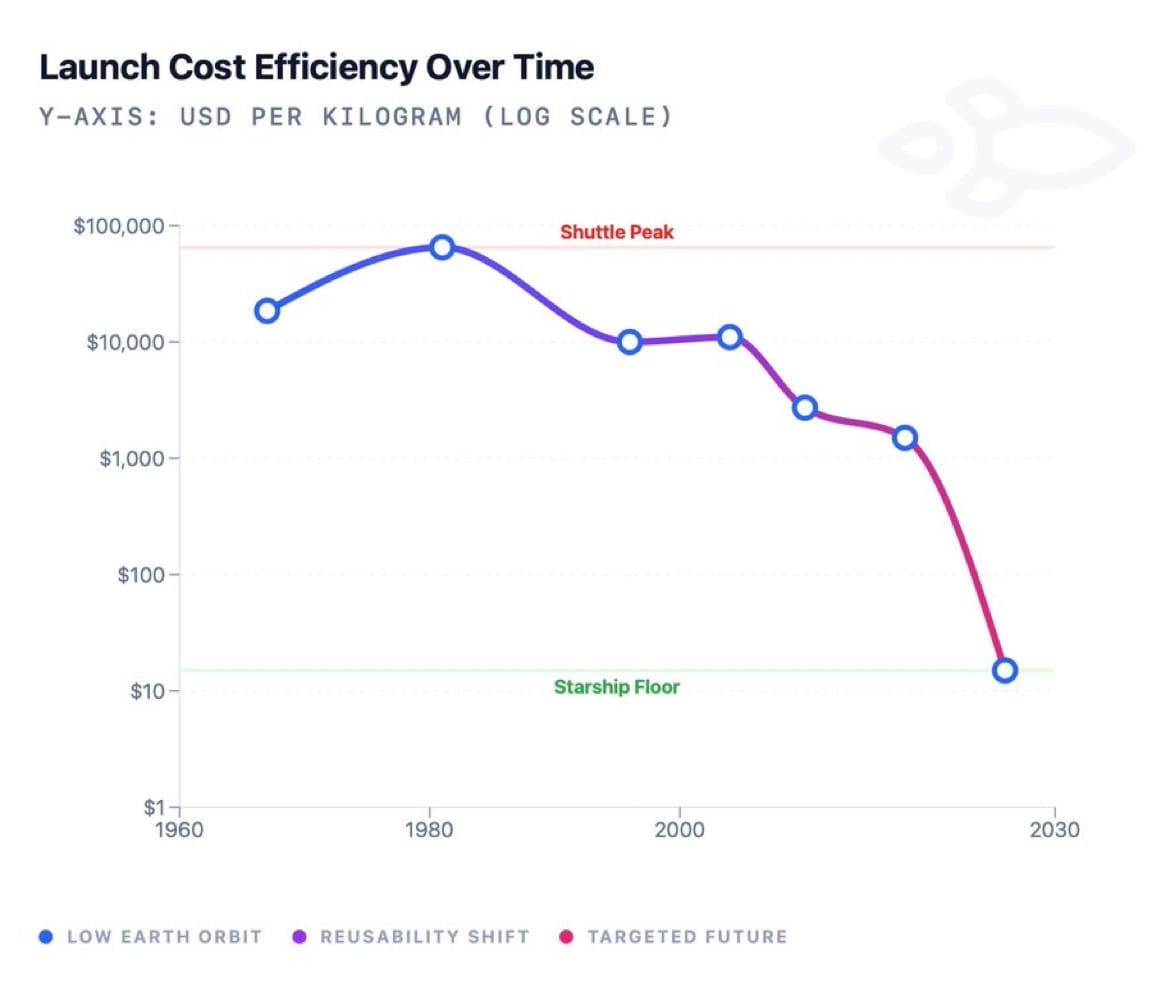
The trajectory of launch costs is critical. Projections indicate that SpaceX’s Starship program, with its fully reusable architecture, could reduce per-kilogram costs to the target range. At $500/kg, the launch cost for 100 metric tons of orbital system mass approaches $50 million, bringing it closer to terrestrial hardware costs. At $200/kg, the amortized energy cost could become comparable to terrestrial data center energy expenses, though engineering, qualification, and integration costs would remain substantially higher. The realization of these lower launch costs is contingent on the successful development and operational cadence of Starship.
Network Latency: Manageable But Worth Monitoring
While Bitcoin mining is not bandwidth-intensive, network latency can impact mining efficiency by increasing the rate of rejected shares. Current observations indicate that pings exceeding 100 milliseconds can lead to approximately 0.1% rejected shares on pools like Luxor Pool. Low Earth Orbit to ground latency typically ranges from 10–50ms, which is competitive with many terrestrial network connections. Therefore, orbital mining operations are expected to perform adequately in terms of latency, although direct testing will be necessary for definitive assessment.
New Complexity
Orbital deployments bypass some terrestrial challenges such as land acquisition and utility interconnection. However, they introduce a new layer of regulatory complexity, including FCC licensing, frequency coordination, debris mitigation filings, and ITU registration. These processes can be extensive, particularly for large satellite constellations, and are subject to evolving international and domestic regulations. Starcloud’s FCC filing, for instance, has already faced opposition from other major players in the satellite communications industry, indicating a dynamic and potentially contested regulatory landscape.
The trajectory towards extraterrestrial infrastructure development aligns with civilizational energy harnessing frameworks, such as the Kardashev scale. A Type I civilization harnesses all the energy reaching its home planet from its star. Achieving this necessitates capturing solar energy beyond Earth’s atmosphere to overcome limitations imposed by weather, atmospheric absorption, and the diurnal cycle. Artificial intelligence represents a rapidly growing demand for energy, and the terrestrial grid faces limitations in meeting this escalating requirement. Orbital solar power, coupled with efficient energy monetization through Bitcoin mining, offers a scalable solution to provide the necessary energy abundance for advanced AI and potentially future space-based endeavors, such as asteroid mining and lunar habitation.
The current energy consumption of the Bitcoin network is a small fraction of global electricity usage. However, if Bitcoin mining gravitates towards orbital infrastructure, it could act as a significant driver for the capital investment required to scale up space launch capabilities. This, in turn, could reduce access costs to space for a multitude of applications, fostering a positive feedback loop for the expansion of off-world infrastructure.
What to Watch:
- The performance of ASICs in the LEO environment during the Starcloud-2 mission, scheduled for October 2026, will be a critical proof of concept.
- The success and operational cadence of SpaceX’s Starship program in achieving projected launch costs of $200–$500 per kilogram is vital for orbital mining economics.
- The evolving hashprice environment will continue to influence the profitability of mining operations, both terrestrial and orbital, making the operational cost advantage of sub-$0.01/kWh power increasingly significant.
For inquiries regarding Luxor’s comprehensive Bitcoin mining services, please contact [email protected] or visit https://luxor.tech.
About Luxor Technology Corporation
Luxor provides a suite of hardware, software, and financial services that support the global compute and energy sectors. Its offerings include Bitcoin Mining Pools, ASIC Firmware, Hardware trading platforms, Hashrate Derivatives, Energy services, and the Hashrate Index data platform.
Source: : hashrateindex.com