


- Bitcoin (BTC) concluded March with a 1.8% gain, breaking a five-month streak of negative returns.
- Analysts are forecasting a potential market bottom later in the current year.
- Ongoing geopolitical tensions continue to exert pressure on market sentiment.
Bitcoin (BTC) concluded the month of March with a modest gain of 1.8%. This development signifies the first positive monthly performance since September 2025 and interrupts a sequence of five consecutive months with declining prices.
The month of April has commenced with increased volatility, as the primary cryptocurrency has experienced minor price depreciation.
Market Performance and Seasonal Trends
Data from BeInCrypto Markets indicated that the cryptocurrency was trading at approximately $67,630 during early Asian trading hours.
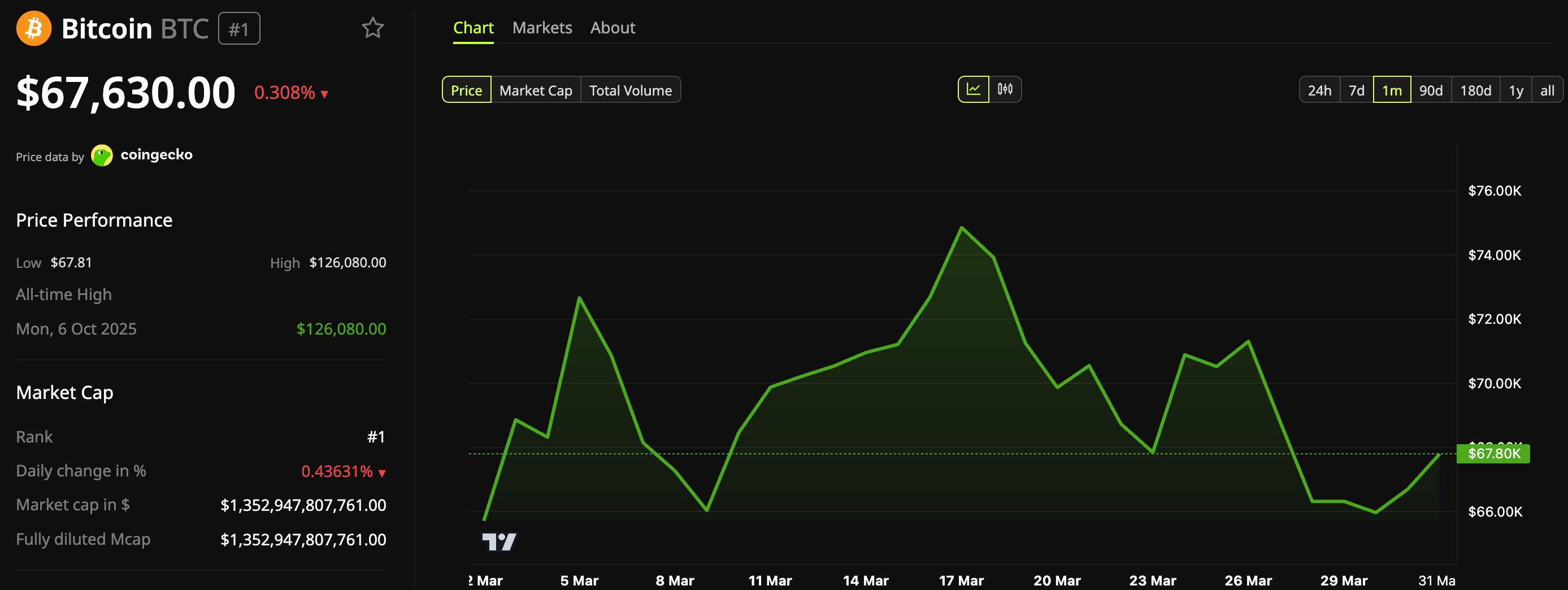
Historically, April has demonstrated a positive trend for Bitcoin, with average returns of 12.1% and a median of 5.04%. However, the asset has deviated from these seasonal patterns since late 2025. January and February recorded losses of 10.1% and 14.9% respectively, both significantly below their historical averages. The marginal gain in March has had a limited impact in offsetting these earlier declines.
Analysis of Bitcoin’s Recent Performance and Outlook
The prevailing geopolitical and macroeconomic uncertainties are tempering the predictive power of seasonal trends. With a significant portion of the market now considering Bitcoin to be in a bear market phase, attention is focused on its trajectory for April.
Geopolitical Influences and Technical Indicators
Binance Research has suggested that any concrete signals of a ceasefire between the US and Iran could potentially catalyze a broader recovery in the cryptocurrency market, with higher-beta assets like Ethereum (ETH) possibly outperforming Bitcoin.
“Caution is still warranted: Iran says there are only ‘message exchanges,’ not formal negotiations, Israel’s objectives remain more aggressive than Washington’s, and the IRGC’s threat against major U.S. tech firms remains a meaningful tail risk,” Binance Research wrote.
From a technical standpoint, an analysis by CryptosRus noted that periods where copper reached cycle lows while gold’s rate of change peaked preceded significant Bitcoin surges in both 2016 and 2020.
“Today’s macro conditions align closely with those setups, even as market sentiment lags behind. The market hasn’t priced this convergence in yet,” the post read.
Long-Term Price Projections
Conversely, some analysts maintain a more conservative outlook. Joao Wedson, CEO of Alphractal, observed that Bitcoin’s cycle top occurred 534 days post the April 2024 halving event, representing the shortest cycle top observed to date.
“This decaying pattern across cycles suggests the historical bottom may occur between 912 and 922 days after the Halving. That points to a bottom in late September or early October 2026,” he stated.
Data from CryptoQuant’s models supports this extended timeline, estimating that the market bottom could occur between June and December 2026, with the September to November window presenting the highest probability.
The consensus among many analysts suggests a potential bottom formation around or below the $40,000 level, implying the possibility of further downward price movement in the upcoming months.
Based on materials from : beincrypto.com