

Bitcoin (BTC) experienced a notable downturn, shedding over 1.8% and falling below the $72,000 mark following the unsuccessful conclusion of peace talks between the United States and Iran in Islamabad, Pakistan.
- Bitcoin (BTC) declined over 1.8% after diplomatic efforts between the US and Iran failed to yield an agreement in Islamabad.
- Vice President Vance concluded his 21-hour visit to Pakistan without an accord.
- Reports suggest Iran has no immediate plans for further discussions.
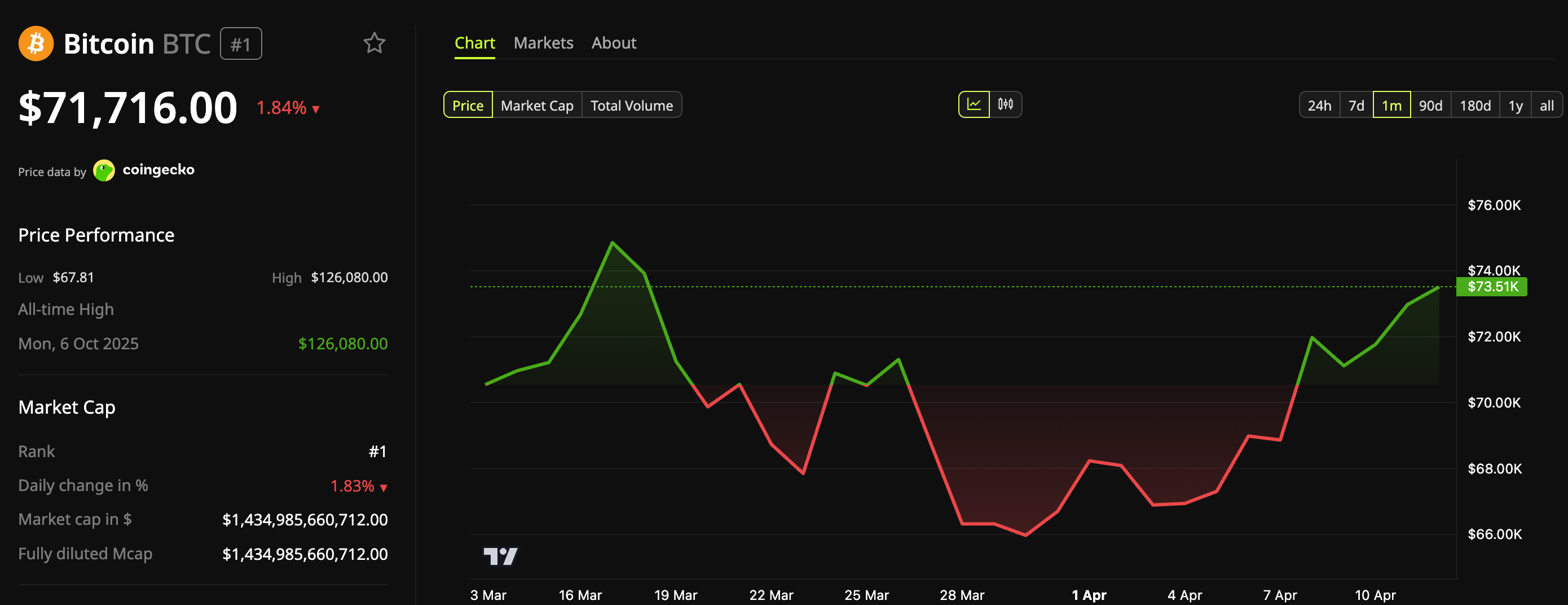
The cryptocurrency, which had reached a high near $74,000 on Saturday, saw its value diminish to an intraday low of $71,168 during early Asian trading. At the time of reporting, BTC was trading at $71,716, reflecting a 1.84% decrease in the last 24 hours.
Bitcoin Suffers as US-Iran Diplomatic Talks Conclude Without Agreement
The broader cryptocurrency market also registered a decline, with the total market capitalization falling by 1.7%. Major cryptocurrencies like Ethereum (ETH) slipped to approximately $2,220, and XRP dropped to $1.33, both experiencing losses close to 2%.
The earlier weekly gains for BTC were attributed to a recently announced two-week ceasefire, which had provided some market stability. However, the fragility of this ceasefire was underscored by continued Israeli airstrikes in Lebanon and Iran’s imposition of crypto tolls on vessels transiting the Strait of Hormuz. Reports also indicated that US officials claimed Tehran had not fully located all mines within the strait, a claim Iran subsequently refuted.
The US Central Command reported that US Navy destroyers transited the Strait of Hormuz to commence mine-clearing operations, a statement met with outright rejection by Iran.
BREAKING: President Trump says the US has now begun the process of clearing out mines from the Strait of Hormuz. Several US Navy ships were just seen crossing the Strait of Hormuz. pic.twitter.com/EUrm7YbeWq — The Kobeissi Letter (@KobeissiLetter) April 11, 2026
Analysis of the US-Iran Diplomatic Breakdown in Islamabad
The extensive negotiations between Washington and Tehran concluded without a peace deal, with both parties presenting differing accounts of the outcome. According to Iran’s Fars news agency, the failure to reach an agreement was due to “unreasonable demands” from the US side, particularly concerning the control of the Strait of Hormuz and Iran’s nuclear program.
“Despite various initiatives from the Iranian delegation, the unreasonable demands of the American side prevented the progress of the negotiations. Thus, the negotiations ended,” Iranian state broadcaster IRIB said in a post.
A source close to the Iranian negotiating team indicated to Fars news agency that the US sought diplomatic concessions it had failed to secure through military actions.
“The Americans needed the negotiation for their lost face in the international arena and were unwilling to lower their expectations despite the defeat and stalemate in the war with Iran,” the source said. “Iran has no plans for the next round of talks,” they mentioned.
🚨 Vance: U.S. leaves Pakistan talks without agreement after 21 hours Speaking after marathon negotiations in Islamabad, Vice President JD Vance outlined the outcome and U.S. position, saying Washington has shared with Iran its “final and best offer” on “a method of… pic.twitter.com/nim0r9YEFh — Drop Site (@DropSiteNews) April 12, 2026
On the US side, Vice President JD Vance stated that the American delegation had been “quite accommodating and flexible.”
“The president told us, ‘You need to come here in good faith and make your best effort to get a deal.’ We did that, and unfortunately, we weren’t able to make any headway,” he said.
Vice President JD Vance gives an update in Pakistan: “The simple fact is that we need to see an affirmative commitment that they will not seek a nuclear weapon, and they will not seek the tools that would enable them to quickly achieve a nuclear weapon.” pic.twitter.com/il4THN5DwV — The White House (@WhiteHouse) April 12, 2026
Vance reiterated that President Trump’s primary objective remains preventing Iran from developing nuclear weapons. He described the US proposal presented as its “final and best offer.”
“So, look, we were constantly in communication with the team, because we were negotiating in good faith. And we leave here with a very simple proposal, a method of understanding that is our final and best offer. We’ll see if the Iranians accept it.”
The diplomatic impasse raises concerns regarding the stability of the existing ceasefire. Pakistan’s foreign minister issued a statement, emphasizing the importance for both parties to “continue to uphold their commitment to ceasefire.”
Learn more at : beincrypto.com