


This article is a submission by wowo, a white-hat researcher from SlowMistZone, and is based on his hands-on security audit of multiple mainstream fingerprint browser products.
Preface
Fingerprint browsers (antidetect browsers) have emerged in recent years as a fast-growing category of tools, widely used for multi-account management in cross-border e-commerce, social media operations, ad campaigns, and in Web3 for airdrop farming and multi-wallet management. Their core value proposition is “isolating browser fingerprints and protecting account security”; users often entrust them with high-value digital assets — including e-commerce login sessions, social media sessions, payment credentials, and even private keys and seed phrases for cryptocurrency wallets.
After conducting in-depth security audits of multiple mainstream fingerprint browser products across the industry, we have found a troubling reality: these products, which market themselves on “security,” have security postures far below industry expectations and suffer from widespread, systemic security weaknesses.
Equally alarming is that the risks identified in these audits are not theoretical — the industry has already seen multiple real-world incidents where security defects in fingerprint browsers led to significant user losses, ranging from hundreds of thousands to millions of US dollars.
This report analyzes security risks in the fingerprint browser industry based on hands-on audits of multiple products and documented real-world incidents. It does not name specific vendors or disclose exploitable vulnerability details.
I. Lessons Written in Blood: Real Security Incidents
Before diving into technical analysis, it is important to recall real security incidents that have already occurred in the industry. These events show that fingerprint browser security flaws are not hypothetical — they have already caused substantial financial harm.
Incident 1: Wallet Extension Supply-Chain Poisoning — Millions Stolen (2025)
In January 2025, a major fingerprint browser vendor was hit by a targeted supply-chain attack. Attackers compromised the vendor’s third-party object storage service (OSS) and replaced cryptocurrency wallet extensions (mainly MetaMask and similar) in its app store with backdoored, malicious versions.
What happened:
• During a window of roughly 72 hours (January 21–24, 2025), every user who installed or updated wallet extensions via that fingerprint browser’s app store actually received the tampered, malicious build.
• The malicious extensions silently exfiltrated users’ wallet private keys and seed phrases in the background.
• Attackers then used the stolen keys to move user funds in bulk.
Impact:
• Over $4.1 million USD stolen
• Approximately 30,000 users affected
• Stolen assets were quickly dispersed to multiple addresses and laundered through mixers
Root cause: The incident stemmed from a lack of end-to-end integrity protection in the extension distribution pipeline from upload to OSS through to user download and install, there was no code-signing or integrity verification. By compromising a single link (OSS storage), attackers could run a watering-hole style attack against tens of thousands of users.
Incident 2: Suspected Client-Side Backdoor — Mass Private Key Leak (2023)
In August 2023, another well-known fingerprint browser was reported to have suffered a mass leak of user private keys. A prominent blockchain security team investigated and confirmed that the incident caused significant financial losses.
What happened:
• Multiple users found that after installing the fingerprint browser, assets in their cryptocurrency wallets were transferred out.
• Investigators traced more than 3,000 affected wallet addresses.
• Stolen ETH was quickly moved across multiple chains (zkSync, Arbitrum, Optimism), with some funds flowing into privacy protocols (Tornado Cash, Railgun) for laundering.
Impact:
• Direct losses of at least $410,000 USD (236.27 ETH)
• Single-user losses as high as $60,000
• Investigators successfully froze some assets (including 83 AVAX), but most funds could not be recovered
Root cause: The incident was suspected to be linked to a backdoor or security vulnerability in the fingerprint browser client itself. Whether the cause was malicious logic in the client, supply-chain compromise, or improper access to user data on the server side, it pointed to the same fundamental issue — users had entrusted their most sensitive crypto assets (private keys and seed phrases) to a third-party desktop application whose security had not been validated.
Incident 3: Fake Official Sites Distributing Malicious Clients (Ongoing)
Beyond supply-chain attacks, the industry has repeatedly seen cases where fake “official” sites distribute infected fingerprint browser installers. Attackers register domains that closely resemble the real vendor site (e.g., typosquatting), host tampered installers containing remote-access trojans, and lure users via SEO or social engineering. Once installed, the user’s device is fully controlled and all passwords, keys, and session data are at risk.
Takeaways
These incidents illustrate a harsh reality:
Fingerprint browsers have become high-value targets for attackers — because they concentrate users’ digital assets in a single place.
When users concentrate dozens or hundreds of high-value accounts and crypto wallets inside one fingerprint browser, that product becomes an attractive “honeypot.” Attackers do not need to compromise each platform one by one; compromising the fingerprint browser alone can yield access to all of a user’s assets.
II. Special Risks: Web3 and Crypto Wallet Custody
The widespread use of fingerprint browsers in Web3 introduces a distinct, high-severity risk dimension that does not exist in traditional e-commerce use cases.
2.1 Why Do Web3 Users Rely Heavily on Fingerprint Browsers?
Web3 has many scenarios that require multi-account operations:
• Airdrop farming (“farming”): Users create dozens or hundreds of separate wallet addresses and interact with different DeFi protocols, NFT platforms, and L2 networks to qualify for airdrops. Each wallet needs a distinct browser fingerprint and IP to avoid being flagged as a Sybil attack and disqualified by projects.
• Multi-account trading: Managing multiple trading accounts on DEXs and lending protocols.
• GameFi multi-accounting: Running multiple in-game accounts at once.
Fingerprint browsers, with their “one environment, one fingerprint, one IP” model, have become the de facto standard for Web3 multi-account operations.
2.2 Wallet Extension Custody: A Fatal Concentration of Trust
In these scenarios, the typical user workflow is:
Environment #1 → Install MetaMask → Import wallet #1 (private key / seed phrase)
Environment #2 → Install MetaMask → Import wallet #2 (private key / seed phrase)
Environment #3 → Install MetaMask → Import wallet #3 (private key / seed phrase)
…
Environment #N → Install MetaMask → Import wallet #N (private key / seed phrase)
In other words, users store the private keys or seed phrases of all their wallets inside the local environments managed by the fingerprint browser, via browser extensions.
From a security perspective, this creates an extremely dangerous trust model:
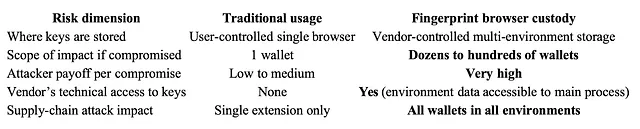
2.3 Unique Threats Fingerprint Browsers Pose to Wallet Extensions
Technically, fingerprint browsers create unique threats to crypto wallet extensions that do not exist when users rely on normal Chrome or Firefox:
1. Extension distribution can be hijacked
Normal browsers distribute extensions through Chrome Web Store or Firefox Add-ons, with review and signing by Google or Mozilla. Fingerprint browsers typically run their own “app stores” or serve extensions from their own infrastructure — the security of this distribution channel depends entirely on the vendor. As the 2024 incident showed, once that channel is compromised, tens of thousands of users can have their wallet extensions replaced with malicious builds in one go.
2. Main process can access extension data
In an Electron-based fingerprint browser, the main process (Node.js) has full filesystem access to all browser environment data. That means the Vault files where wallet extensions store encrypted private keys can, in principle, be read by the main process. Any vulnerability that allows arbitrary file read from the main process, or a deliberate backdoor, would expose users’ wallet keys directly.
3. Environment sync and cloud backup create key exposure risk
Some fingerprint browsers offer “environment cloud sync” — backing up browser environments, including extension data, to the vendor’s cloud for cross-device recovery. If those backups include wallet extension storage (as they often do), users’ encrypted wallet Vault files are uploaded to the vendor’s servers. At that point, the safety of user funds depends entirely on the strength of the vendor’s cloud security, the integrity of the vendor’s staff, and the vendor’s servers not being compromised — in direct tension with the “not your keys, not your coins” principle.
4. 1-Click attacks can wipe out wallets
Combined with unauthenticated local API exposure (described later), a single malicious webpage can:
• Enumerate all of the victim’s browser environments
• Remotely start each environment (loading wallet extensions and bringing keys into memory)
• Interact with the running environments’ wallets via local interfaces
• Batch-transfer assets from all wallets
All of this can be done automatically in tens of seconds, with the user potentially unaware from the moment they open the malicious page until their assets are gone.
2.4 Attack Surface Overview for Web3 Users
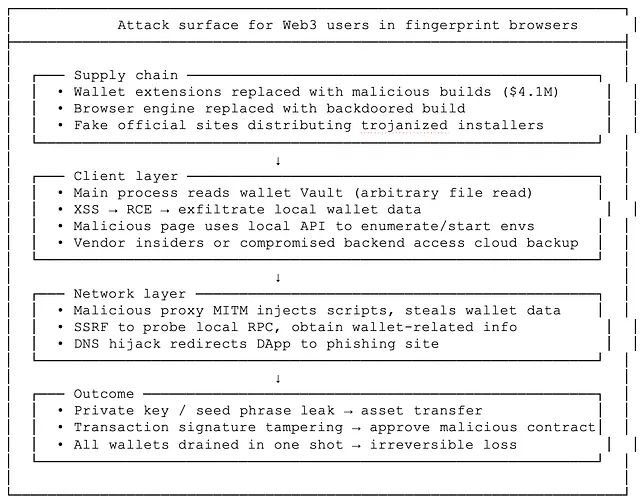
III. Industry-Wide Common Security Risks: Overview
Across our audits, we identified ten common security risk areas. These are not one-off defects in a single product but recurring, industry-wide issues.
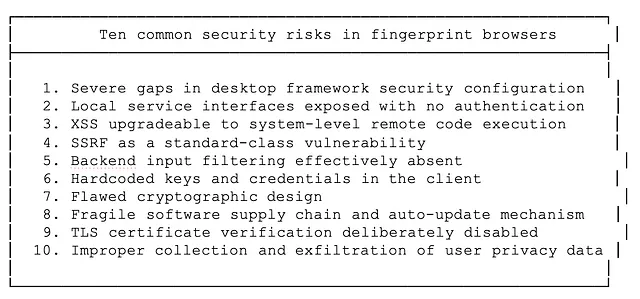
IV. Detailed Risk Analysis
Risk 1: Severe Gaps in Desktop Framework Security Configuration
Prevalence: Nearly all products are affected to some degree
Virtually all mainstream fingerprint browsers are built on Electron. Electron bundles the Chromium renderer with a Node.js runtime and provides security knobs such as process isolation, context isolation, and sandboxing. In practice, we found that most products do not configure these options correctly and often disable critical protections.
Typical issues include:
• Node.js integration enabled in the main window (nodeIntegration): Any JavaScript running in the renderer can then call OS-level APIs (file I/O, process creation, network). Any script injection in the page gives the attacker immediate system-level control.
• Context isolation disabled (contextIsolation): Context isolation is meant to prevent page scripts from reaching Node.js APIs. Turning it off removes the last line of defense of the browser sandbox.
• Sandbox disabled globally: Some products pass a global flag to disable Chromium’s sandbox, giving the renderer far more privilege than a normal browser page.
• Inconsistent security across windows: Different windows (main, popup, notification, debug) may use different security settings. Even if the main window is locked down, a weaker auxiliary window can serve as an entry point.
• Missing or bypassable navigation restrictions: No or weak allowlists for navigation, or substring matching instead of strict origin checks, allowing attackers to craft URLs that navigate the main window to a malicious page.
Bottom line: The framework’s security configuration sets the “ceiling” for impact — with proper settings, an XSS may be medium severity; with poor settings, the same XSS equals full remote code execution (RCE). Most fingerprint browser vendors have not fully internalized this.
Risk 2: Local Service Interfaces Exposed with No Authentication
Prevalence: Most products; severity from medium to critical
Fingerprint browsers typically run a local HTTP or WebSocket server for in-app communication, extension interaction, and automation. We found that in most products these local services share a dangerous combination:
A fatal triple:
1. CORS wide open (Access-Control-Allow-Origin: *): Any website on the internet can make cross-origin requests to the local service.
2. No authentication: No token, cookie, or signature is required for any API endpoint.
3. Predictable ports: Fixed or narrowly dynamic ports make it easy for attackers to discover the service.
Together, these allow any malicious page (including phishing links or ad-infected legitimate sites) to call the fingerprint browser’s full local API without the user’s knowledge.
Worse, in some products the local API acts as an auth proxy: it automatically attaches the user’s session and forwards requests to the vendor’s backend. So a single malicious page can call all backend APIs as the victim and achieve full account takeover.
Dangerous capabilities that we saw exposed without authorization include:
• Reading user account and configuration data
• Reading arbitrary files on the system
• Starting, stopping, or deleting browser environments
• Issuing arbitrary HTTP requests (SSRF)
• Subscribing to real-time events
• Injecting control commands
• Reading clipboard content
Bottom line: Developers often assume “local means only this machine can access it, so no auth is needed.” In reality, the browser’s cross-origin rules allow any page to send requests to 127.0.0.1, and CORS *removes the last same-origin protection. Local does not mean safe.
Risk 3: XSS Upgradeable to System-Level RCE
Prevalence: All audited products had exploitable XSS → RCE chains
In traditional web apps, cross-site scripting (XSS) is usually rated medium — it can steal cookies and hijack sessions but not directly control the OS. In Electron, because of the weak framework configuration described above, XSS impact is dramatically higher.
The XSS → RCE chains we saw follow a consistent pattern:
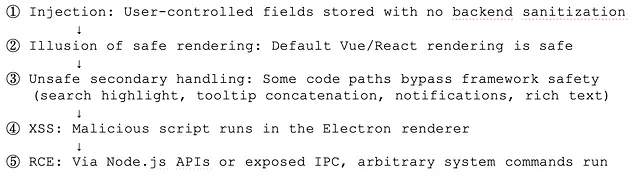
Even when products use modern frameworks (React/Vue) that escape user data by default, we still found unsafe HTML rendering in “harmless”-looking features:
• Search highlight: Safe text was turned into HTML via string replace and inserted with innerHTML.
• Batch tooltips: Multiple user-supplied names were concatenated with <br>and rendered as HTML.
• Notifications: Message content was rendered with innerHTML in the notification window.
• Debug/log windows: Program output was rendered as HTML.
Lessons:
• Default framework safety does not guarantee safety everywhere. A single code path that renders user data with
innerHTML is enough for XSS.
• In Electron, any XSS should be treated as Critical, as it can lead to full RCE.
• Search highlight, tooltips, and notification popups are common XSS hotspots.
Risk 4: Server-Side Request Forgery (SSRF) as a Standard Vulnerability
Prevalence: Most audited products
Fingerprint browsers naturally handle many network requests — proxy checks, IP refresh, page loads. We found that many products expose interfaces where the request URL can be controlled, with little or no validation of the target.
Typical SSRF abuse:
• Cloud metadata theft: If the fingerprint browser runs in a cloud VM, SSRF can hit the cloud metadata API, obtain temporary credentials, and take over the entire cloud account.
• Internal network probing: Using the victim’s machine to scan or attack internal services (databases, admin panels).
• Real IP exposure: SSRF to an external service can reveal the user’s real egress IP — an ironic failure for a product that sells “anonymity.”
Some products also disable TLS verification (rejectUnauthorized: false) on the SSRF path, widening the attack surface further.
Risk 5: Backend Input Filtering Effectively Absent
Prevalence: All audited products
A simple but far-reaching finding: none of the audited products’ backend APIs perform effective HTML/XSS filtering on user input. Malicious payloads are stored and returned to the frontend as-is.
So attackers can inject malicious code in any user-editable field, including:
• Browser environment names
• Notes and description fields
• Proxy configuration
• Automation parameters
• Team member information
Lack of backend filtering is what makes stored XSS possible. Even with perfect frontend escaping (which we did not see), a single frontend mistake would complete the attack chain without backend defense.
Industry state: None of the audited products had deployed a WAF or effective input validation. This suggests the industry is still at an early stage in terms of secure development lifecycle (SDL).
Risk 6: Hardcoded Keys and Credentials in the Client
Prevalence: Multiple products, varying severity
Electron apps are packaged JavaScript — however obfuscated, the code can be extracted and analyzed. We found multiple products with sensitive credentials hardcoded in the client:
• Third-party API keys: e.g., AI service API keys; anyone who extracts the package can abuse the vendor’s quota.
• OAuth client secrets: These belong on the server, not in the client. Leakage enables phishing and fake OAuth flows.
• Communication encryption keys: Hardcoded in the client, allowing full decryption of “encrypted” traffic.
• Internal service credentials: Logging, monitoring, and other internal services had credentials visible in the client.
Lesson: Obfuscation is not encryption. Any secret in the client will eventually be extracted.
Risk 7: Flawed Cryptographic Design
Prevalence: Products that use encryption often get the design wrong
Some products do encrypt API traffic, which is a positive intention. However, we repeatedly found cryptographic anti-patterns:
• Weak hashes: MD5 for integrity or API signing; MD5 collision attacks are practical.
• Reduced key space: Using the hex string of a SHA-256 output as the ASCII key for AES shrinks effective key space from 128 bits to roughly 64.
• Static IV: Per-user fixed IVs break the semantic security of CBC.
• No authentication tag: AES-CBC without MAC; vulnerable to padding oracle and bit-flipping.
• Encryption bypass: A specific header can skip encryption/decryption entirely.
• Hardcoded fallback keys: When normal key derivation fails, a fixed key is used.
Bottom line: “We use encryption” does not mean “we are secure.” Bad crypto can be worse than none because it creates false confidence.
Risk 8: Fragile Software Supply Chain and Auto-Update
Prevalence: Multiple products; update mechanism can be hijacked
Auto-update is critical for desktop app security. If the update pipeline is compromised, attackers can silently push malicious code to all users. We observed:
• Update URL controllable from renderer: After XSS, the attacker can point the updater to a malicious server.
• Update package signature verification disabled: Some products explicitly disable code signing checks.
• Weak integrity for browser engine updates: MD5 instead of SHA-256 for engine binaries.
• Runtime loading of remote scripts: Scripts fetched from a CDN at startup and executed; if the CDN is compromised, zero-interaction RCE is possible.
• Update source entirely from API: Update URL comes from the server; if the API response is tampered with, the update pipeline is hijacked.
• Extension store without signing: In-house extension distribution has no end-to-end code signing; compromising the storage backend lets attackers replace all extensions (as in the real incident).
Special risk: Users also update the browser engine. If that update is weakly verified, attackers can replace the entire engine — every “environment” would then run code controlled by the attacker.
Risk 9: TLS Certificate Verification Deliberately Disabled
Prevalence: Multiple products in specific scenarios
The main security guarantee of HTTPS is TLS certificate verification — it ensures the client talks to the real server, not a man in the middle. We found products that disable it in these cases:
• Global disable when proxy is used: When the user configures a proxy (almost universal among fingerprint browser users), the entire Chromium network stack’s certificate verification is disabled via a startup flag.
• SSRF endpoints: The local HTTP proxy used for SSRF-style requests has verification turned off.
• Fallback lines over plain HTTP: Some products offer multiple “lines”; some use plain HTTP for the main window and API.
This is especially dangerous for fingerprint browsers. Users rely on proxies for anonymity and geo-spoofing. If the app disables certificate verification when a proxy is in use:
• Any malicious proxy can perform MITM.
• Attackers can inject JavaScript into the main window.
• Combined with weak Electron configuration, this leads directly to RCE.
Ironically, a product that sells “security” and “privacy” removes the most basic protection exactly when users depend on it most — when browsing through a proxy.
Risk 10: Improper Collection and Exfiltration of User Privacy Data
Prevalence: Multiple products
Fingerprint browsers handle highly sensitive data: account info, cookies, proxy config, fingerprint data. We observed:
• Sensitive data sent to unrelated domains: Some products automatically send user data (real name, email, device info, browser debug interface addresses) to domains that are not the product’s own; users are not informed and cannot disable it.
• Browser debug interface address leakage: Some products include the Chrome DevTools Protocol (CDP) WebSocket URL in error reports or logs — anyone with that URL can fully control the browser instance, read all cookies (including HttpOnly), execute arbitrary JavaScript, and capture the screen.
• Tokens in logs and URLs: Auth tokens written in plaintext to log files or passed as URL parameters.
• Debug endpoints exposing infrastructure: Backends had debug endpoints left on, returning real IPs, CDN nodes, server software versions.
• Encryption keys stored in plaintext locally: Auth tokens and crypto keys in plaintext config files.
V. Fundamental Flaws in the Trust Model
5.1 The “Single Point of Trust” Problem
All of the technical risks above point to a deeper architectural issue: fingerprint browsers require users to place nearly unlimited trust in a single vendor.
When users adopt a fingerprint browser, they effectively delegate the security of all of the following to that vendor:
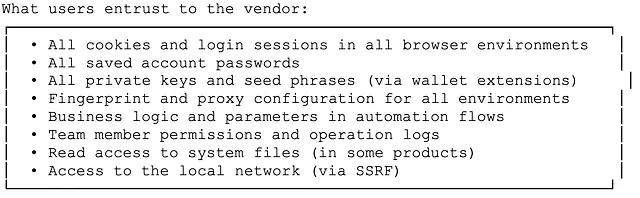
In a traditional browsing model, these assets are spread across different trust boundaries — Chrome is maintained by Google (a top-tier security team), each site’s sessions are protected by each platform, and wallet keys are protected by the wallet vendor’s design. Fingerprint browsers collapse all of these boundaries into one: the vendor’s own security posture.
5.2 Attacker’s View: A High-Value Single Target
From an attacker’s perspective, fingerprint browsers are highly attractive:

This explains why the fingerprint browser space has already seen multiple large-scale incidents — the return on investment for attackers is very high.
5.3 The Dual Role of the Vendor
An uncomfortable fact: fingerprint browser vendors have the technical ability to access all user data. Even without malicious intent, the following scenarios remain serious risks:
• Rogue insiders: Employees with backend access can read user data.
• Vendor compromise: Attackers who breach the vendor gain the same access.
• Legal or policy pressure: Vendors may be compelled to hand over user data.
• Business incentives: Some vendors may collect or use user data without clear consent (e.g., the privacy exfiltration issues above).
VI. The “1-Click” Attack: The Industry’s Greatest Threat
Among all findings, the most concerning is what we call the “1-Click attack” — the attacker only needs to lure the victim to open a link (or a legitimate site that loads malicious code), and can then complete the full chain from data theft to remote code execution with no further user interaction.
This is possible because of the combination of risks described earlier:
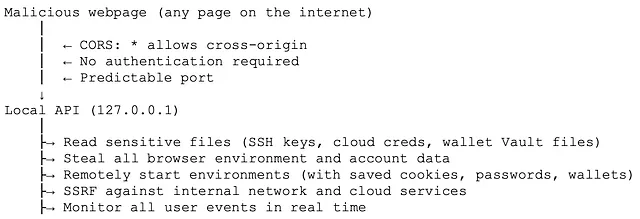
Scope of impact:
Every account the victim has in the fingerprint browser — e-commerce (Amazon, Shopify, etc.), social (Facebook, TikTok, etc.), ads (Google Ads, etc.), payment systems, and all cryptocurrency wallets — can be fully taken over in a single click.
For Web3 users, this is especially severe: cryptocurrency transactions are irreversible, so once assets are moved, they cannot be recovered even after the breach is discovered.
VII. Threat Actor Profile
Understanding who attacks fingerprint browser users helps clarify how real these risks are.
7.1 Types of Threat Actors
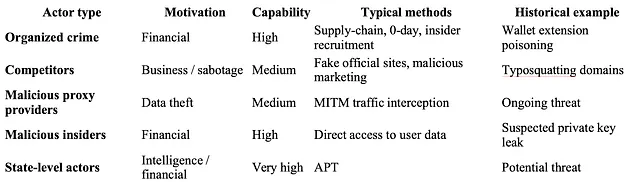
7.2 Attack Economics
Fingerprint browsers are attractive targets because of leverage:
• One supply-chain attack → 30,000 users → $4.1M stolen (real case).
• One local API 0-day → Combined with a malicious page → Can automatically drain all victims’ wallets at scale.
• One compromise of the extension store → Every user who installs or updates in the window is compromised.
By contrast, traditional phishing typically affects one user per campaign. This economic incentive drives continued investment in attacking the fingerprint browser ecosystem.
VIII. Industry Security Maturity Assessment
8.1 Comparison with Other Software Categories
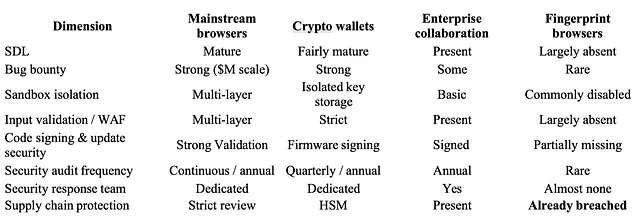
8.2 The Core Contradiction
The industry’s core contradiction can be summed up in one sentence:
Products charge users for “security” and “privacy” as their main value proposition, yet their own security posture is at the bottom of the software industry.
Root causes include:
1. Feature focus over security: Development is driven by feature delivery; security is treated as a non-functional afterthought.
2. Lack of security expertise: Most teams have no dedicated security engineers or architects.
3. Poor understanding of Electron’s security model: Developers do not fully grasp how Electron’s security options determine overall posture.
4. “Local equals safe” fallacy: Widespread belief that local services cannot be reached from outside, so authentication is unnecessary.
5. No security testing regime: Security testing is not part of CI/CD; there are no regular security audits.
6. Underestimation of asset value: Vendors do not fully recognize the value of the assets their product holds and the security responsibility that comes with it.
8.3 A Telling Comparison
MetaMask (the most widely used crypto wallet extension) is distributed via Chrome Web Store, under Google’s review and signing, and has its own security team and bug bounty. Yet when users install MetaMask inside a fingerprint browser, all of those safeguards are bypassed — the extension’s distribution, storage, and execution environment are all under the control of a fingerprint browser vendor with far weaker security than Google’s.
Users believe they are protected by MetaMask’s security level; in reality they are protected only by the fingerprint browser’s security level.
IX. Security Recommendations for the Industry
9.1 Recommendations for Vendors
Immediate (P0):
1. Harden Electron security baseline
◦ All windows: nodeIntegration: false, contextIsolation: true, sandbox: true
◦ Expose a minimal API set via contextBridge
◦ Strict navigation allowlist and Content-Security-Policy (CSP)
2. Harden local services
◦ Add random-token authentication to all local APIs
◦ Tighten CORS; never use *
◦ Require user confirmation for high-risk actions (start/stop environment, delete data)
3. Build defense in depth
◦ Backend: HTML-escape and character allowlist all user input
◦ Deploy WAF to block common attack patterns
◦ Frontend: Audit and remove unsafe use of innerHTML/ dangerouslySetInnerHTML
4. Secure extension distribution
◦ Code-sign all distributed extensions
◦ Use SHA-256 or stronger integrity checks
◦ Apply least-privilege and change-audit to extension storage
Short-term (P1 — within 30 days):
5. Upgrade crypto
◦ Replace AES-CBC with AES-256-GCM (authenticated encryption)
◦ Use random IVs and a proper key derivation function
◦ Move file integrity checks to SHA-256 or stronger
6. Harden supply chain
◦ Hardcode update URLs; do not allow renderer to change them
◦ Enable and verify code signing for update packages
◦ Stop loading and executing remote scripts from CDN at runtime
7. Remove all hardcoded credentials; use server-side proxy for third-party API calls
Long-term (P2):
8. Establish a Secure Development Lifecycle (SDL) and embed security in the development process
9. Set up a vulnerability response team and bug bounty program
10. Commission regular third-party penetration tests
11. Security awareness training for all staff
12. Explore zero-trust design: So that the vendor cannot technically access users’ sensitive data (e.g., end-to-end encrypted environment sync)
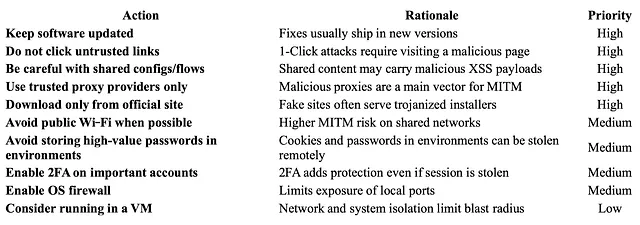
9.2 Recommendations for General Users
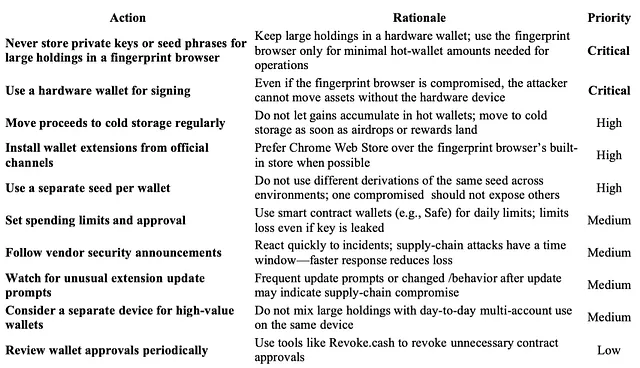
9.3 Recommendations for Web3 / Crypto Users
Because crypto transactions are irreversible, Web3 users face higher risk and should take extra steps:
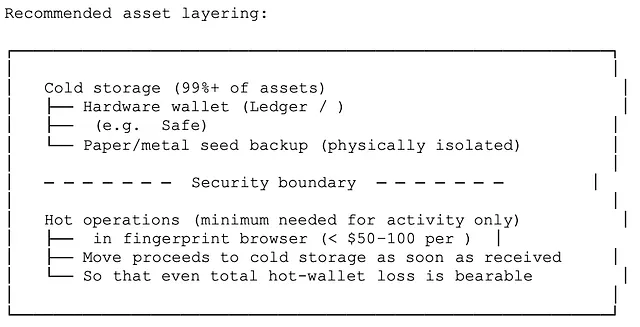
9.4 Core Principle for Users
Treat the fingerprint browser as an “ operations environment,” not a “secure asset vault.”
Using it for on-chain interaction is fine; keeping long-term control of large assets (private keys) inside it is not. Just as you would not keep all your savings in a shop without a safe — even if the shop claims to be secure.
X. Regulation and Compliance Outlook
10.1 Current Regulatory Gap
The fingerprint browser industry currently operates in a regulatory gray area:
• No industry security standard: No security certification or compliance standard exists for fingerprint browsers.
• No mandatory security audit: Vendors can ship products without any security assessment.
• No data protection compliance check: Most vendors do not follow privacy regulations such as .
• No coordinated vulnerability disclosure: The industry lacks a common disclosure and response process.
• Unclear liability: When user loss is caused by vendor security defects, compensation and standards are unclear.
10.2 Foreseeable Changes
As the industry grows and more incidents occur, the following may happen in the coming years:
1. Rising user awareness: As incidents are reported more widely, users will care more about vendor security; security will become a .
2. Industry self-regulation: Leading vendors may agree on baseline security standards and certification.
3. Third-party security ratings: Independent bodies may offer security evaluation and ratings for fingerprint browsers.
4. Litigation driving change: Major incidents may lead to class actions and force vendors to invest in security.
5. security community involvement: security firms (e.g.SlowMist, Certik ) may include fingerprint browsers in their audit scope.
XI. Summary and Outlook
Industry State
Fingerprint browsers are a fast-growing market with revenue in the billions, yet their security maturity is badly out of step with their scale. The ten common risks summarized here are not isolated defects in a few products but reflect systemic gaps across the industry in security design, development, and operations. The multiple real incidents — millions of dollars in stolen — have already demonstrated these findings at great cost.
Four Core Systemic Issues
1. Electron security configuration is widely ignored — Most teams do not understand how , and security posture, so readily escalates to .
2. The “local equals safe” fallacy — Developers assume services on 127.0.0. be reached from outside and therefore need no authentication. In reality, any can call local services via the browser’s cross-origin behavior.
3. Supply chain security is effectively absent — In-house extension distribution lacks code signing and integrity protection and has already been exploited, with losses in the millions of dollars.
4. No security development culture — No , no security audits, no WA F, no bug bounty — security is treated as an afterthought rather than built in from the start.
Hopes for the Industry
Fingerprint browsers hold some of users’ most sensitive and valuable digital assets — from e-commerce and social accounts to payment systems and wallets. Users trust vendors’ security promises and entrust them with large amounts of value. That trust should not be betrayed.
We hope this analysis will:
• Help vendors recognize the severity and urgency of these security issues
• Provide clear direction and priorities for hardening
• Encourage the industry to adopt baseline security standards
• Help users, especially users, make better choices and protect their assets
• Draw the security community’s attention to fingerprint browsers as an under-addressed attack surface
Closing
Security is not a feature; it is an ongoing process.
For an industry that sells “security” as its core value, it is time to turn that promise into practice.
For users who entrust real assets to these products, understanding the risks is the first step to protecting themselves.
Ps:(This document is based on hands-on security audits of multiple mainstream fingerprint browser products and publicly reported industry incidents. It is intended for industry security research and knowledge sharing only. It does not name specific vendors, disclose concrete vulnerability details, or include exploitable attack code. Data on real security incidents is drawn from public security team reports and news coverage.)
This report analyzes security risks in the fingerprint browser industry based on hands-on audits of multiple products and documented real-world incidents. It does not name specific vendors or disclose exploitable vulnerability details.
About SlowMist
SlowMist is a threat intelligence firm focused on blockchain security, established in January 2018. The firm was started by a team with over ten years of network security experience to become a global force. Our goal is to make the blockchain ecosystem as secure as possible for everyone. We are now a renowned international blockchain security firm that has worked on various well-known projects such as HashKey Exchange, OSL, MEEX, BGE, BTCBOX, Bitget, BHEX.SG, OKX, Binance, HTX, Amber Group, Crypto.com, etc.
SlowMist offers a variety of services that include but are not limited to security audits, threat information, defense deployment, security consultants, and other security-related services. We also offer AML (Anti-money laundering) software, MistEye (Security Monitoring), SlowMist Hacked (Crypto hack archives), FireWall.x (Smart contract firewall) and other SaaS products. We have partnerships with domestic and international firms such as Akamai, BitDefender, RC², TianJi Partners, IPIP, etc. Our extensive work in cryptocurrency crime investigations has been cited by international organizations and government bodies, including the United Nations Security Council and the United Nations Office on Drugs and Crime.
By delivering a comprehensive security solution customized to individual projects, we can identify risks and prevent them from occurring. Our team was able to find and publish several high-risk blockchain security flaws. By doing so, we could spread awareness and raise the security standards in the blockchain ecosystem.
Original article : slowmist.medium.com