


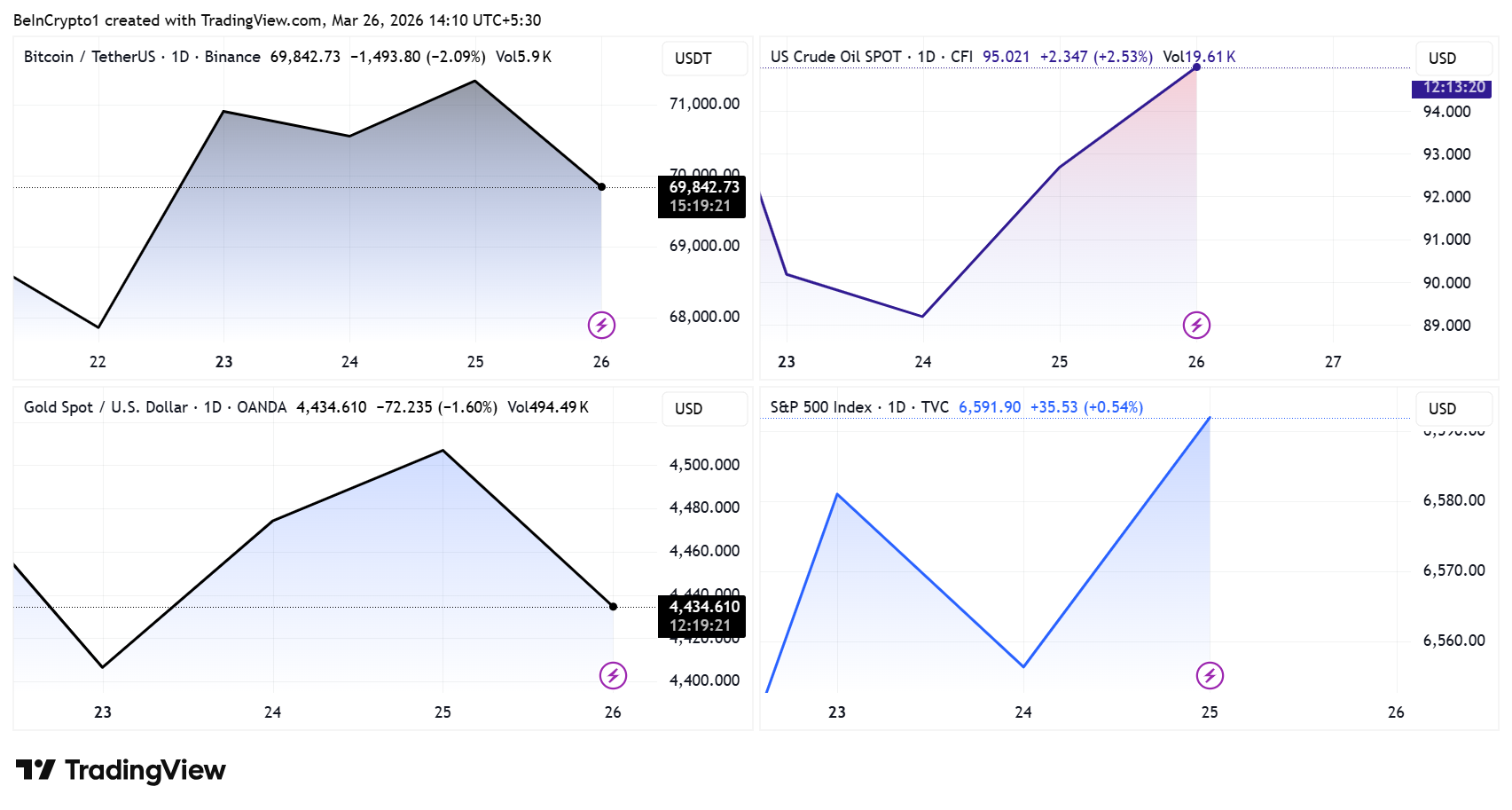
On Monday, March 23, President Trump announced a 5-Day pause on strikes against Iranian energy infrastructure. This decision initially added $1.7 trillion to US stocks, caused oil prices to crash by 15%, and propelled Bitcoin above $70,000. The pause was subsequently extended until April 6.
However, Tehran officially denied any discussions took place, labeling the claims as ‘fake news’. Israel also reportedly violated Trump’s pause. Consequently, nearly all of the initial financial gains were erased within a week.
This raises the question of whether Donald Trump genuinely engaged in productive talks with Iran, or if the announcement served as a strategic maneuver to benefit financial markets and allow major players to divest positions.
Further adding to the intrigue, a report from The Kobeissi Letter on March 29, 2026, stated: “BREAKING: The US is preparing for a potential ground invasion into Iran that would last for up to 2 months, per the Washington Post. Details include: Thousands of American soldiers are arriving in the Middle East for what could become a ‘dangerous new phase’ of the war.”
How Trump’s Pause Aligns With Market Hours
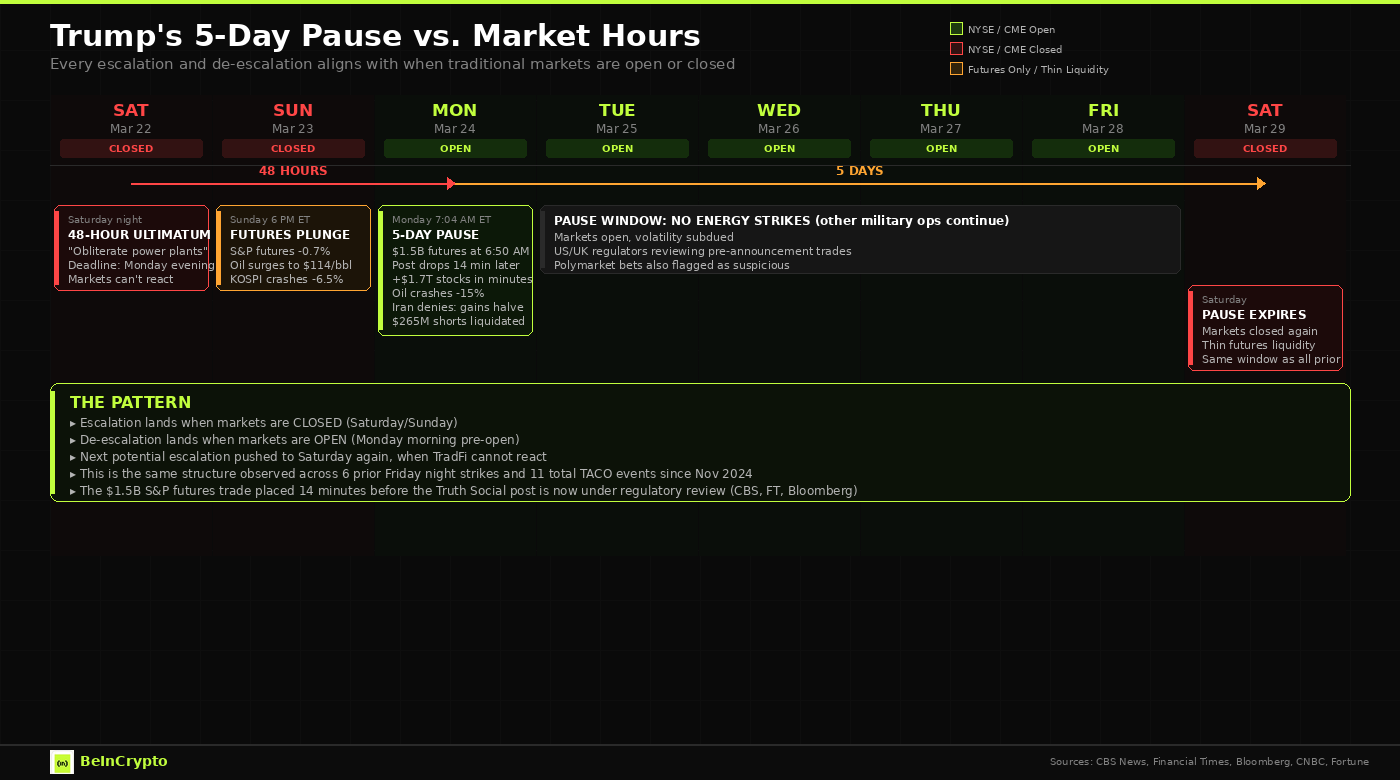
The sequence of events began on Saturday, March 22, when Trump issued a 48-hour ultimatum via Truth Social, demanding Iran reopen the Strait of Hormuz or face strikes on its power plants.
This deadline was set to expire Monday evening, a period when traditional markets are fully open and susceptible to significant volatility.
Instead of proceeding with the threatened strikes, Trump posted at 7 a.m. ET on Monday, claiming “very good and productive conversations” with Tehran and announcing a 5-day postponement of strikes on energy infrastructure.
Donald J. Trump Truth Social Post 07:23 AM EST 03.23.26 pic.twitter.com/SfWY4o7k5U— Commentary Donald J. Trump Posts From Truth Social (@TrumpDailyPosts) March 23, 2026
The 5-day postponement concluded on Saturday, March 28. This date is noteworthy because:
- Equity markets were closed.
- Futures liquidity was thin.
- Institutional desks were offline.
Any resumption of escalation during this period would align with the same low-liquidity window that has preceded major Trump-era market shocks since mid-2025.
Unusual Trading Activity Precedes Announcement
Market movements were observed prior to the official announcement. Between 6:49 and 6:50 a.m. ET, approximately 6,200 Brent and WTI futures contracts were traded, with a notional value of $580 million.
According to Bloomberg data reported by the Financial Times, the average volume for that same minute over the preceding five trading days was around 700 contracts.
Simultaneously, $1.5 billion in S&P 500 futures were purchased. This substantial order contributed to an immediate 0.3% increase in the index. Fourteen minutes later, Trump’s announcement was made. By 7:10 a.m. ET, the S&P 500 had surged by approximately $2 trillion in value.
Is this the best timed trade of 2026?At 6:50 AM ET today, $1.5 BILLION in notional value worth of S&P 500 futures contracts were bought.This trade was so large it sent the entire index +0.3% higher that minute.Then, 14 minutes later at 7:04 AM ET, President Trump announced… pic.twitter.com/zFdZ1sQxeq— The Kobeissi Letter (@KobeissiLetter) March 23, 2026
Reports indicate that U.S. and UK regulators are reviewing the trading data. No charges have been filed at this time.
“The massive spike in volume of trades right before that post is certainly enough to raise eyebrows, and I think to launch an investigation into what was behind that,” wrote CBS News, citing Stephen Piepgrass, a partner who specializes in futures trading at the law firm Troutman Pepper Locke.
Iran Denies Negotiations Occurred
Tehran’s response was unequivocal. Parliament Speaker Mohammad Bagher Ghalibaf dismissed the claims as “fake news” designed to manipulate financial and oil markets.
2/ No negotiations have been held with the US, and fakenews is used to manipulate the financial and oil markets and escape the quagmire in which the US and Israel are trapped.— محمدباقر قالیباف | MB Ghalibaf (@mb_ghalibaf) March 23, 2026
The Foreign Ministry characterized the announcement as psychological warfare aimed at suppressing energy prices and gaining time for further strikes. Officials confirmed receiving messages through intermediaries but explicitly denied any direct negotiations.
This denial precipitated an immediate market reversal. Oil prices recovered, and stocks relinquished approximately half of their earlier gains. Bitcoin also pulled back after briefly surpassing $70,000, leading to the liquidation of $265 million in crypto shorts within a 15-minute window.
Pattern Repeats: 11 Events Since November 2024
Monday’s announcement was not an isolated incident. BeInCrypto has documented 11 market-moving announcements from Trump since November 2024, each aligning with a pattern traders have termed TACO: Action, Crash, Reversal, and Recovery.
- On April 2, 2025, Liberation Day tariffs were announced at 4:30 p.m. ET, after market closure. The following morning, minutes after opening, Trump posted “BE COOL! THIS IS A GREAT TIME TO BUY!!” A subsequent 90-day pause resulted in a 9.5% rally in the S&P 500.
- On October 10, 2025, a threat of 100% tariffs on China was issued on a Friday, 20 minutes after the market closed. Bitcoin experienced an 18.4% decline, with crypto liquidations reaching $19.1 billion in 24 hours.
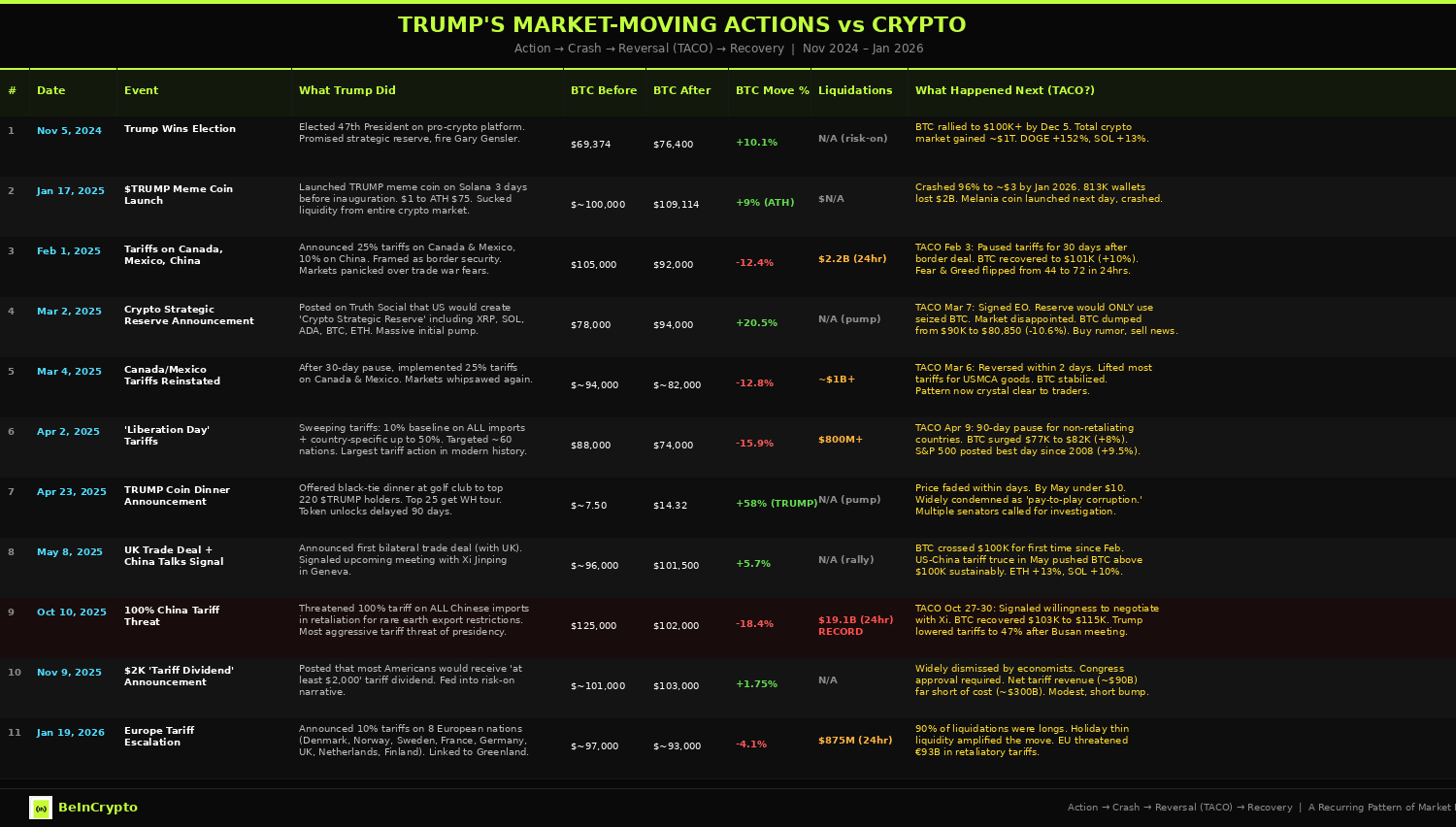
Six confirmed Friday night announcements between June 2025 and February 2026 followed a similar methodology. BeInCrypto identified a repeatable 60-hour sequence across these events.
The Iran pause represents an evolution of this strategy. Rather than a Friday shock followed by a Monday correction, Monday itself became the catalyst for market reaction. The sequence involved an ultimatum on Saturday, followed by relief on Monday, with the next potential escalation window again falling on a Saturday.
Expert Analysis on Geopolitical and Economic Factors
Richard Heydarian, a political scientist based in Oxford, cautioned during a BeInCrypto podcast appearance that the economic repercussions of the conflict could amount to trillions, while Trump’s tactical decisions remain highly unpredictable.
“Trump is strategically predictable, but tactically impossible to predict. We know what his endgame is. American hegemony, beyond question. But how to achieve that in such a complex world? No one knows,” Richard Heydarian told BeInCrypto.
Mordecai Kurz, an economist from Stanford, also speaking on the BeInCrypto podcast, framed the current dynamics within a broader structural issue of concentrated private power that leaves ordinary citizens vulnerable.
“There are so many concentrations of private power in America that this cannot continue… young people have a chance only if technology is made to serve people and policy serves people,” Kurz explained.
The 5-day period concluded on Saturday. If historical patterns persist, the next significant announcement is likely to occur during a period of low market liquidity.
Across 11 documented events spanning 16 months, this pattern has consistently held true.
Original article : beincrypto.com