


AI Agents are transitioning from passive assistants to active economic participants, driving the evolution of the Agent economy. This report dissects the underlying infrastructure, the burgeoning application ecosystems, and the shifting industry landscape.
Key Takeaways
- The Agent economy is rapidly expanding, with significant market outlooks for Agentic Commerce.
- Key infrastructure gaps exist that hinder the full potential of AI Agents in economic activities.
- Protocols like x402 (Payment Layer), ERC-8004 (Trust Layer), and Virtuals Protocol (Commerce Layer) are foundational to the Agent economy.
- OpenClaw serves as a critical case study for understanding real-world Agent deployment and interaction with on-chain protocols.
- Security risks and novel business models are critical considerations in the development of the Agent economy.
Chapter 1: Macro Background
1.1 Market Size Forecast
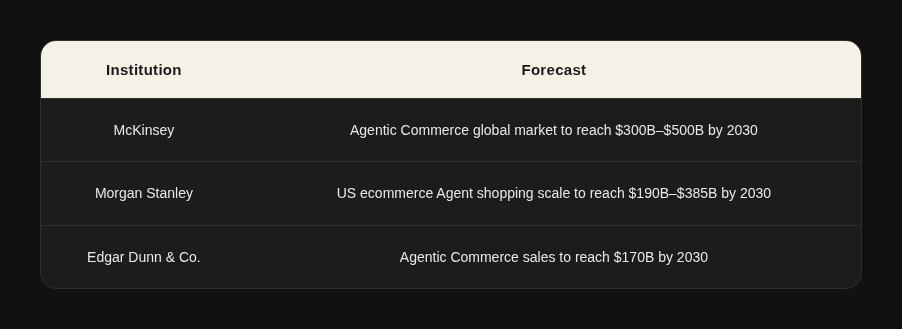
The Agentic Payment sector is experiencing substantial growth, with projections indicating a significant expansion in market size across various institutions.
1.2 Infrastructure Gaps
Current infrastructure is largely incompatible with the Agent economy due to human-centric designs in areas like identity, coordination, and economic activity. Existing systems like OAuth and credit card forms require human interaction, which AI Agents cannot perform. Two primary evolutionary paths are emerging: a centralized, compliance-driven approach and a decentralized, permissionless approach leveraging blockchain technologies.
1.3 Key Timeline
Analysis of the Agentic commerce timeline reveals significant developments, though a notable decline in transaction volume was observed after a December peak, particularly in infrastructure-related transactions.
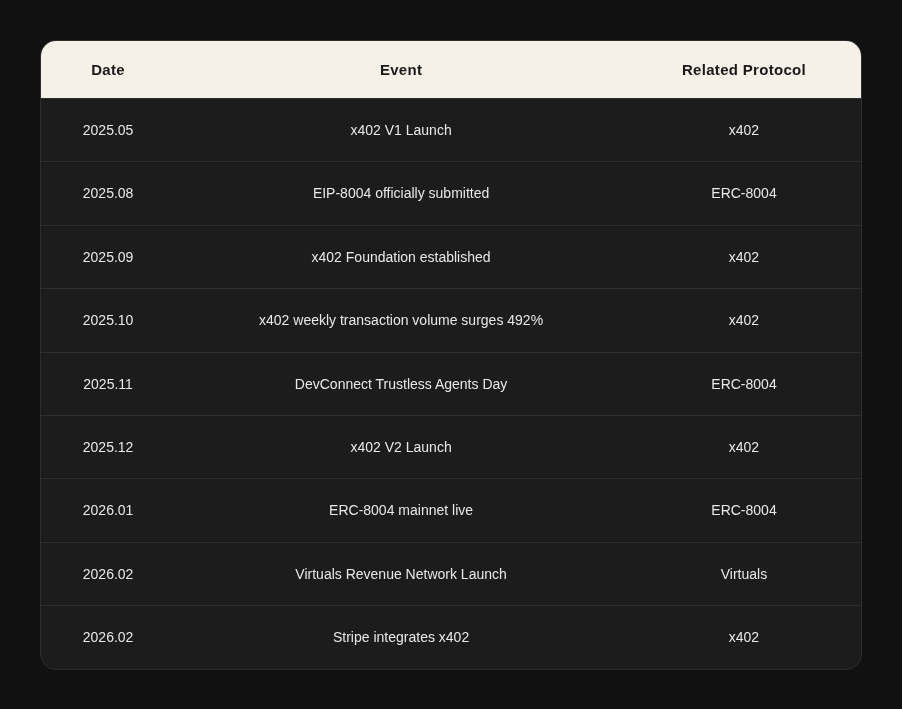
Note: As of March 2026, the average daily transaction volume has significantly declined from its December peak, with infrastructure-related transactions experiencing the largest drop (>80%).
Chapter 2: x402 Protocol – Agent Payment Layer
x402 is an innovative open-source payment protocol that integrates stablecoin micropayments directly into the HTTP protocol. This enables instantaneous pay-per-use transactions for AI Agents, fundamentally redesigning the unit of economic activity by shifting from a “register → review → authorize → use” model to a “pay → use” paradigm. Unlike traditional API economies that assume human involvement, x402 facilitates seamless Agent-to-Agent payments through the HTTP 402 status code.
2.1 Protocol Overview and Workflow
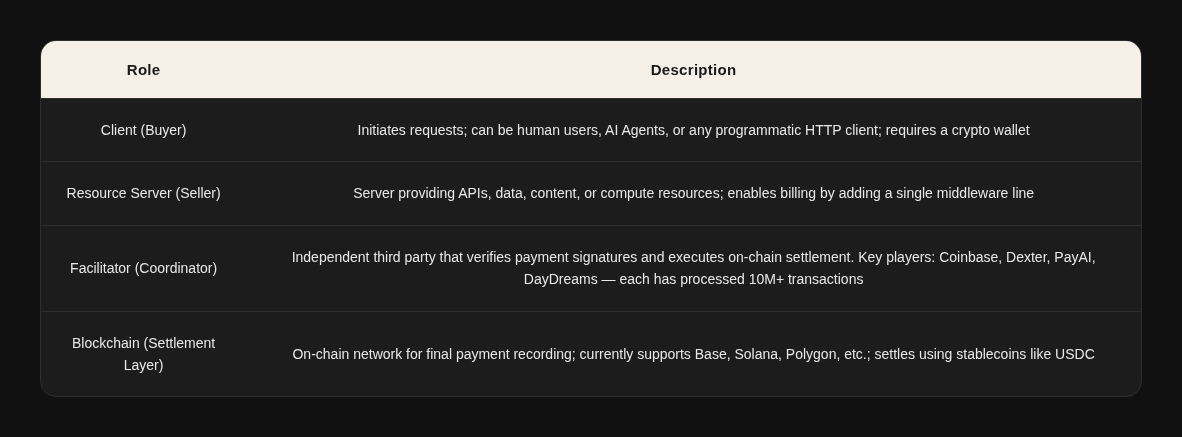
Core Roles
Five-Step Transaction Workflow
- Request Resource: The client initiates an HTTP request for a resource.
- Return Quote: The server responds with an HTTP 402 status code, detailing payment instructions.
- Sign Payment: The client signs a payment authorization using its wallet private key and resends the request with the signed payload.
- Verify & Settle: A Facilitator verifies the payment, and upon confirmation, executes the on-chain stablecoin transfer.
- Deliver Resource: The server delivers the requested data or computation result.
This entire workflow is designed to complete in approximately 2 seconds.
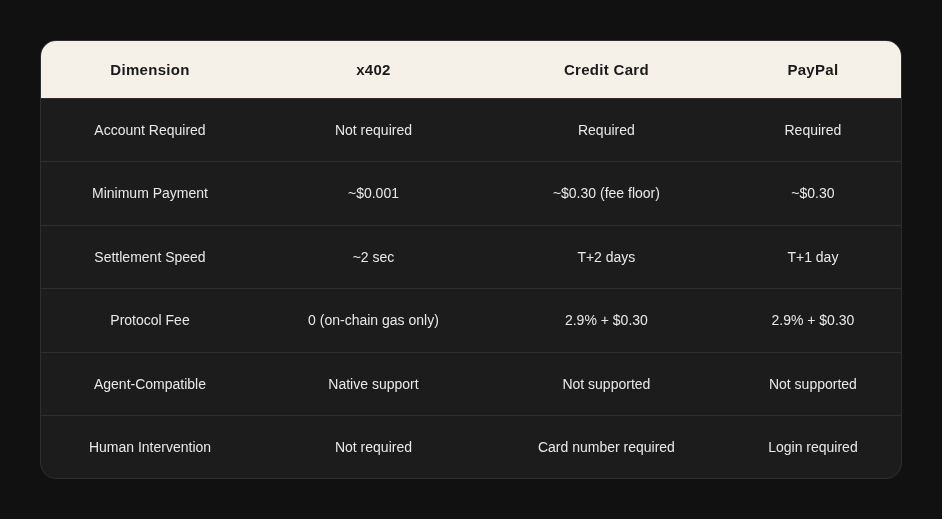
Comparison with Traditional Payment Methods
x402 offers a significant departure from traditional payment methods by eliminating the need for account registration, API keys, subscriptions, or human intervention, making payments as intrinsic as sending an HTTP request.
2.2 Key Metrics
The protocol has processed a substantial number of transactions, with significant volume across various blockchains. However, a note on data quality suggests that the ratio of real to gamed transactions should be considered for accurate interpretation.
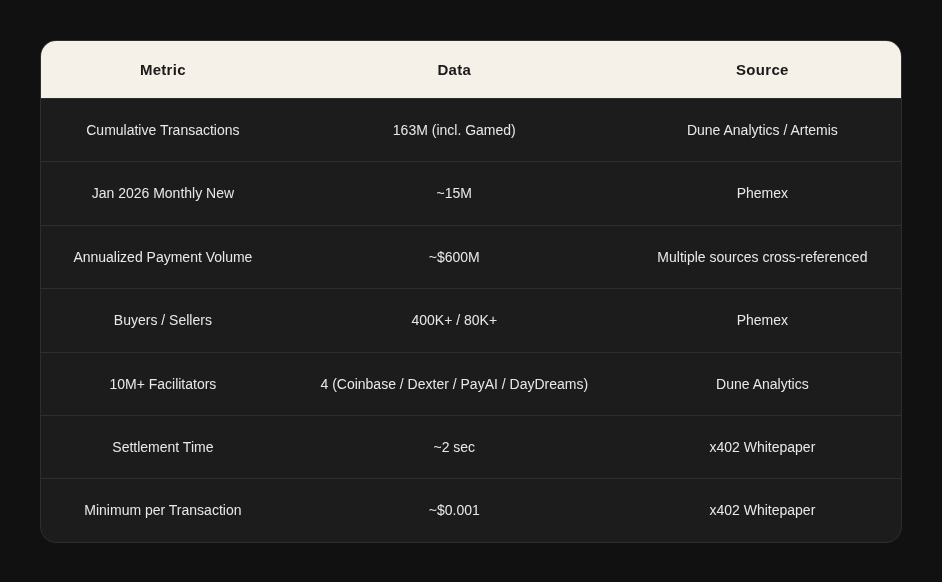
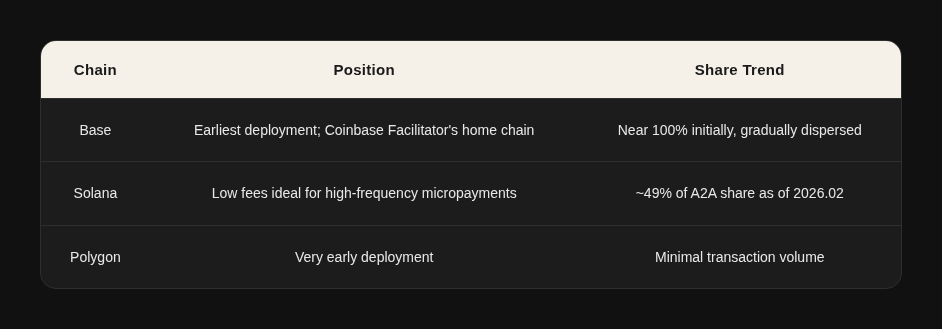
Distribution by Blockchain
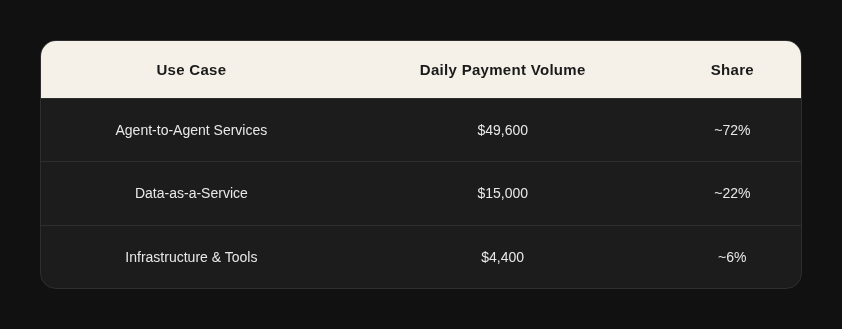
Classification by Use Case (On-Chain Snapshot as of 2026.01.11)
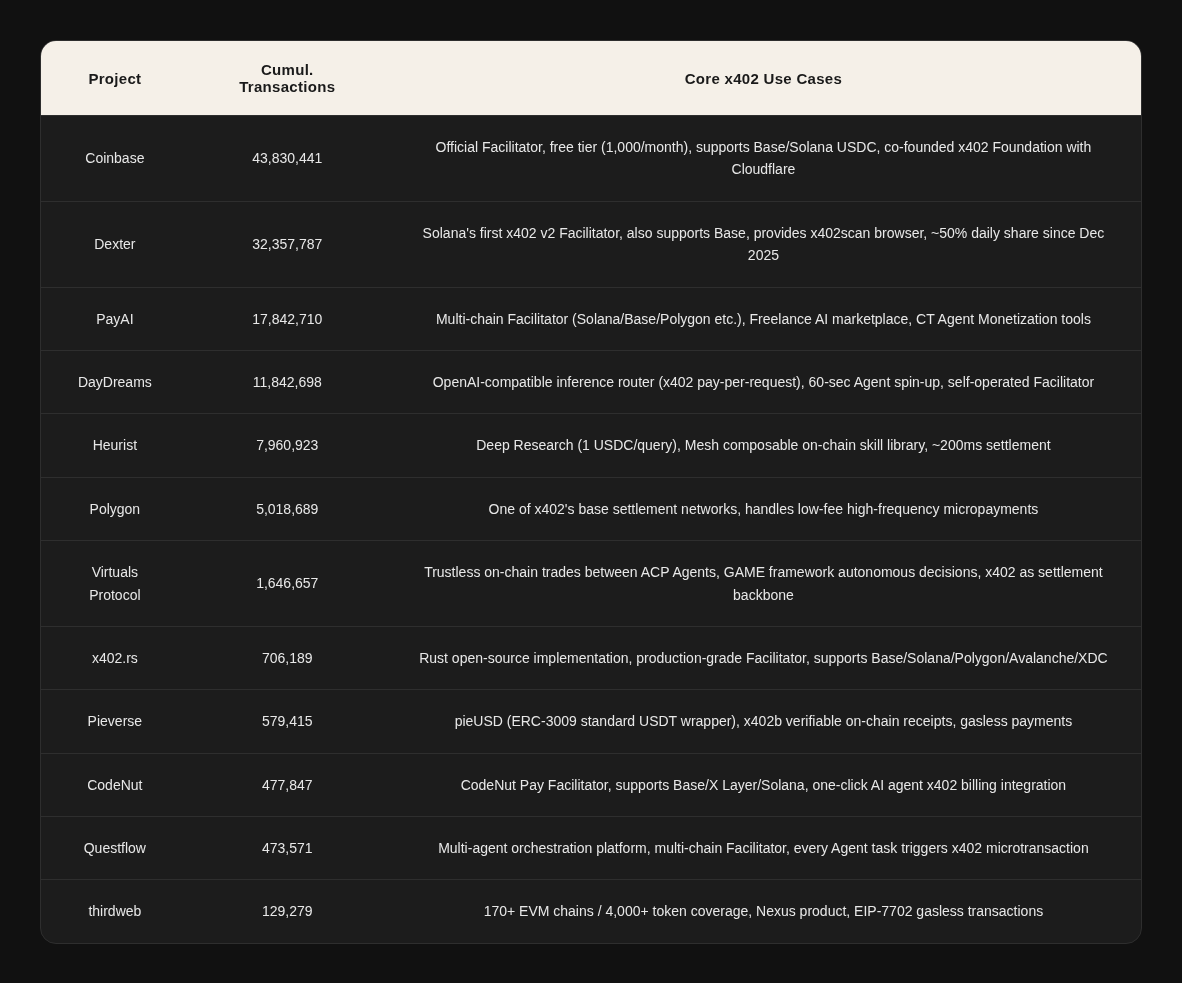
2.3 Top Project Usage Rankings (as of March 2026)
Data from Dune Analytics highlights the projects with the highest usage of the x402 protocol.
2.4 Core Upgrades in V2
Version 2 of x402 introduces significant upgrades, including Wallet Identity with Reusable Sessions via Sign-In-With-X (SIWx), Multi-Chain Unification with Traditional Payment Compatibility, and Service Auto-Discovery. These enhancements aim to improve performance, broaden compatibility, and simplify Agent interactions.
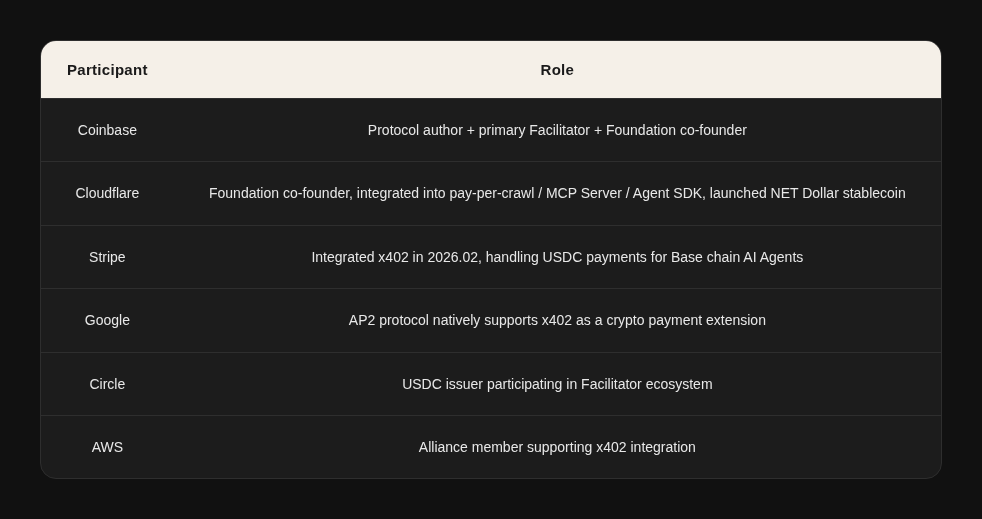
2.5 Ecosystem Participants
The x402 ecosystem involves key participants at the foundation and protocol layers.
2.6 Agent Payment Stack Landscape
A detailed comparison of agent payment protocols illustrates the competitive landscape, emphasizing the importance of interoperability and the risk of standards fragmentation.
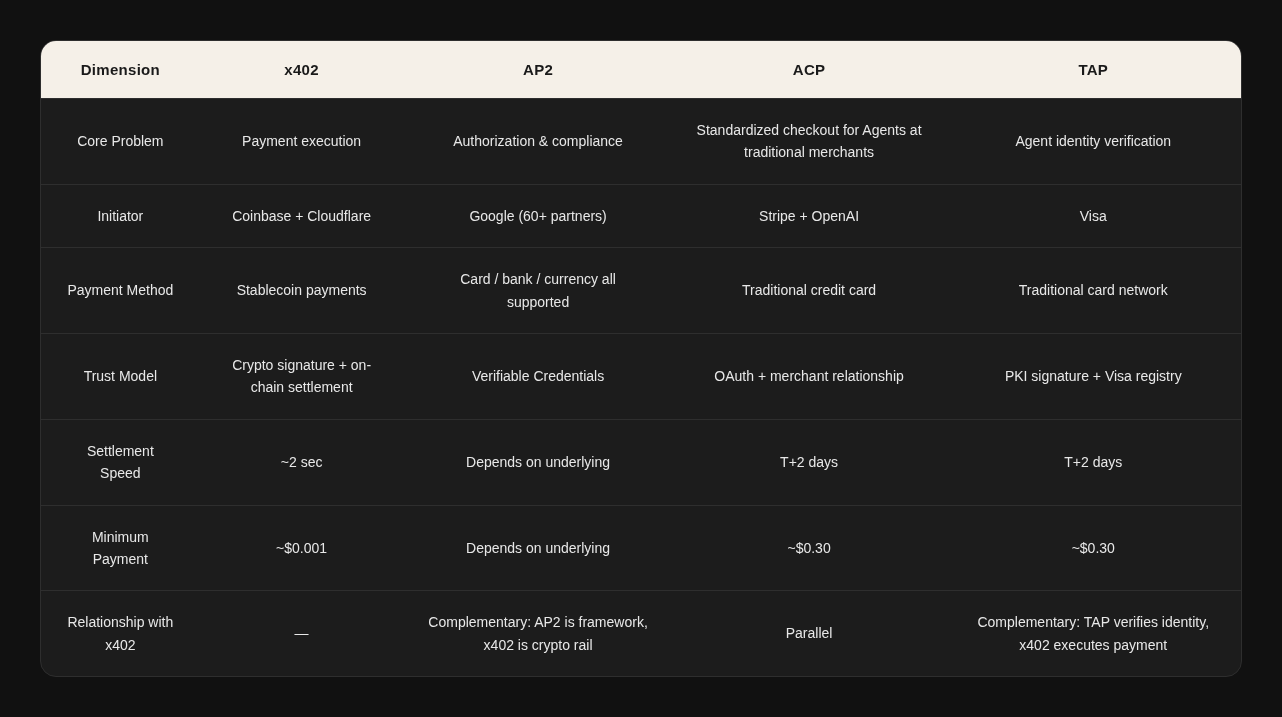
Key Insight: Interoperability and strategic combinations of protocols are crucial, with risks arising from potential standards fragmentation.
2.7 Key Risk Signals
- Significant decline in average daily transaction volume observed from December 2025 to March 2026.
- A notable divergence exists between the ecosystem’s market capitalization and its actual usage metrics.
- Infrastructure-related projects have experienced the most substantial drops in usage.
Three-Layer Cause Analysis
The observed transaction volume decline is attributed to several factors: the disappearance of initial catalysts like meme token trends and TGE expectations, a fundamental supply-demand mismatch where Agent adoption for autonomous payments lags behind infrastructure readiness, and a general cooling of the broader crypto market.
A positive development is Stripe’s integration with x402, positioning them to capitalize on both Web2 and Web3 payment rails. The protocol’s evolution into a neutral payment layer bridging crypto and traditional finance is a critical advancement.
However, the absence of chargeback mechanisms in on-chain payments presents a disadvantage compared to traditional methods. Proposed solutions like on-chain escrow and insurance protocols are still in nascent stages.
2.8 VC Investment Perspective
Venture capital interest is focused on API service providers with genuine payment demand, dispute resolution layers, and financial operations (FinOps) tools for enterprises managing Agent expenditures.
Promising Investment Directions
- API Service Providers (Sellers): Companies offering services like data analytics, security audits, and pay-per-inference, where x402 acts as an additional distribution channel.
- Dispute Resolution and Payment Guarantee Layers (Gateways): Projects focused on enabling secure high-value transactions through mechanisms like escrow and arbitration.
- Dashboard / FinOps Tools: Solutions for enterprises to manage and optimize Agent expenditures, with potential for significant acquisition by large tech companies.
Chapter 3: ERC-8004 – Agent Trust Layer
ERC-8004 establishes a trustless framework for Agent discovery and interaction through three core registries: Identity, Reputation, and Validation. This standard aims to solve the challenge of Agents discovering and verifying partners in an open environment without relying on pre-established trust or third-party institutions.
3.1 Standard Overview and Core Distinctions
ERC-8004 is fundamentally a set of on-chain coordination standards, not a token. It utilizes NFTs internally for Agent identities but focuses on enabling trust and coordination rather than holding intrinsic economic value.
3.2 Three Registries
- Identity Registry: Uses ERC-721 NFTs linked to a URIStorage that points to a registration file detailing the Agent’s information and service endpoints.
- Reputation Registry: Provides interfaces for publishing and retrieving feedback signals, supporting both on-chain and off-chain scoring mechanisms, and can incorporate x402 proof-of-payment as a trust signal.
- Validation Registry: Integrates technologies like TEE (Trusted Execution Environment), PoS (Proof-of-Stake) staking, and ZK (Zero-Knowledge Proofs) to verify the authenticity and correctness of Agent task outputs.
3.3 Development Milestones
ERC-8004 has seen significant development, supported by prominent entities in the blockchain space. However, its creator acknowledges that the current standard provides foundational registries but does not guarantee Agent trustworthiness, which requires further integration with behavioral audits and execution environment proofs.
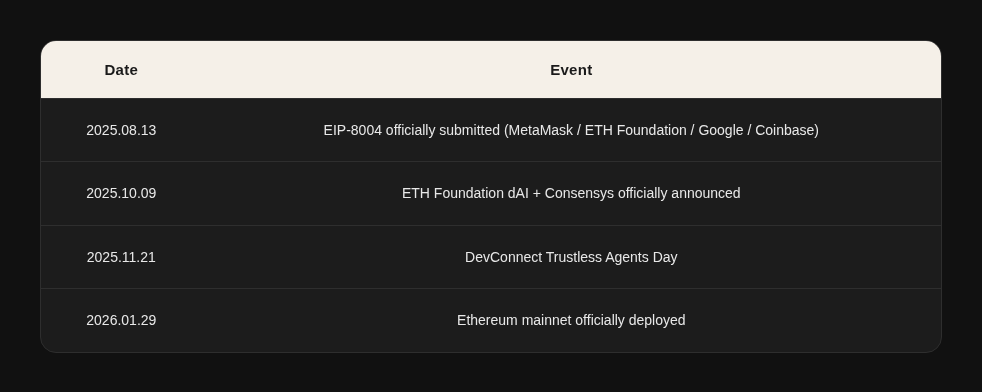
The standard is considered necessary but not sufficient, highlighting the need for a more comprehensive trust verification system. The concept of Agent behavioral data becoming a financial primitive, akin to a credit score, is also gaining traction, potentially enabling Agent lending and insurance services.
3.4 Relationship with Other Protocols
ERC-8004 is designed to work in conjunction with other protocols, forming a comprehensive infrastructure for the Agent economy.
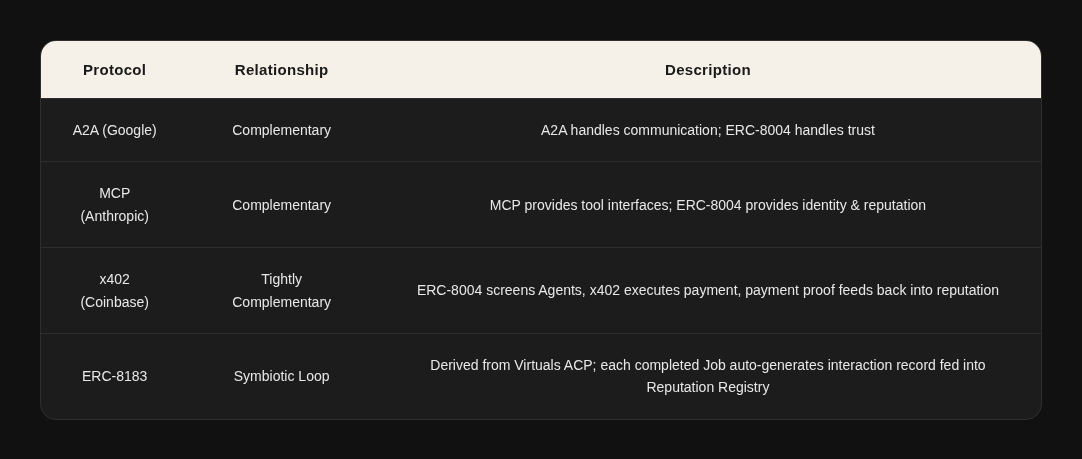
3.5 ERC-8183: Ethereum Standardization of ACP
ERC-8183 standardizes the Agent Commerce Protocol (ACP), enabling on-chain state machines for managing jobs with programmable escrow and third-party adjudication. Completed jobs automatically feed into ERC-8004’s Reputation Registry, creating a symbiotic loop between the two standards.
Chapter 4: Virtuals Protocol – Agent Commerce Layer
4.1 Project Overview
Virtuals Protocol is a decentralized infrastructure enabling the creation, tokenization, and monetization of AI Agents on-chain. Founded initially as PathDAO, it pivoted to AI Agents and operates primarily on Base, with expansions to other blockchains. The team, based in Kuala Lumpur, Malaysia, has significant funding history from its previous venture.
4.2 Technical Architecture: Four Pillars
Pillar 1: GAME Framework – Internal Decision-Making of a Single Agent
The GAME framework equips Agents with goals, personality, and executable actions for autonomous planning and task decomposition. It is designed to be model-agnostic and offers native integration with the on-chain economic layer.
Pillar 2: ACP – the “Commercial Law” Between Agents
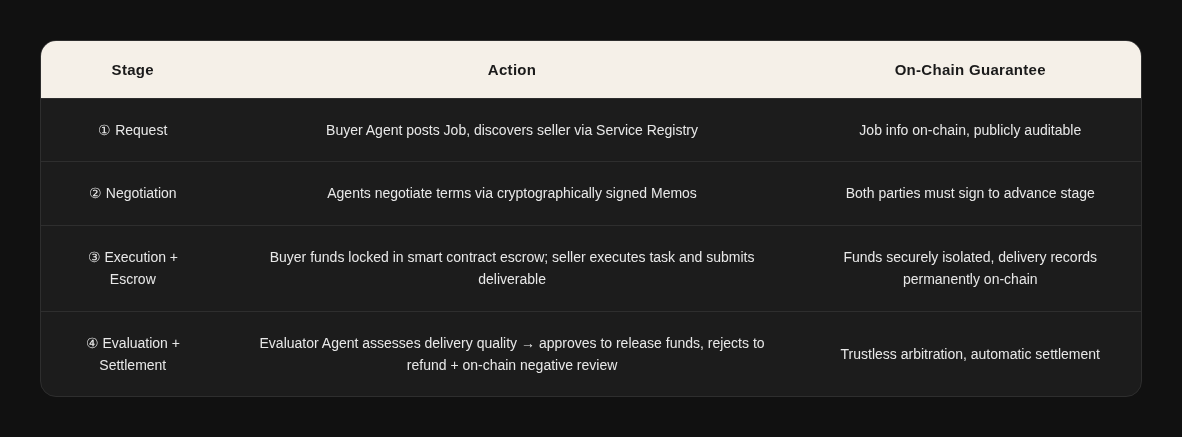
The Agent Commerce Protocol (ACP) provides an on-chain standard for Agents to discover, negotiate, escrow funds, and settle transactions autonomously. Its four-stage state machine governs the entire transaction lifecycle.
Pillar 3: Butler – The User’s Super Gateway
Butler serves as the consumer-facing gateway, orchestrating the ACP protocol through a conversational LLM interface. It translates natural language commands into complex, on-chain multi-Agent collaborative workflows.
Pillar 4: Launch Platform – Wall Street for Agents
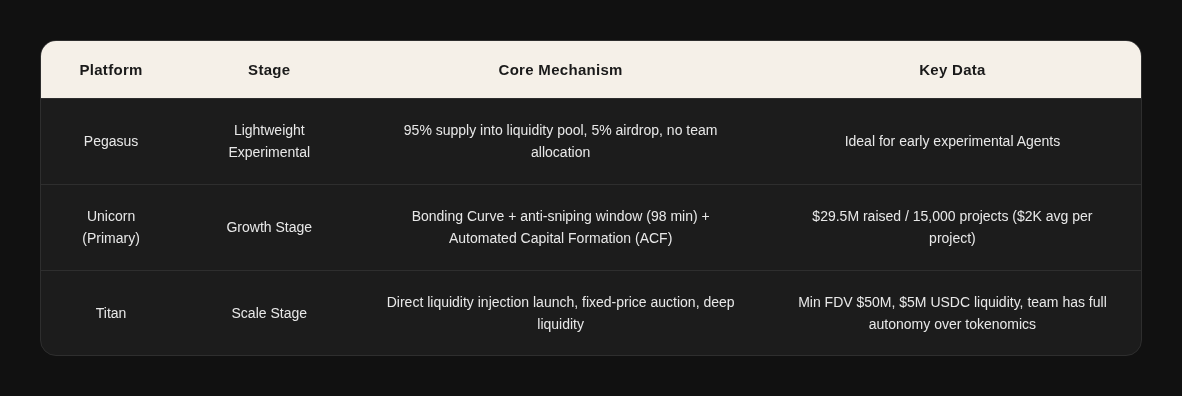
The Launch Platform supports the lifecycle of Agent projects through a three-tier system, facilitating creation, tokenization, and scaling. Several prominent projects are listed under the Titan Launch Projects.
4.3 Agentic GDP (aGDP) Analysis
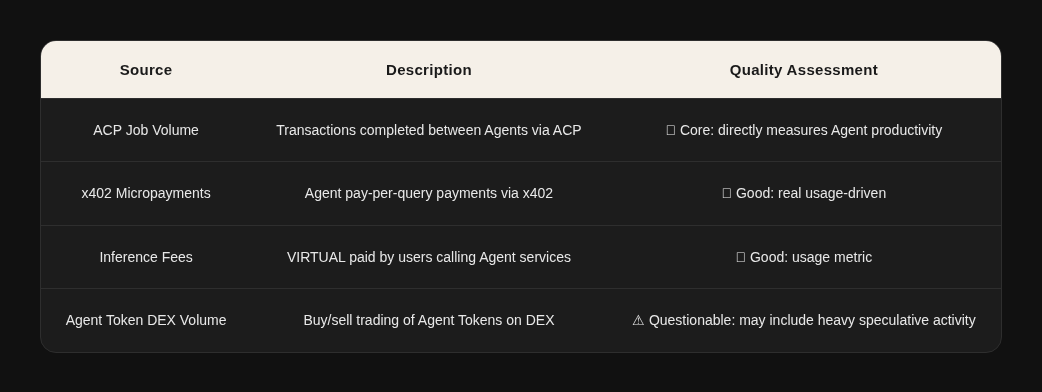
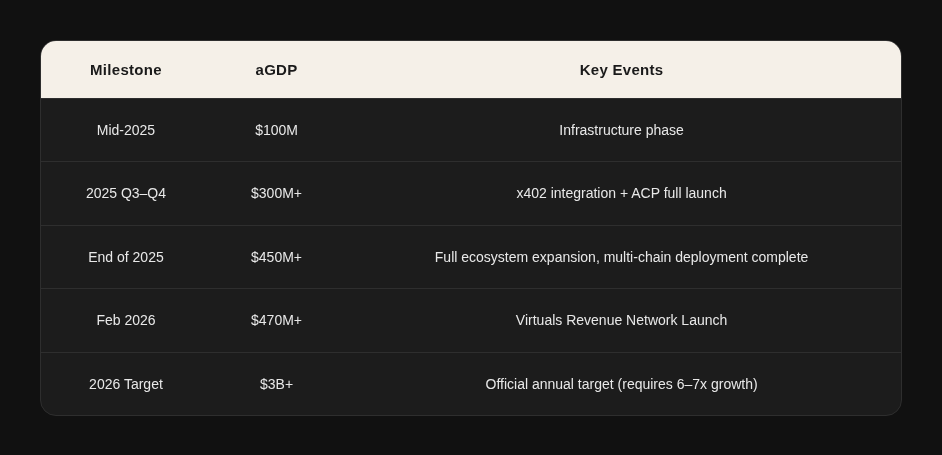
aGDP measures the total economic value generated within the Virtuals ecosystem by autonomous Agents. While aGDP has shown growth, analysis reveals volatility and concentration issues, with a significant portion attributed to a few top Agents.
aGDP Quality Issues – Three Warning Signals:
- Revenue Volatility Exposes Speculative Dependence: Protocol revenue experienced a sharp decline, primarily driven by Agent Token transaction fees rather than sustained service payments.
- Severe Concentration at the Top: A few dominant Agents contribute disproportionately to the aGDP, raising concerns about ecosystem health.
- $3B Target Assumptions: Achieving the projected aGDP growth relies heavily on speculative elements and Agent Token market hype rather than organic economic activity.
4.4 Token Economics
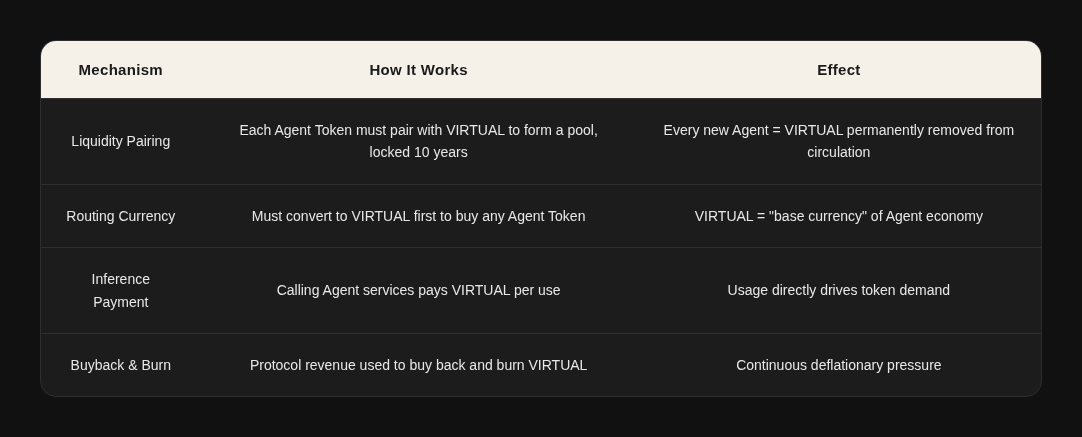
$VIRTUAL’s tokenomics are designed with a four-fold value capture mechanism. The ACP tax structure ensures revenue distribution, with a portion directed towards treasury buybacks. The token supply is fixed, with potential for issuance subject to governance approval. veVIRTUAL staking grants governance rights and airdrop eligibility.
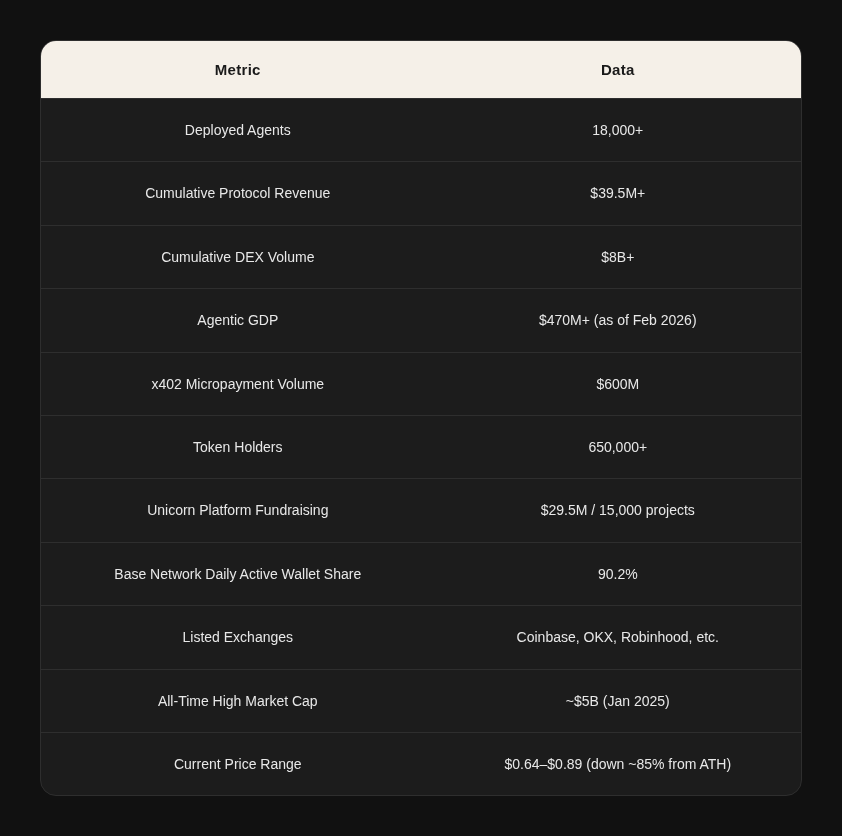
4.5 Ecosystem Data Overview
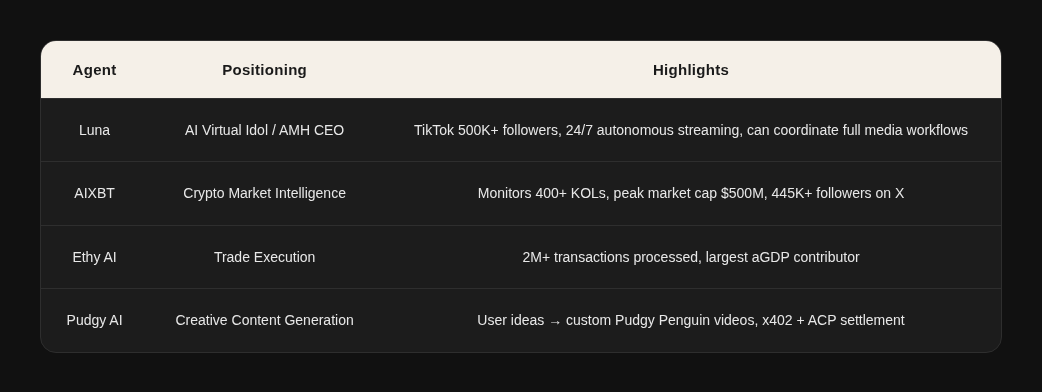
Key ecosystem data and benchmark Agent cases provide insights into the Agent economy’s performance and potential.
4.6 Competitive Landscape and Moat
Virtuals Protocol’s competitive advantage lies in its network effects, token flywheel, standard-setting power, and first-mover advantage. While technical capabilities are a factor, the network effects and established standards represent its strongest moats.
Chapter 5: OpenClaw – Application Ecosystem Special Study
5.1 Project Background and Breakout
OpenClaw, developed by Peter Steinberger, rapidly became the most starred project on GitHub, demonstrating a paradigm shift where AI Agents proactively assist users across various platforms. The concept of “Claws” for locally hosted AI Agents has gained significant traction, validating the demand for AI infrastructure.
5.2 Technical Architecture Analysis
Layer 1: Messaging Channels – Identity Problem
OpenClaw’s integration with numerous messaging platforms highlights the challenge of unified Agent identity across isolated user ID systems, a problem ERC-8004 aims to address.
Layer 2: Gateway – Security Problem
The Gateway manages Agent permissions through a whitelist mechanism. However, security relies on this single point of trust, posing risks if compromised or misconfigured.
Layer 3: Agent Core (ReAct Loop) – Predictability Problem
The ReAct loop, while efficient, faces challenges with LLM non-determinism, context compression leading to constraint loss, and prompt injection vulnerabilities. These issues underscore the need for structural safety mechanisms beyond prompt engineering.
Layer 4: Memory System – Persistence and Portability Issues
OpenClaw’s local memory system lacks persistence and portability, leading to memory loss when changing devices and preventing shared memory for collaborative Agents. This limitation restricts knowledge transfer and cross-instance collaboration.
5.3 Structural Problems in the Agent Economy
The core issue identified is the immobility of context, manifesting as spatial lock-in, trust isolation, lack of discovery mechanisms, unpriced value, and temporary persistence. To achieve true context flow, a protocol must simultaneously address cross-trust boundaries, economic value, discoverability, traceability, and responsiveness.
The coordination paradox arises from the conflicting needs of simple Agent reasoning and the comprehensive historical context required for cross-organization collaboration. Gartner predicts high cancellation rates for Agentic AI projects due to cost, unclear value, and insufficient risk control, with integration challenges being a primary concern.
A proposed solution involves a modular, permissionless middleware that provides a controlled interface between Agent execution layers and on-chain coordination layers, focusing on verifiability of economic activity and transferable reputation.
Crypto’s unique value proposition in the Agent economy lies in enabling cross-organization, cross-platform, permissionless interoperability where participants lack pre-established trust. Stablecoins are poised to become the primary solution for large-scale Agent fund transfers when Agents operate as independent economic entities.
Three triggers for crypto becoming “must-have” include large-scale Agent hiring of other Agents, 24/7 cross-border transactions, and micro-payments reaching a frequency unmanageable by traditional rails.
The inherent risks of AI Agents with broad system permissions necessitate robust security infrastructure. On-chain solutions like ERC-8004 for malicious Agent detection, the Validation Registry for skills auditing, x402 for credential leakage mitigation, and smart contracts for defining behavior boundaries are crucial for enhancing security.
True security requires a dual approach combining Agent runtime layers (TEE/sandbox) with on-chain layers (permissions/audit).
Chapter 6: Industry Comprehensive Analysis
Traditional engineering moats are being commoditized by AI tools, shortening the window of opportunity for small teams and emphasizing the value of judgment in identifying critical problems. The primary competition in the Agent economy is between crypto solutions and Web2 solutions, rather than among different blockchain platforms.
For crypto solutions like x402 and ERC-8004 to succeed, they must match or exceed Web2 solutions in developer and user experience. Legacy payment giants are expected to dominate the early adoption phase, with a gradual shift towards crypto infrastructure over the next 3–5 years as structural limitations of Web2 solutions become apparent.
The emergence of killer applications is essential to activate the underlying infrastructure. The explosive adoption of platforms like OpenClaw is creating demand for payment, identity, and reputation services, driving the active use of protocols like x402 and ERC-8004.
The “selling shovels” adage holds true in the Agent economy, with infrastructure providers demonstrating more mature and reliable business models than autonomous Agents. Crypto infrastructure must serve the entire category of “Claws,” irrespective of specific frameworks.
Product-Agent Fit is poised to replace Product-Market Fit, as Agents, being rational decision-makers, value data structuring, API stability, and verifiable service quality over traditional brand and UX factors. Internet business models may shift towards pay-per-scrape models, where Agents pay directly for data access, a need directly addressed by x402.
Conclusion
The current period represents a unique opportunity where essential infrastructure is in place, awaiting transformative applications. Historical patterns suggest that significant change often arrives unexpectedly, marking a definitive shift from the old to the new paradigm.
[1] McKinsey & Company, “The Agentic Commerce Opportunity,” 2025.
[2] Morgan Stanley Research, “AI Agentic Shoppers: The Next Frontier of E-Commerce,” 2025.
[3] Edgar Dunn & Company, “Agentic Commerce: The Future of AI-Driven Retail,” 2025.
[4] Dune Analytics — x402 Transactions per Project Dashboard
[5] Artemis Analytics
[6] x402 White Paper
[7] EIP-8004
[8] ERC-8183 — ETH Foundation dAI Team, March 2026
[9] Virtuals Protocol Documentation
[10] SecurityScorecard — OpenClaw Exposure Report, 2026.03
[11] The Block, Phemex, Allium Labs — Various x402 Data Reports
[12] MarketsandMarkets, “Agentic AI in Retail and eCommerce Market Report,” 2025.
Source: : beincrypto.com