


- Strategy Inc. has developed two distinct Bitcoin investment vehicles with contrasting risk profiles to cater to diverse investor needs.
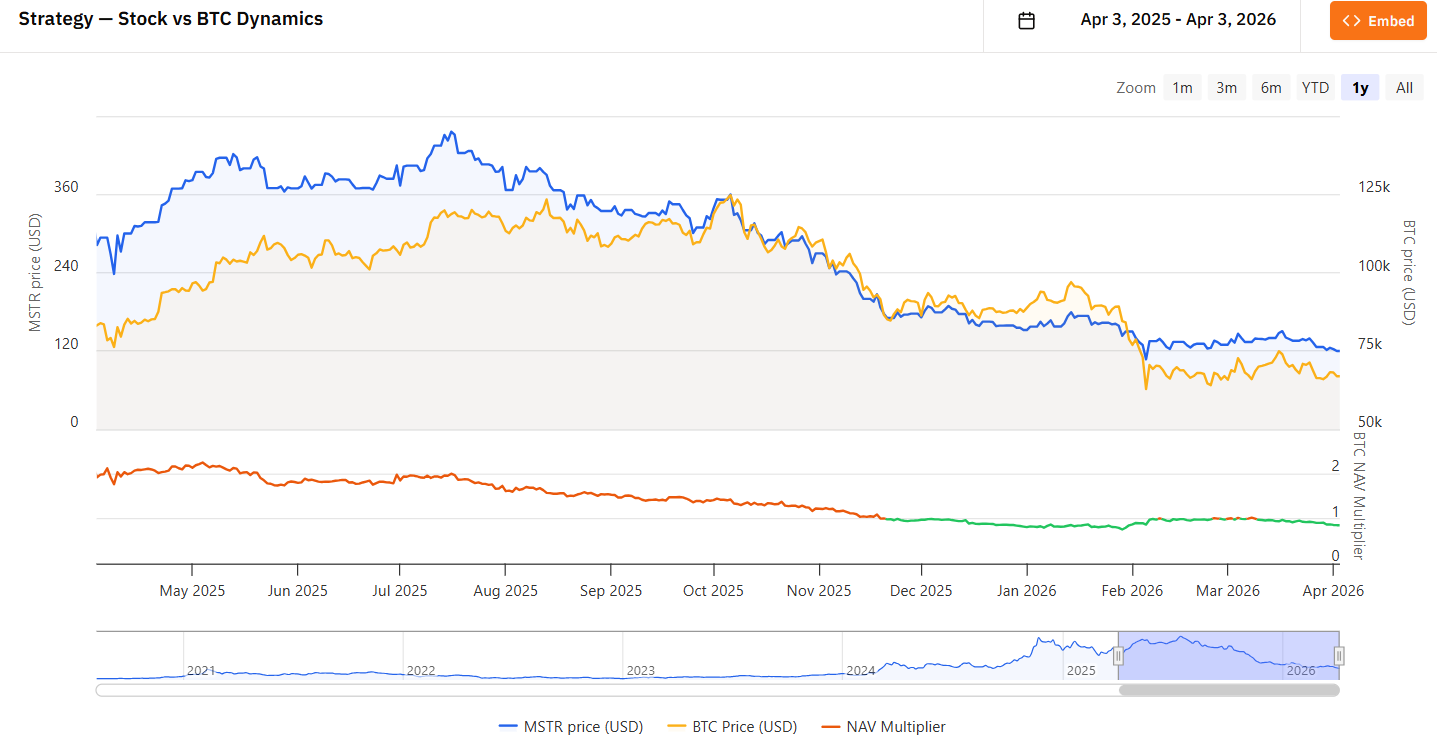
- While MicroStrategy’s common stock (MSTR) experienced a significant decline of 56% over six months, Strategy Inc.’s preferred shares (STRC) have provided a steady 4% return through consistent dividends.
- A notable shift in investor preference is observed, with 80% of STRC holders being retail investors, prioritizing yield over the volatility typically associated with Bitcoin.
Strategy Inc. now offers Bitcoin proponents two fundamentally different ways to engage with the asset. One offers direct exposure to price fluctuations, while the other provides income generation alongside underlying asset value. The choice between these two offerings may represent a critical decision for investors committed to Bitcoin this year.
The company, previously known as MicroStrategy, currently holds 762,099 BTC, acquired at an average price near $75,694 per coin, valuing its Bitcoin treasury at approximately $51 billion. This substantial Bitcoin holding underpins both its common stock (MSTR) and its perpetual preferred shares, branded as Stretch (STRC). Despite originating from the same corporate treasury, these two instruments provide vastly different investment experiences.
Two Products, One Treasury, Completely Different Rides
MSTR represents the high-volatility investment choice. Strategy issues equity and debt to acquire more Bitcoin, thereby amplifying price movements in both upward and downward market conditions.
During periods of market ascent, MSTR has historically demonstrated outperformance against BTC, ranging from 1.5x to 3x. Conversely, during market declines, the amplified downside risk becomes apparent.
The capital structure places debt obligations ahead of common equity. Furthermore, continuous equity dilution resulting from capital raises exacerbates losses when Bitcoin experiences stagnation or depreciation.
There is no dividend distribution or yield associated with MSTR. It offers no capital cushion. Investors in MSTR are essentially making a directional bet on the price appreciation of Bitcoin. While the potential rewards during favorable market conditions are substantial, the past six months serve as a stark illustration of the risks involved when the market moves unfavorably.
STRC offers an alternative investment strategy based on the same underlying Bitcoin thesis. Introduced in July 2025, this perpetual preferred stock provides a 9% dividend, making monthly cash distributions. The mechanism is designed to maintain its trading price near the par value of $100 by adjusting its yield.
The dividend yield has seen seven consecutive monthly increases, reaching 11.5%, and remained at that level for April. This initial stabilization since its launch indicates the successful operation of its designed mechanism.
Stretch Dividend Rate maintained at 11.50% for April 2026. $STRC
— Michael Saylor (@saylor) April 1, 2026
The adjustment parameters are publicly disclosed. If the 30-day volume-weighted average price of STRC falls below $95, the board is authorized to increase the dividend by 50 basis points or more.
When the price is between $99 and $101, no adjustments are made. An increase above $101 could trigger a dividend reduction. This structure effectively neutralizes the impact of Bitcoin’s daily price volatility, replacing it with predictable monthly income.
Strategy CEO Phong Le indicated in March that approximately 80% of STRC holders are retail investors, a figure that contrasts with the 40% retail ownership observed in MSTR common shares.
~ 40% of $MSTR shares are owned by retail. ~ 80% of $STRC shares are owned by retail. Retail investors prefer low-volatility, high-yield digital credit.
— Phong Le (@phongle) March 26, 2026
The market appears to be segmenting based on investor profiles. Different types of investors are gravitating towards the investment vehicle that best aligns with their financial objectives, risk tolerance, and preferences for portfolio management.
“$MSTR is for people so convinced of bitcoin they want leveraged exposure to it… $STRC is for people who believe in bitcoin but want yield, not volatility,” wrote Bitcoin advocate Halston Valencia in a post.
The Numbers Make the Gap Impossible to Ignore
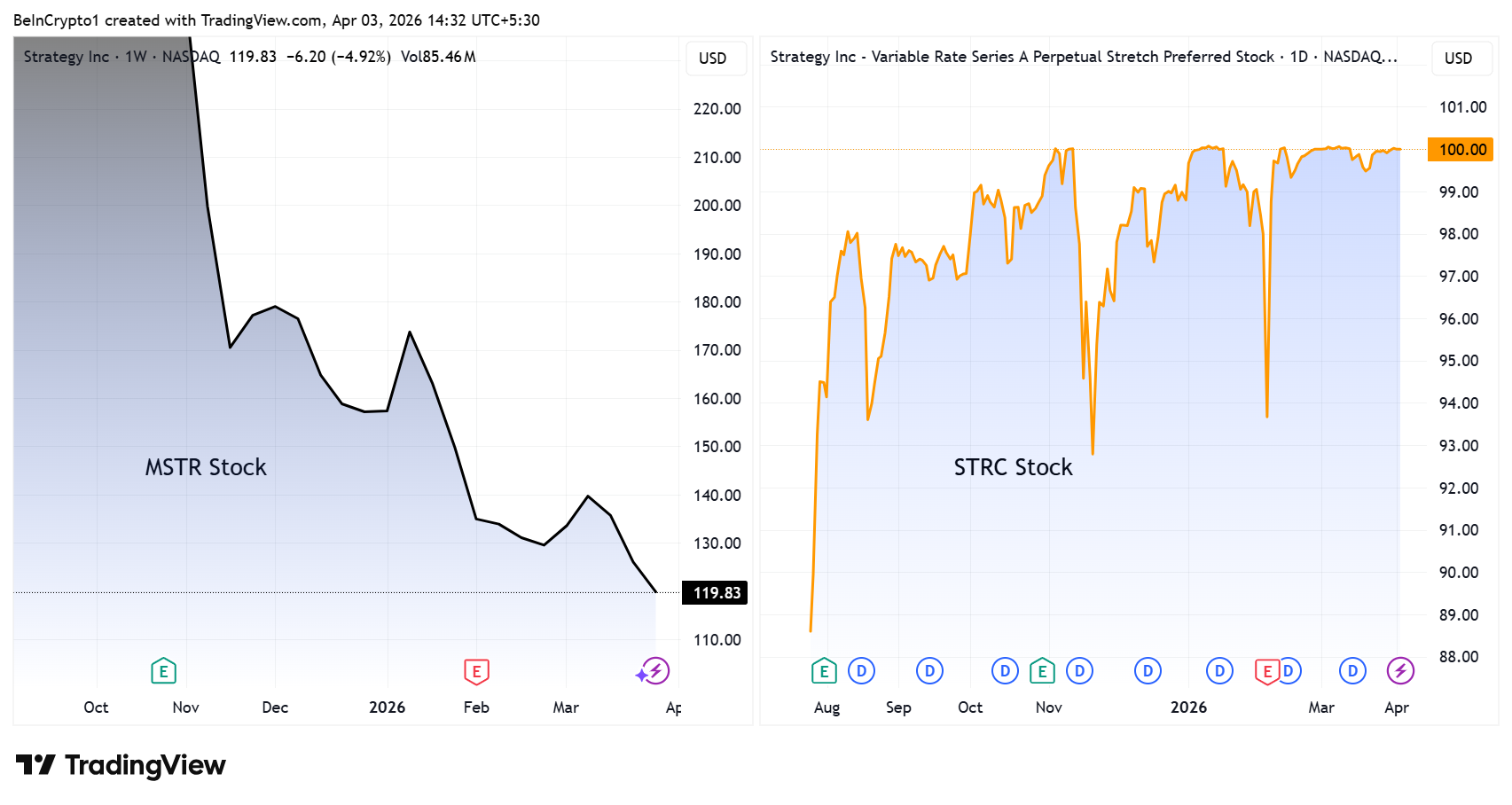
On April 2, MSTR closed at $119.13, trading within a narrow intraday range of $116.40 to $120.22. Over the preceding six months, the stock has depreciated by approximately 56%, and it is currently trading 74% below its 52-week high of $457.22. This demonstrates the impact of leverage operating in reverse, directly affecting investor portfolios in real-time.
STRC traded flat at $100.00 on the same day. Its entire 52-week trading range is confined between $88.00 and $100.42. Year-to-date returns are approximately 4%, primarily generated from dividend distributions rather than price appreciation. This stability is a deliberate design feature intended to provide consistent returns.
Mark Palmer, an equity research analyst at Benchmark-StoneX, characterized MSTR as a leveraged, non-yielding Bitcoin proxy suitable for sophisticated investors with a high tolerance for risk.
Conversely, Palmer noted that STRC aligns with the income expectations of most retail investors due to its predictable returns and substantial Bitcoin overcollateralization.
🧵 7/7 🌍 The TL;DR: STRC is the ultimate bridge between TradFi yield and a Bitcoin-native balance sheet.
As Benchmark analyst Mark Palmer notes, STRC is a key driver for expanding Strategy's Bitcoin holdings while minimizing the dilution of common shares. It offers the…
— PreferredPath (@PreferredPath) March 11, 2026
The aspect of overcollateralization is significant. Strategy maintains $2.25 billion in cash reserves designated for servicing dividend payments. Furthermore, its Bitcoin treasury substantially exceeds the $5 billion notional market capitalization of STRC.
Even in the event of a severe Bitcoin price correction, the preferred stock ranks senior to common equity in the capital structure. This means MSTR holders would bear the initial losses before any impact is felt by STRC investors.
The capital structure adds another layer to that thesis. Preferred holders sit senior to equity. Even a severe BTC correction that wipes out MSTR common equity creates a much higher failure threshold before it reaches the preferred dividend. He built the risk in layers.
— Collin 🍊 (@STRchitect) March 31, 2026
Strategy Inc. also announced a $42 billion at-the-market program, equally allocated between common stock and STRC issuance. This program is intended to facilitate continued Bitcoin accumulation, supporting the company’s objective of reaching 1 million BTC in its treasury.
This initiative positions STRC not only as an income-generating instrument but also as the primary funding mechanism for the company’s ongoing Bitcoin acquisition strategy.
Growth or Income. That Is the Whole Question.
The choice between MSTR and STRC primarily hinges on an investor’s temperament rather than their fundamental conviction in Bitcoin. Both MSTR and STRC shareholders share a belief in Bitcoin’s long-term value proposition. However, they differ in their preferred method of expressing this belief within their investment portfolios.
MSTR is designed for investors who possess significant patience and robust risk management capabilities. Should Bitcoin rebound from its current valuation near $67,000 and surpass previous all-time highs, MSTR investors are positioned to achieve substantial capital gains that are unattainable through traditional spot Bitcoin holdings or preferred stock instruments.
Historical performance data supports this thesis. Across several multi-year bull market cycles, MSTR has delivered returns exceeding 3,000%, while Bitcoin itself has shown returns of approximately 900% in certain analyses.
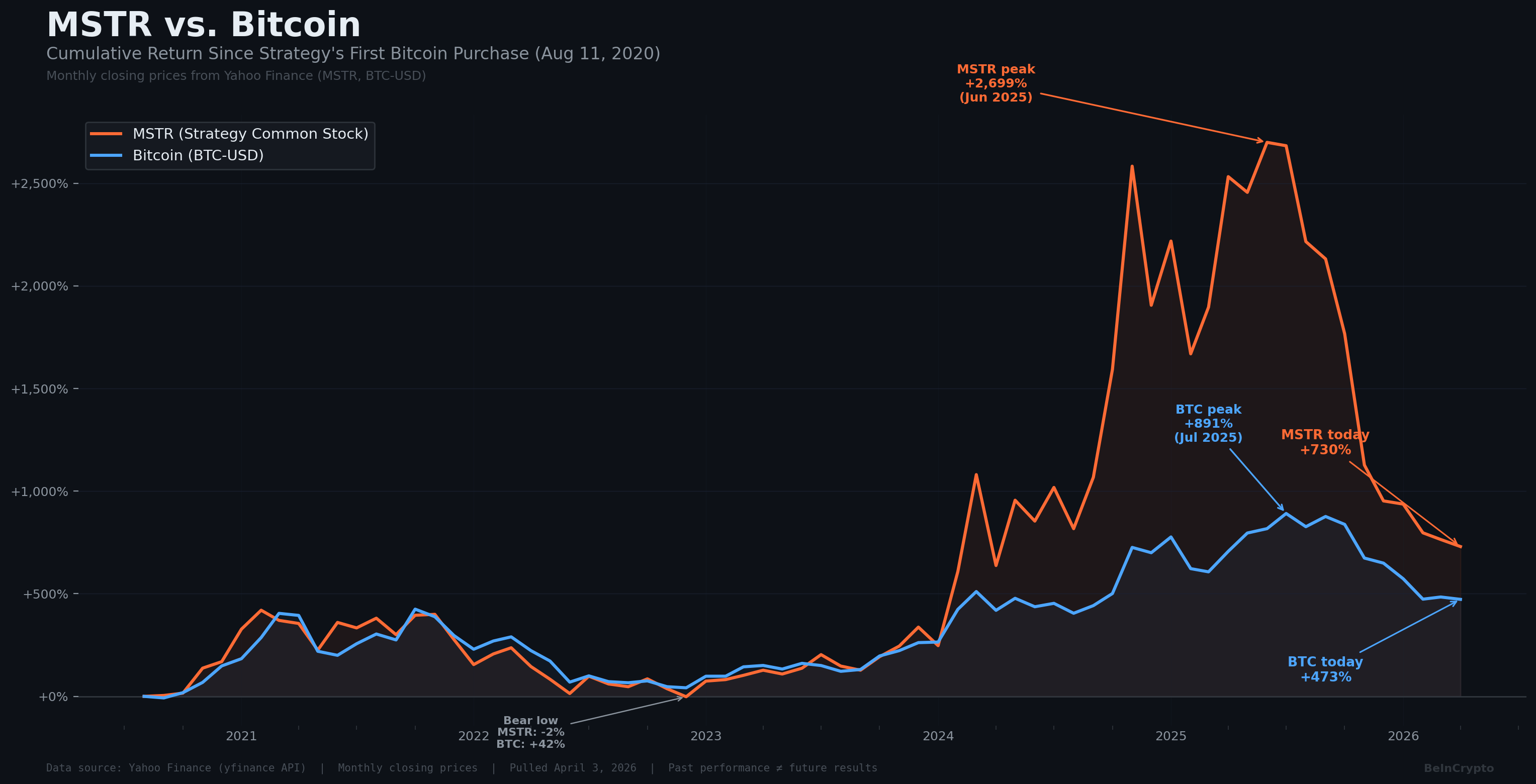
However, the current financial statements highlight the cost associated with this leveraged exposure. Strategy Inc.’s Bitcoin holdings currently reflect unrealized losses exceeding $5.5 billion.
The company recently halted its 13-week Bitcoin purchasing streak. Additionally, there has been notable insider selling, with board director Jarrod Patten divesting 2,100 shares.
The stock is trading below key moving averages, and its momentum indicators suggest a weakening trend.
STRC, conversely, is structured to reward consistency and adherence to a disciplined investment approach. The annualized yield of 11.5%, distributed monthly at approximately $0.96 per share, functions more like a high-yield debt instrument than a typical equity position.
Following each ex-dividend date, which typically corresponds with a minor price dip, STRC has historically recovered to its par value within approximately nine to twelve trading sessions.
To date, dividend distributions have been classified as a non-taxable return of capital. This classification reduces the holder’s cost basis rather than generating an immediate tax liability.
The fundamental trade-off is clear:
- STRC investors will not participate in extreme upward price movements of Bitcoin.
- The share price is managed to remain stable around $100.
- The potential for capital appreciation is intentionally limited.
- The primary investment objective is income generation.
The Bigger Picture Most Investors Miss
In March alone, the issuance of STRC facilitated $1.18 billion in Bitcoin acquisitions, equivalent to approximately 16,800 BTC. In contrast, common stock sales generated $396 million during the same period.
Here it is.
More than 0.1% of the entire Bitcoin supply in a single week.
Strategy's largest Bitcoin purchase since 2024.
A massive $1.18bn from $STRC with the common stock $MSTR raising $396m.
We are living in historic times.
Absolutely incredible. https://t.co/I6v1mxOYZz
— Zynx (@ZynxBTC) March 16, 2026
Holders of STRC have become the principal source of capital fueling Strategy Inc.’s ongoing Bitcoin accumulation efforts.
This dynamic represents a significant shift in the relationship between the two investment instruments.
- MSTR indirectly benefits from increased capital flowing into STRC. A larger STRC issuance enables more Bitcoin purchases without substantially diluting common shareholders.
- STRC benefits from Bitcoin’s appreciation, as the underlying treasury backing its dividend payments becomes more robust. The success of each instrument is intrinsically linked to the other.
A growing segment of investors are incorporating both MSTR and STRC into their portfolios, often alongside direct holdings of spot Bitcoin.
- Leveraged growth potential through MSTR
- Consistent income generation through STRC, and
- Direct control and ownership via self-custodied BTC.
These three approaches are not mutually exclusive; they serve complementary roles within a diversified investment strategy rooted in conviction towards Bitcoin.
The ongoing debate among Bitcoin proponents, contrasting those who reject financial products with those who embrace them, often overlooks the fundamental structural realities at play.
- All three investment avenues contribute to increased Bitcoin demand.
- All three benefit from the growth of the company’s Bitcoin treasury.
The critical consideration for any investor is determining the optimal allocation mix that aligns with their individual financial goals and risk tolerance.
While there may not be a universally applicable solution, neglecting one side of this investment spectrum means foregoing either potential growth or reliable income.
Learn more at : beincrypto.com