

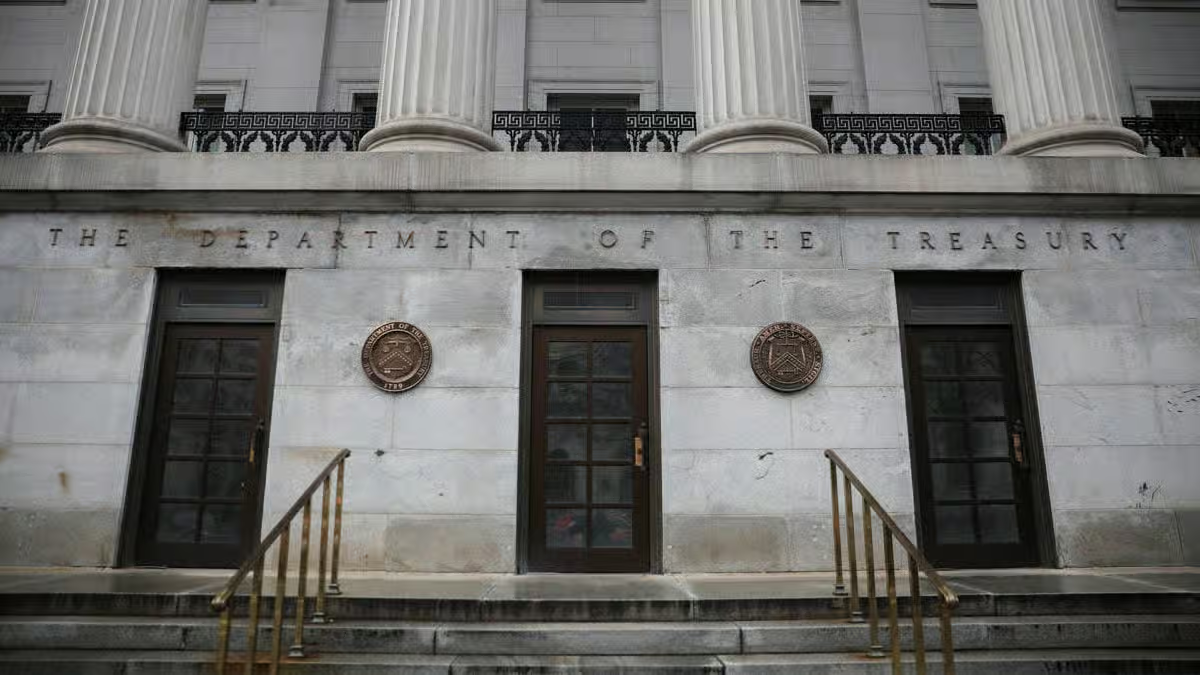
The U.S. Treasury Department has initiated a new phase in the implementation of the Guiding and Establishing National Innovation for U.S. Stablecoins (GENIUS) Act, a legislative framework established last summer governing stablecoin issuance and utilization within the United States. On Wednesday, the department released a notice of proposed rulemaking (NPRM) that signifies its first regulatory proposal specifically designed to enact provisions of the GENIUS Act. This initiative seeks public input on the criteria for evaluating state-level regulatory regimes for smaller stablecoin issuers.
Key Takeaways
- The Treasury has proposed its initial regulation under the GENIUS Act, focusing on state-level oversight for smaller stablecoin issuers.
- Public feedback on the proposed rulemaking notice will be accepted for 60 days via the Federal Register.
- Major banking regulators, including the FDIC and OCC, are also actively publishing proposed rulemakings as part of the ongoing implementation of the stablecoin law.
The NPRM outlines broad principles intended to determine if a state’s regulatory framework is “substantially similar” to the federal standards set forth by the GENIUS Act. This provision is particularly relevant for stablecoin issuers with less than $10 billion in issued assets, who may elect to operate under state regulation rather than comprehensive federal oversight, provided their state’s regime meets the established similarity standard. The Treasury’s solicitation for comments underscores the ongoing efforts by federal agencies to interpret and operationalize the high-level guidelines provided by the GENIUS Act, including its intersection with existing money transmission regulations and the division of oversight responsibilities among different agencies.
Potential Regulatory Precedent
The Treasury’s current proposal addresses a critical aspect of the GENIUS Act by defining the conditions under which state regulatory frameworks can be deemed equivalent to federal standards for smaller stablecoin issuers. This approach to allowing alternative oversight, contingent on meeting stringent similarity criteria, could establish a significant precedent for future regulatory developments in the digital asset space. By seeking public comment on these foundational principles, the Treasury is engaging in a transparent rulemaking process that could influence how other jurisdictions approach the regulation of emerging financial technologies and the balance between federal and state authority.
This is not the Treasury’s first engagement with the public regarding the GENIUS Act. Following the law’s passage, the department issued requests for comment on digital forensic tools related to stablecoins in August and a broader Advance Notice of Proposed Rulemaking in September, soliciting input on various implementation aspects, including tax implications and information collection. Concurrently, top U.S. banking regulators, the Federal Deposit Insurance Corporation (FDIC) and the Office of the Comptroller of the Currency (OCC), have also released their own NPRMs. Notably, the GENIUS Act does not explicitly address yield-bearing stablecoins, an issue that has presented a considerable challenge in subsequent legislative efforts, such as proposed market structure bills in the House.
Information compiled from materials : www.theblock.co