

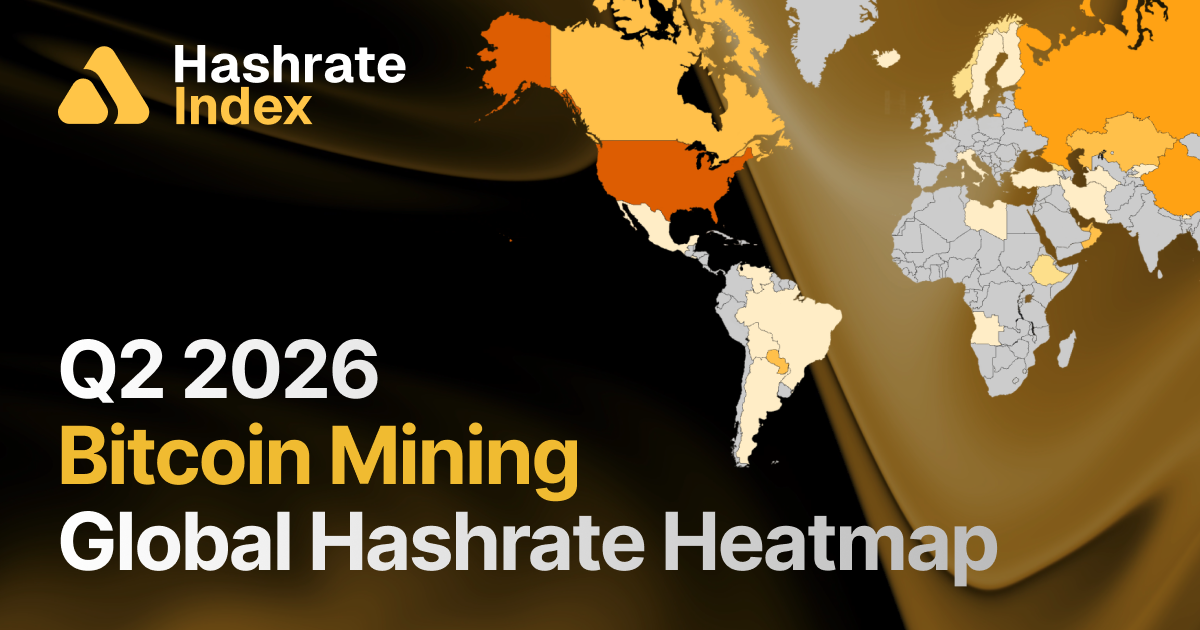
The second quarter of 2026 reveals a significant contraction in the global Bitcoin mining hashrate, a trend directly attributable to economic cycles rather than geopolitical shifts or energy policy changes. The network’s total hashrate declined by 5.8% quarter-over-quarter, settling at 1,004 EH/s from the previous quarter’s 1,066 EH/s. This downturn is precipitated by a steep decrease in Bitcoin’s market price, which fell approximately 50% from its October 2025 peak, pushing the “hashprice”—the revenue generated per unit of hashrate—to historic lows. Consequently, older, less energy-efficient mining hardware, particularly ASICs with efficiencies exceeding 25 J/TH, have been forced offline as they operate at negative gross margins.
Key Takeaways
- Economic Downturn Drives Hashrate Decline: The 5.8% QoQ drop in global hashrate to 1,004 EH/s is primarily a response to reduced mining profitability caused by Bitcoin’s price depreciation.
- Equipment Stratification is Key: While overall hashrate decreased, the composition of the remaining hashrate is shifting. Less efficient legacy hardware is being retired, while more modern, efficient ASICs (14-17 J/TH) are being deployed selectively in operations that can sustain profitability.
- Emerging Markets Show Mixed Performance: Countries like Kyrgyzstan saw significant increases, while others like Pakistan moderated after earlier rapid growth. Ethiopia maintained its position despite regulatory hurdles, highlighting the interplay of policy and operational viability.
- Profitability Over Policy: Mining profitability remains the paramount factor determining geographic deployment and operational status. Policy and energy costs act as secondary considerations, influential only when basic economic viability is established.
Global Hashrate Decline: The Economic Cycle Takes Center Stage
The primary narrative for Bitcoin mining in Q2 2026 is economic. The average network hashrate’s 30-day simple moving average (SMA) experienced a 5.8% quarter-over-quarter contraction, falling to 1,004 EH/s. This contraction directly correlates with the Bitcoin market’s current cycle. The approximate 50% price drop from the October 2025 high of ~$124K to February 2026 lows around ~$65K compressed hashprice to an all-time low of approximately $27.89/PH/s/day. At these revenue levels, mining equipment with efficiencies below 25 J/TH becomes unprofitable. Our analysis estimates that around 252 EH/s of marginal capacity has been taken offline, predominantly consisting of legacy ASIC hardware that has reached its end-of-life in terms of profitability.
This cycle of deployment and retirement based on profitability is a recurring pattern. While geopolitical events influencing energy markets and regulatory shifts can impact mining economics over time, their effects typically lag behind initial economic pressures. The current trend underscores that the fundamental profitability of mining operations, dictated by hardware efficiency and prevailing cryptocurrency prices, is the most significant driver of hashrate distribution and operational decisions.
Top 10 Countries by Market Share (Q2 2026)
Geographic concentration in Bitcoin mining remains high, with the top three countries collectively accounting for approximately 65% of the global hashrate. The United States leads, followed by Russia and China.
- United States — 37.4% (~375 EH/s)
- Russia — 16.9% (~170 EH/s)
- China — 12.0% (~120 EH/s)
- Paraguay — 4.3% (~43 EH/s)
- United Arab Emirates — 3.0% (~30 EH/s)
- Oman — 3.0% (~30 EH/s)
- Canada — 2.6% (~26 EH/s)
- Ethiopia — 2.5% (~25 EH/s)
- Kazakhstan — 1.8% (~18 EH/s)
- Indonesia — 1.8% (~18 EH/s)
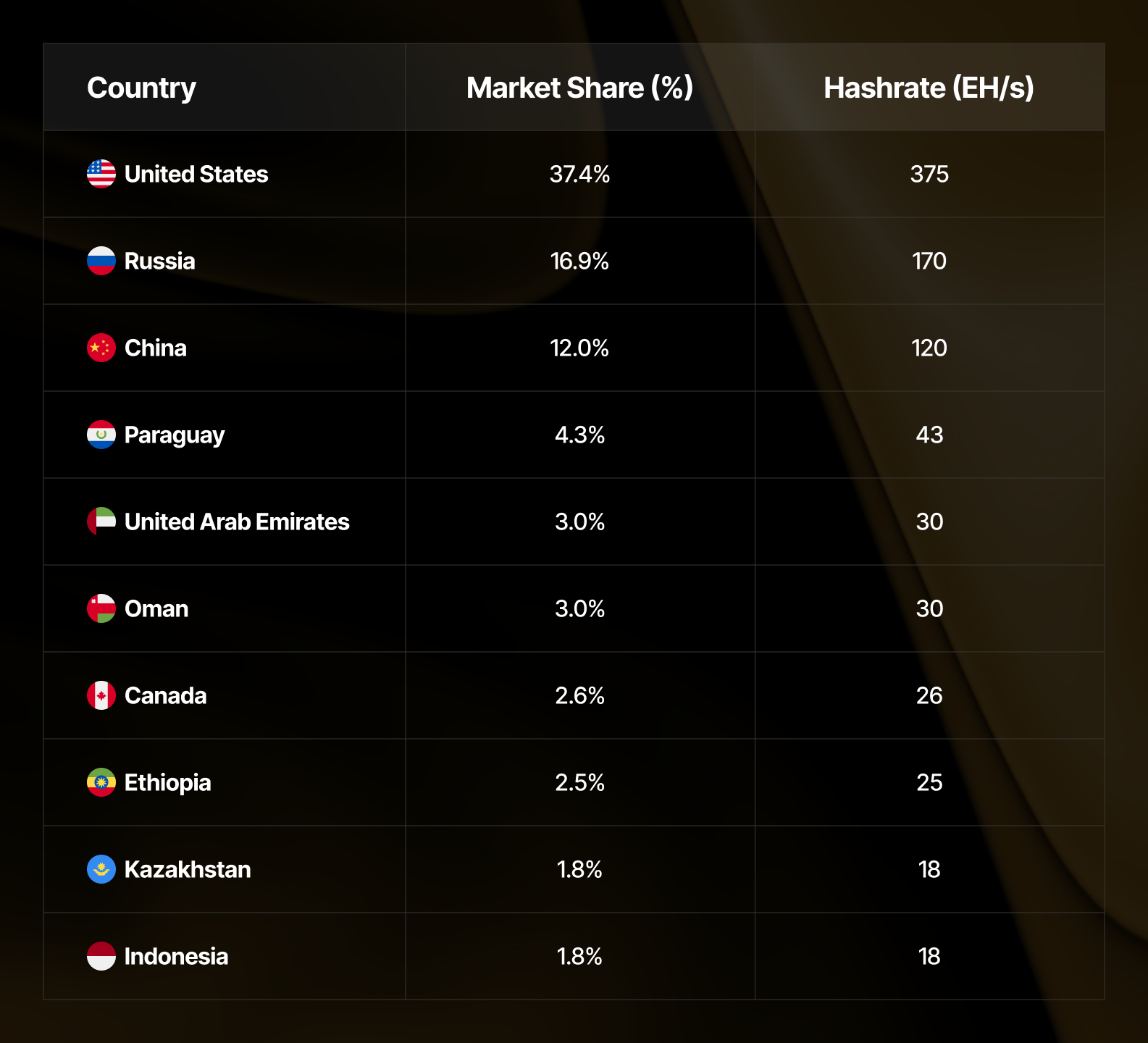
While the top three nations maintain dominance, accounting for approximately 65.6% of the global hashrate, notable shifts indicate gradual diversification. Ethiopia’s consistent rise into the top 10 and the increasing presence of Middle Eastern and Southeast Asian countries suggest a broadening geographic distribution of mining operations.
Quarter-over-Quarter Movers
Examining market share changes from Q1 2026 to Q2 2026 highlights specific regional dynamics:
Top Gainers:
- Kyrgyzstan: Maintained its operational hashrate, leading to a relative gain of approximately 0.4% in global market share.
- Paraguay: Steady hashrate contributed to a 0.3% QoQ increase in market share, reaching 4.3%.
Notable Decliners:
- China: Experienced a 1.35% QoQ decline, attributed to regulatory enforcement actions in Xinjiang in late 2025, which impacted roughly 13% of its capacity.
- Iran: Saw a 0.6% QoQ reduction in market share, likely influenced by regional geopolitical instability.
- United States: A marginal QoQ decline of 0.13%, despite a 3% YoY increase, reflects the ongoing retirement of older ASICs and miners selectively curtailing operations due to low margins, alongside a trend towards AI/HPC utilization.
- Canada: A modest QoQ pullback of 0.13%, offset by 0.83% YoY growth, indicates operational adjustments including shifts towards AI/HPC and stricter regulations in Quebec.
Multi-Quarter Trends (Q1 2025 → Q2 2026)
An analysis over the past 18 months reveals sustained regional trends:
Consistent Growth: Kyrgyzstan and Ethiopia have demonstrated consistent upward trajectories, each gaining roughly one percentage point in market share year-over-year, signaling sustained investor confidence in their long-term operational viability despite market downturns.
Emerging Markets Moderate: Pakistan, which saw explosive YoY growth in Q1, moderated to approximately 3 EH/s in Q2. Similarly, Bolivia exhibited significant YoY growth followed by potential pullbacks, indicating a period of operational recalibration in these markets.
U.S. Expansion Fueled by Modern Hardware: The United States continues to expand its hashrate (39% YoY to 375 EH/s). This growth is characterized by the strategic deployment of new, efficient hardware, offsetting the forced retirement of older, less efficient machines.
Russia Faces Market Share Erosion: Despite positive year-over-year growth, Russia has experienced a decline in its relative market share over recent quarters, potentially due to regulatory uncertainties and sanctions.
Standout Countries: Growing Despite Down-Cycle
Several jurisdictions have continued to grow their hashrate throughout Q2 2026, a period marked by a global contraction. This growth is primarily driven by the deployment of state-of-the-art mining hardware and access to competitively priced energy:
Kyrgyzstan (+300% YoY, +167% QoQ): Sustained expansion indicates the operationalization of new mining facilities equipped with highly efficient ASICs, capable of remaining profitable even under depressed hashprice conditions.
Paraguay (+54% YoY): Consistent growth and a stable market share suggest professional mining operations utilizing modern equipment are weathering the current economic cycle effectively.
Laos (+100% YoY): Operations largely powered by hydroelectricity are scaling steadily, insulated from market volatility due to low and stable energy costs.
Finland (+100% YoY): Benefiting from favorable climate conditions for efficient cooling, Finnish mining operations demonstrate resilience, remaining profitable as legacy hardware globally is decommissioned.
The ability of operations in these regions to expand during a period of global contraction underscores their reliance on cutting-edge hardware and genuine energy cost advantages, allowing them to maintain profitability where less efficient operations cannot.
Regional Dynamics
North America: The U.S. maintains its leading position (37.4%) through a strategic balance of deploying next-generation ASICs and retiring legacy equipment. Canada also demonstrates similar resilience, with modest YoY growth reflecting optimization rather than a large-scale exodus.
Europe & Central Asia: Kyrgyzstan’s impressive growth, contrasted with slower expansion in some neighboring regions, highlights the impact of clear regulatory frameworks. Mid-2025’s transparent mining regulations in Kyrgyzstan appear to be attracting capital. Russia’s hashrate remains substantial but shows flat year-over-year growth, indicating constraints from regulatory environments and international sanctions.
Asia-Pacific: China’s hashrate (11.95%) reflects an equilibrium following regulatory actions in late 2025, with operators adapting through relocation rather than complete exit. Indonesia’s steady climb to 1.8% suggests Southeast Asia is capturing diversified mining operations, leveraging lower regulatory friction and access to hydroelectric power.
Middle East: While geopolitical tensions have impacted Iran’s mining sector, neighboring UAE and Oman maintain stable market shares. These operations represent strategic, long-term infrastructure investments rather than opportunistic expansion.
Latin America: Paraguay serves as a stable anchor for the region. Brazil’s significant YoY growth (133% to 3.5 EH/s) signals substantial infrastructure investment. Argentina’s continued decline highlights the vulnerability of mining operations to macroeconomic instability.
Africa: Ethiopia’s rise to the 8th global position (2.5% hashrate) is notable, particularly given a mid-2025 freeze on new mining permits. This growth validates the operational capacity from the Grand Ethiopian Renaissance Dam’s hydroelectric power, while the permit freeze indicates a focus on consolidating existing operations.
Emerging Players (<1% Global Share)
Several smaller markets have exhibited significant growth, signaling their potential as future mining hubs:
- Laos: Constituting approximately 0.9% of global hashrate, entirely powered by hydroelectric resources.
- Finland: Reached 8 EH/s with 100% YoY growth, capitalizing on its cold climate for efficient cooling.
- Malaysia: Emerging as a potential hub in Southeast Asia with 6.5 EH/s.
- Brazil: Demonstrating substantial infrastructure investment with 3.5 EH/s and 133% YoY growth.
- Nigeria: With 1 EH/s, Africa’s most populous nation is beginning to establish a presence in the mining landscape.
Impact on Network Security and Miner ROI
The current economic downturn and subsequent hashrate decline have a dual impact on the Bitcoin network and individual miners. For industrial mining farms operating with the latest generation of ASICs (e.g., 14-17 J/TH), the reduction in hashrate can lead to improved ROI over time as older, less efficient machines are retired, potentially increasing the difficulty-adjusted revenue for remaining miners once the market recovers. The deployment of more energy-efficient hardware also contributes to a more sustainable operational profile. However, for small-scale miners relying on older or less efficient equipment, the current hashprice levels likely render their operations unprofitable, forcing them offline and significantly impacting their ROI. The network’s security, measured by its total hashrate, remains robust at approximately 1,000 EH/s, a level that still represents substantial computational power defending the blockchain. While localized disruptions from geopolitical events can occur, they have not posed a systemic threat to the network’s integrity due to the decentralized nature of hashrate distribution. The continued investment in and deployment of efficient hardware by large-scale operations ensures that the network’s security is maintained and, over the long term, potentially enhanced.
The Global Hashrate Heatmap is updated quarterly. Full datasets and historical comparisons are available via the Data > Network Data > Global Hashrate Heatmap section.
Previous quarterly analyses include:
- Q1 2026
- Q4 2025
About Luxor Technology Corporation
Luxor provides comprehensive hardware, software, and financial services solutions for the global compute and energy sectors. Their offerings encompass Bitcoin Mining Pools, ASIC Firmware, Hardware trading, Hashrate Derivatives, Energy services, the Miner Management software Commander, and the data platform Hashrate Index.
According to the portal: hashrateindex.com