

 data-nimg=”1″ src=”/_mfes/post/_next/image/?url=https%3A%2F%2Fassets.beincrypto.com%2Fimg%2FXPKP7j1YHTbNuIF6_o2evWCudMg%3D%2Fsmart%2Fcf3038efb5ae45c0a484de224b9c79d5&w=1920&q=75″ decoding=”async” class=”Banner-sc-dde1a594-8 cgsQTC” style=”color:transparent”/>
Key Takeaways
- US stocks declined as expectations for interest rate cuts shifted, with no cuts anticipated until December 2027 and a notable chance of a rate hike by March 2027.
- The 10-year Treasury yield rose to 4.48% amid these rate expectations.
- The energy sector saw gains driven by Brent crude prices exceeding $104 per barrel.
- Consumer Cyclical and Technology sectors experienced significant downturns, with the Nasdaq entering correction territory.
- Geopolitical developments, particularly concerning Iran and the Strait of Hormuz, are influencing market sentiment and oil prices, creating uncertainty over the weekend.
The US stock market experienced a downturn on April 7, influenced by escalating geopolitical tensions. A warning from former President Trump regarding potential “civilization” collapse ahead of a deadline related to the Strait of Hormuz injected significant fear into equity markets.
West Texas Intermediate (WTI) crude oil surged to $115.19 per barrel, marking a 13% increase within a week. Reports of Israeli strikes on Iran’s Kharg Island petrochemical infrastructure diminished hopes for de-escalation, which had previously offered a brief respite to stock prices.
BREAKING: Trump warns ‘whole civilization will die tonight, never to be brought back again’ if Iran doesn’t agree to deal to end war
The market’s decline on April 7 was driven by three primary factors, all interconnected and stemming from heightened geopolitical risks. Elevated oil prices above $115 per barrel are fueling inflation expectations, consequently constraining the Federal Reserve’s flexibility on interest rates and negatively impacting both consumer and growth-oriented stocks.
1. Geopolitical Warnings Dampen De-Escalation Hopes
Prior market sentiment had factored in a degree of de-escalation, supported by earlier diplomatic communications from Iran through intermediary channels. However, former President Trump’s statement, issued before his self-imposed deadline for Iran to reopen the Strait of Hormuz, effectively dismantled this narrative and rekindled concerns about direct attacks on Iranian energy assets.
The closure of the Strait of Hormuz has already disrupted approximately 20% of global oil and liquefied natural gas (LNG) supplies. Trump’s demand for an immediate reopening, coupled with alleged strikes on Kharg Island, suggests an escalation rather than a resolution of the conflict.
The Strait of Hormuz closure has disrupted a fifth of the world’s oil supply – and prospects for opening the strait soon look limited, at best. What can we learn from this crisis? @aarondmiller2 hosts @CroftHelima to discuss. April 7, 10am EDT, live online. RSVP:…
The unwinding of the “war ending soon” trade led to a sell-off in risk assets.
2. Oil Prices and Inflationary Pressures
With WTI crude oil trading at $115.19 per barrel, a 13% weekly increase, energy prices are acting as a direct tax on consumers and businesses. This rise in input costs across various sectors contributes to inflationary pressures, which are closely monitored by the Federal Reserve.
The Consumer Price Index (CPI) report for March, scheduled for release on Friday, is anticipated to show the most significant monthly increase since 2022. This outlook further diminishes the likelihood of imminent interest rate reductions.
Inflation Shock Meets Policy Paralysis March US CPI is expected to jump 1%, the sharpest monthly rise since 2022, after the Iran war added roughly $1 a gallon to petrol prices, while core CPI is still seen rising 0.3% and core PCE likely prints 0.4% for a third straight month.…
3. Impact of Major Stock Movements
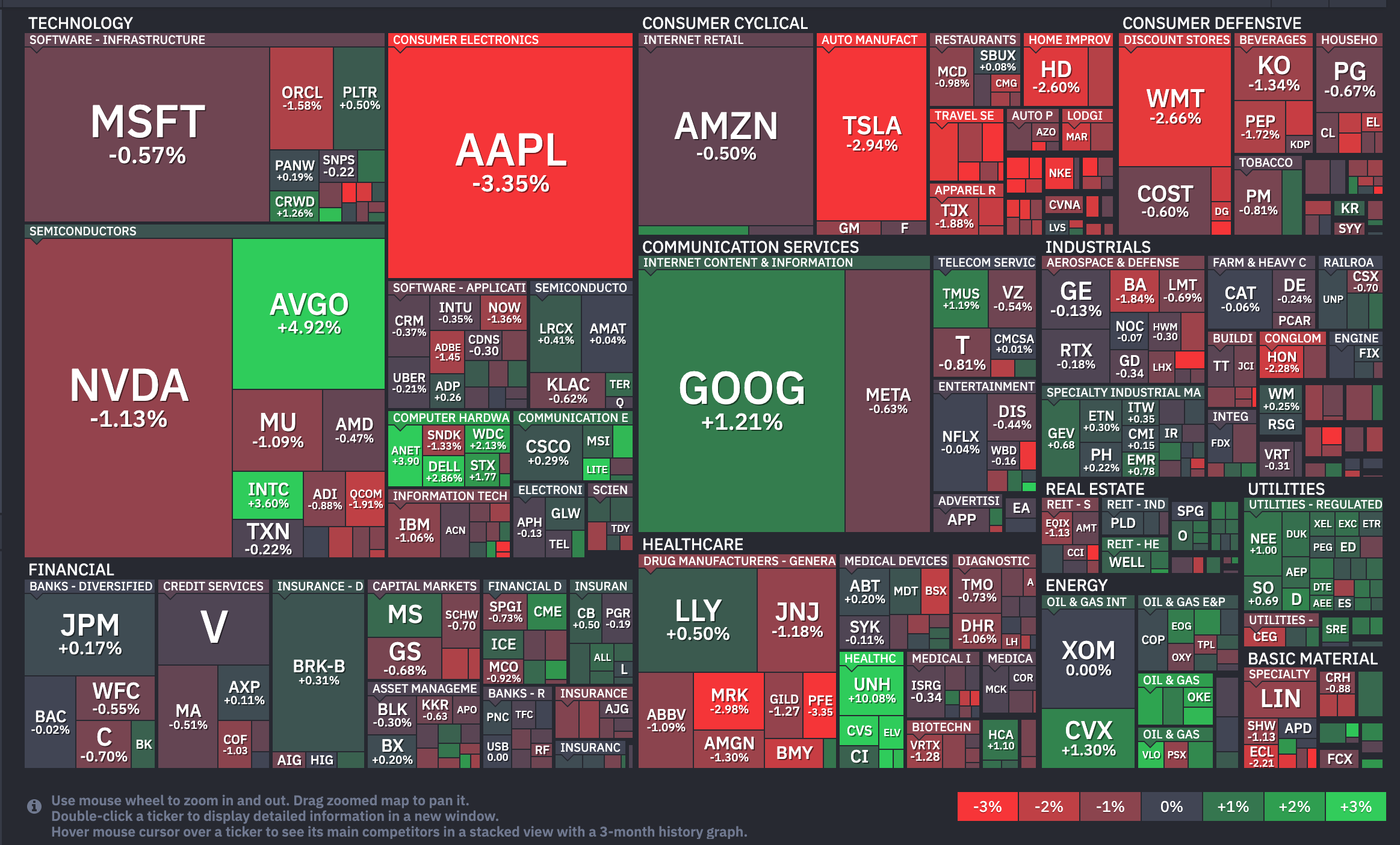
Apple (AAPL) shares experienced a decline of 3.35% following a Nikkei Asia report indicating engineering challenges with its foldable iPhone, potentially delaying production timelines. Given Apple’s substantial weighting in the S&P 500 index, a nearly 4% drop in its stock price has a significant, mechanical impact on the index’s overall performance.
Apple shares sink 4% on report of foldable iPhone delays
Major US Index Performance
As of the latest reporting, all four major US stock indexes were trading in negative territory.
- The S&P 500 saw a decline of 28.89 points (−0.44%), closing at 6,582.94. The index had previously fallen over 1% during the trading session before partially recovering.
- The Dow Jones Industrial Average dropped 244.33 points (−0.52%) to 46,425.60.
- The Nasdaq Composite decreased by 141.40 points (−0.64%), reaching 21,854.90.
The Russell 2000 also registered a loss, slipping 0.85 points (−0.34%) to 251.51, indicating that weakness in small-cap stocks mirrored the broader market trend.
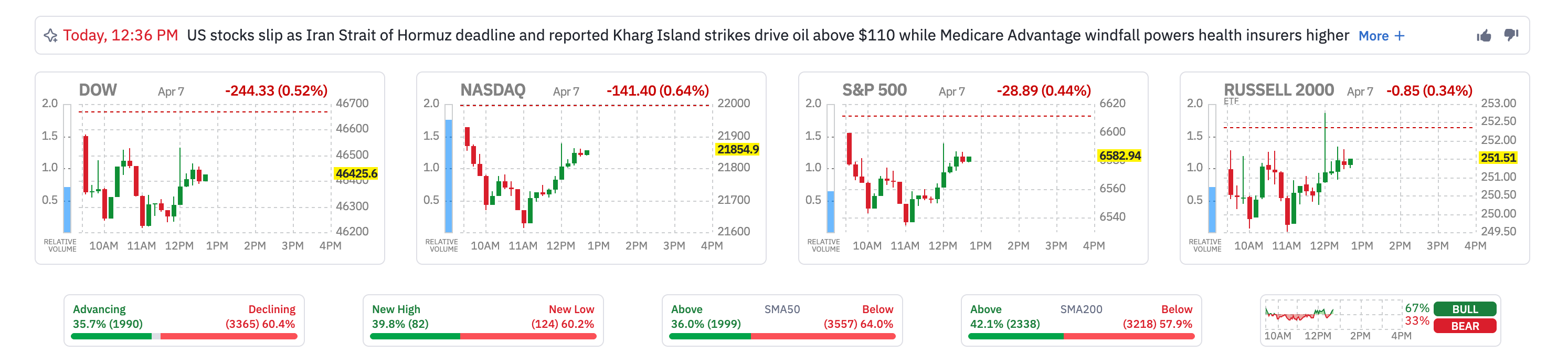
Market breadth analysis showed a predominantly negative sentiment, with 3,365 stocks declining (60.4%) compared to 1,990 advancing stocks (35.7%).
On the daily chart, the S&P 500 is trading around the 6,580 level, encountering resistance near two converging Exponential Moving Averages (EMAs). The 20-day EMA is positioned at 6,601, and the 200-day EMA at 6,587. This tight compression between short-term and long-term EMAs suggests a lack of clear directional conviction in the market, awaiting a significant catalyst for resolution.
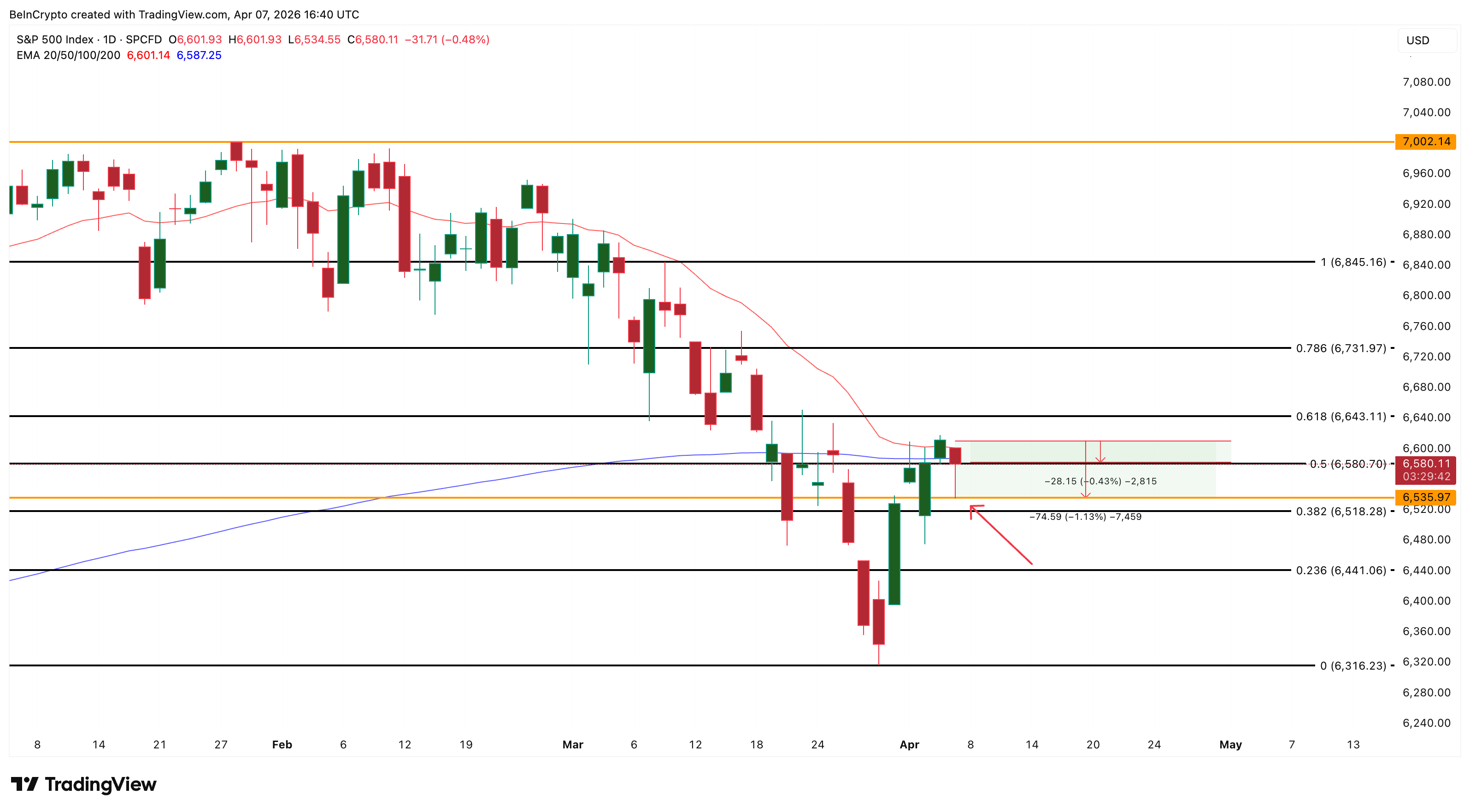
The intraday low of 6,534 found initial support near the 0.382 Fibonacci retracement level at 6,518. A sustained close below this level could open the door for further declines towards 6,441 and the previous swing low at 6,316.
Conversely, for the market to demonstrate recovery strength, a daily close above 6,643 would be necessary, with 6,845 serving as the subsequent resistance target.
Sector Performance Analysis
Sectors Showing Resilience
The Energy sector led gains, increasing by +0.54%, as WTI crude prices remained above the $115 mark. This sector continues to benefit structurally from the geopolitical situation, as higher oil prices directly translate into increased revenues for producers.
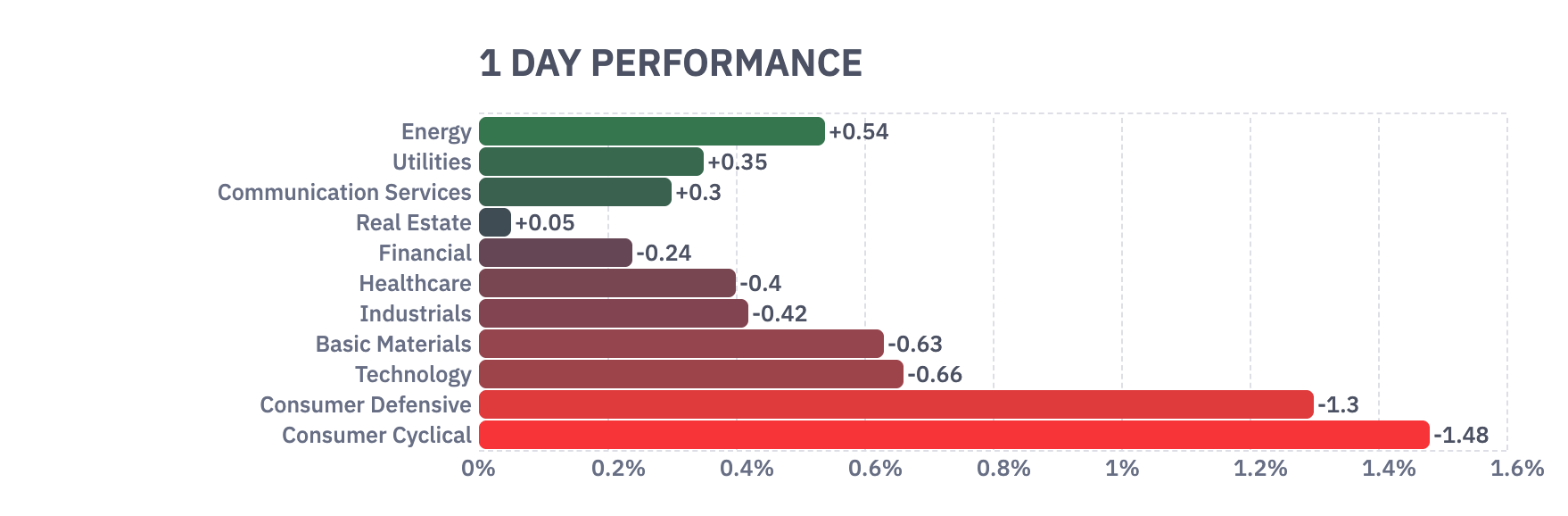
Utilities added +0.35%, reflecting continued defensive positioning by investors. Amid rising risk aversion, the sector’s traditional sensitivity to interest rates is being overshadowed by its appeal as a safe haven for capital seeking yield, despite broader rate concerns.
Communication Services saw a modest gain of +0.30%, supported by a 1.21% increase in Google (GOOG) stock.
Sectors Experiencing Declines
Consumer Cyclical stocks registered the most significant losses, down 1.48%. Elevated oil prices are compressing consumer discretionary spending power due to higher fuel and transportation costs. Notable decliners included Tesla (TSLA) down 2.94%, Home Depot (HD) down 2.60%, and Walmart (WMT) down 2.66%.
Consumer Defensive stocks also declined by 1.30%. This unusual downturn for a traditionally safe sector suggests that selling pressure is widespread, impacting even conservative holdings. Coca-Cola (KO) fell 1.34%, and Procter & Gamble (PG) dropped 0.67%.
The Basic Materials sector declined by 0.63%, despite gold prices holding above $4,400. This indicates that commodity-linked equities are not entirely insulated from the broader market sell-off.
Key Corporate Developments
Broadcom (AVGO) shares surged by 4.92% following reports that Anthropic has entered into an agreement with Google and Broadcom to secure multiple gigawatts of next-generation TPU capacity, commencing in 2027.
This deal underscores the persistent strength in demand for Artificial Intelligence (AI) infrastructure, suggesting that companies directly involved in capacity expansion can potentially overcome macroeconomic headwinds.
We’ve signed an agreement with Google and Broadcom for multiple gigawatts of next-generation TPU capacity, coming online starting in 2027, to train and serve frontier Claude models.
UnitedHealth Group (UNH) saw a significant rise of 10.08%, driven by news related to Medicare Advantage payouts. This surge made it the top-performing stock within the S&P 500 for the day and provided support to the Healthcare sector, preventing a steeper decline.
Investor Outlook and Upcoming Catalysts
Former President Trump’s self-imposed Tuesday deadline for Iran to reopen the Strait of Hormuz is imminent. Any indication of Iranian compliance or a negotiated resolution could lead to a sharp decrease in oil prices, potentially boosting equities by Wednesday.
Conversely, if the deadline passes without resolution and strikes on Iranian energy infrastructure commence, WTI crude could experience further price increases. Such a scenario would intensify the pressure from oil prices, inflation, and interest rates, potentially driving the 10-year yield to new highs and bringing the S&P 500’s 6,316 swing low into sharp focus.
The release of the March CPI data on Friday is another critical event. A higher-than-expected print would reinforce the “higher for longer” interest rate narrative, while a softer number could provide some relief to growth stocks.
The confluence of the Iran deadline and the CPI data makes this week particularly significant for the US stock market, presenting a dense schedule of potential market-moving events.
Original article : beincrypto.com