

NYT Investigation Points to Adam Back as Satoshi Nakamoto
The New York Times published a year-long investigation on April 8, arguing that Blockstream CEO Adam Back, 55, is the most likely candidate for Bitcoin creator Satoshi Nakamoto. The findings are based on writing analysis and archival research spanning 34,000 mailing list users.
Back, a British cryptographer recognized for inventing the Hashcash proof-of-work system referenced in Bitcoin’s white paper, has denied the allegations, attributing the evidence to coincidence.
- NYT’s Carreyrou spent a year analyzing writing from 34,000 mailing list users to identify Satoshi.
- Three separate writing analyses narrowed the candidate pool to one person: Adam Back.
- Back denied the claims, citing coincidence, but refused to share key email metadata.
How the NYT Built Its Case Against Adam Back
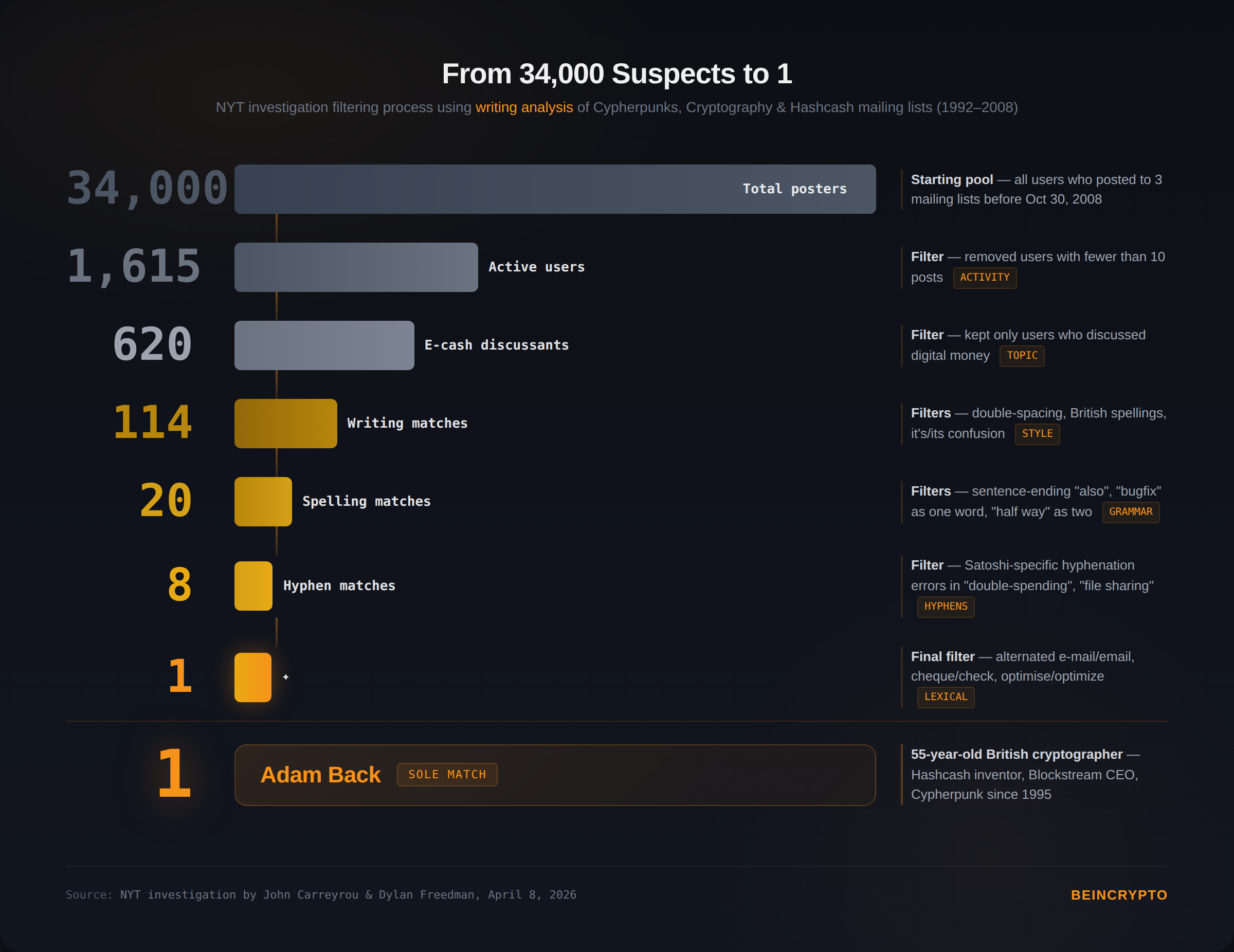
Reporter John Carreyrou, known for his Theranos investigation, dedicated over a year to analyzing Satoshi’s known writings alongside thousands of posts from three cryptography mailing lists active between 1992 and 2008. With the assistance of AI projects editor Dylan Freedman, the team compiled a database of 134,308 posts from 620 candidates who had discussed digital money on the Cypherpunks, Cryptography, and Hashcash lists.
The investigation employed three distinct writing analyses, all of which identified Back as the closest match to Satoshi’s writing style. One analysis focused on grammatical idiosyncrasies, identifying 325 distinct hyphenation errors in Satoshi’s corpus, with Back sharing 67 of them – significantly more than the second-closest match who had 38.
A filtering process that screened for traits such as British spellings, double-spacing between sentences, specific hyphenation patterns, and alternating usage of terms like “e-mail” and “email” effectively narrowed the pool from 620 potential suspects down to a single individual: Adam Back.
The Technical and Behavioral Overlap
The investigation highlighted a significant technical overlap, noting that Back had outlined nearly every core Bitcoin feature on the Cypherpunks list between 1997 and 1999, a full decade before Satoshi published the whitepaper. In these posts, Back proposed a decentralized electronic cash system with built-in privacy for both payer and payee, intrinsic scarcity, a lack of trust requirement, and a publicly verifiable protocol.
Furthermore, he suggested combining his Hashcash invention with Wei Dai’s b-money concept, a combination precisely mirrored in Satoshi’s approach to building Bitcoin. The behavioral patterns also drew scrutiny. Back was a regular participant in electronic cash discussions on these mailing lists for over a decade. However, his activity ceased following Satoshi’s announcement of Bitcoin in late 2008. He did not publicly comment on Bitcoin until June 2011, six weeks after Satoshi’s disappearance from public view.
Back later claimed on a podcast to have participated in the 2008 discussion sparked by Satoshi’s white paper, a claim for which the NYT found no supporting evidence in the mailing list archives.
Back Denies the Claims, Cites Confirmation Bias
Reporter Carreyrou confronted Back in person at a Bitcoin conference in El Salvador in January 2026. During a two-hour meeting, Back repeatedly denied being Satoshi Nakamoto.
“It’s not me, but I take what you’re saying that this is what the A.I. said with the data. But it’s still not me,” wrote Back in a post.
However, the reporter noted what he interpreted as a verbal slip when Back responded to Carreyrou mentioning Satoshi’s quote about being “better with code than with words,” as if he himself had written it.
In a separate response posted on X (formerly Twitter) on April 8, Back attributed the perceived overlap to confirmation bias. He argued that his extensive posting history on the Cypherpunks list made it statistically probable for him to appear in searches related to electronic cash.
i’m not satoshi, but I was early in laser focus on the positive societal implications of cryptography, online privacy and electronic cash, hence my ~1992 onwards active interest in applied research on ecash, privacy tech on cypherpunks list which led to hashcash and other ideas.
— Adam Back (@adam3us) April 8, 2026
He also posited that Satoshi’s anonymity served a strategic purpose, helping Bitcoin to be perceived as a novel asset class.
The timing of these revelations is particularly noteworthy. Back currently serves as CEO of Bitcoin Standard Treasury Company (BSTR), an entity holding over 30,000 BTC. The company is awaiting shareholder approval for a SPAC merger with Cantor Equity Partners.
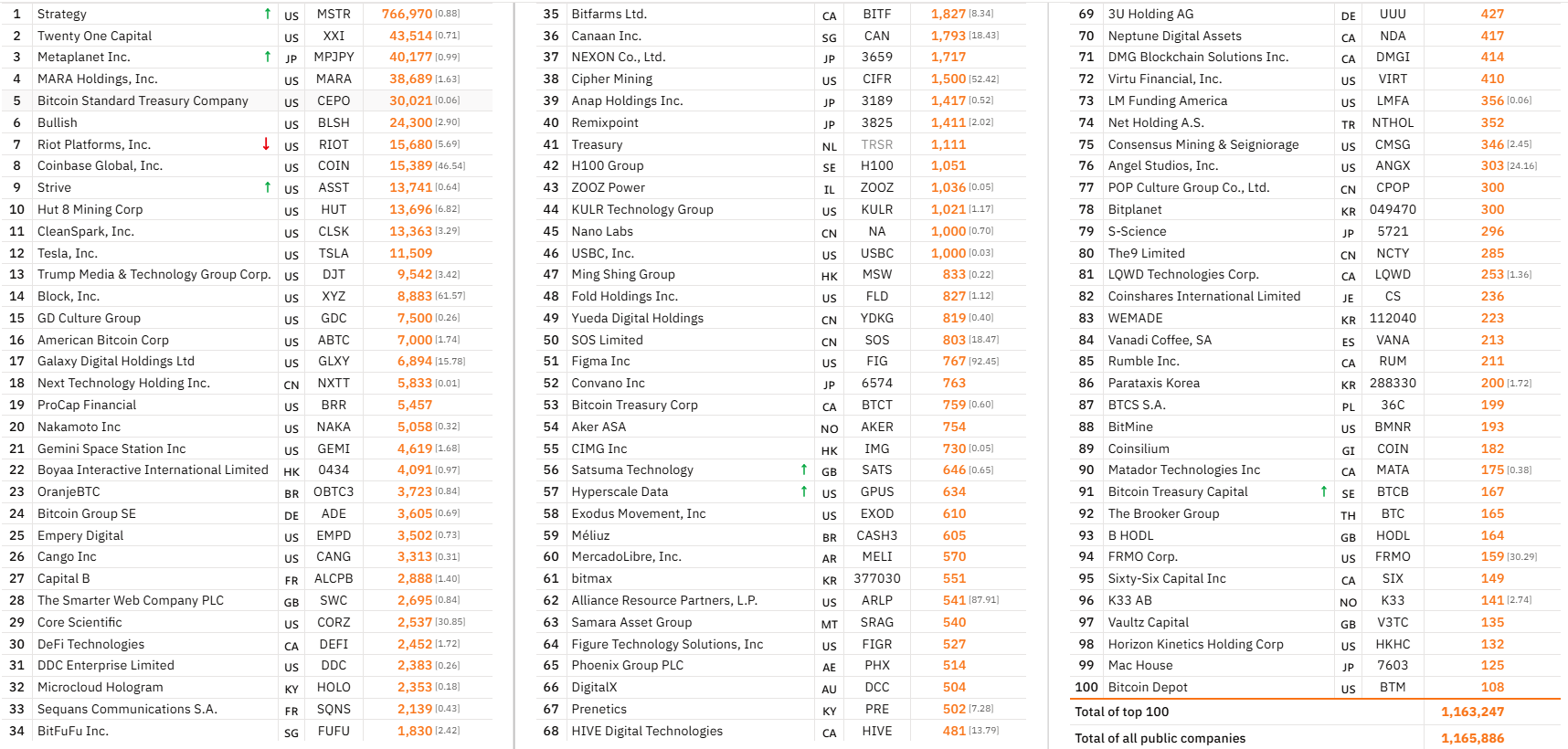
Under U.S. securities law, a confirmed identity as Satoshi, with access to an estimated 1.1 million BTC valued at over $78 billion, could be considered material information requiring disclosure.
Stylometry expert Florian Cafiero, who previously assisted the NYT in identifying the authors of QAnon in 2022, found Back to be the closest match to Satoshi’s white paper in one of his analyses. However, he ultimately deemed the result inconclusive, with Hal Finney identified as a close second.
Without a definitive cryptographic signature from Satoshi’s known wallets, the question of his true identity remains open to speculation.
Details can be found on the website : beincrypto.com