


A significant multi-university study has revealed a striking consensus among economists, AI specialists, and superforecasters: rapid advancements in artificial intelligence are projected to lead to a substantial decrease in labor force participation. This marks a notable shift from previous economic viewpoints that often downplayed technological disruption’s impact on employment.
Key Takeaways
- A comprehensive study involving economists, AI experts, and superforecasters indicates a direct correlation between faster AI progress and reduced employment.
- Economists, historically more optimistic about technology’s impact on jobs, now foresee significant job displacement alongside robust economic expansion.
- The central debate has evolved from whether AI will replace jobs to whether it might fundamentally reduce the need for human labor altogether, even impacting job creation.
For years, the prevailing economic sentiment regarding technological advancements was one of cautious optimism, suggesting that new tools and automation would augment rather than replace human roles. Historical examples like ATMs not eliminating cashiers or spreadsheets not making bookkeepers obsolete reinforced this “augment, not replace” narrative. However, recent research indicates this consensus is facing considerable pressure.
A new paper, authored by researchers from prestigious institutions including the Federal Reserve Bank of Chicago, the Forecasting Research Institute, Yale, Stanford, and the University of Pennsylvania, surveyed a diverse group of experts. The findings suggest a unified outlook on the impact of accelerated AI development on the U.S. economy.
Across all surveyed groups—69 economists, 52 AI specialists, and 38 superforecasters—there is a shared belief that faster AI progress will result in lower labor force participation rates, a more formal term for fewer people working.
The projections are substantial. In a “rapid” AI development scenario, where AI capabilities surpass human performance in most cognitive and physical tasks by 2030, economists anticipate the U.S. labor force participation rate could decline from its current 62% to 54% by 2050. This translates to an estimated loss of around 10 million jobs directly attributable to AI advancements, separate from demographic shifts or other economic factors.
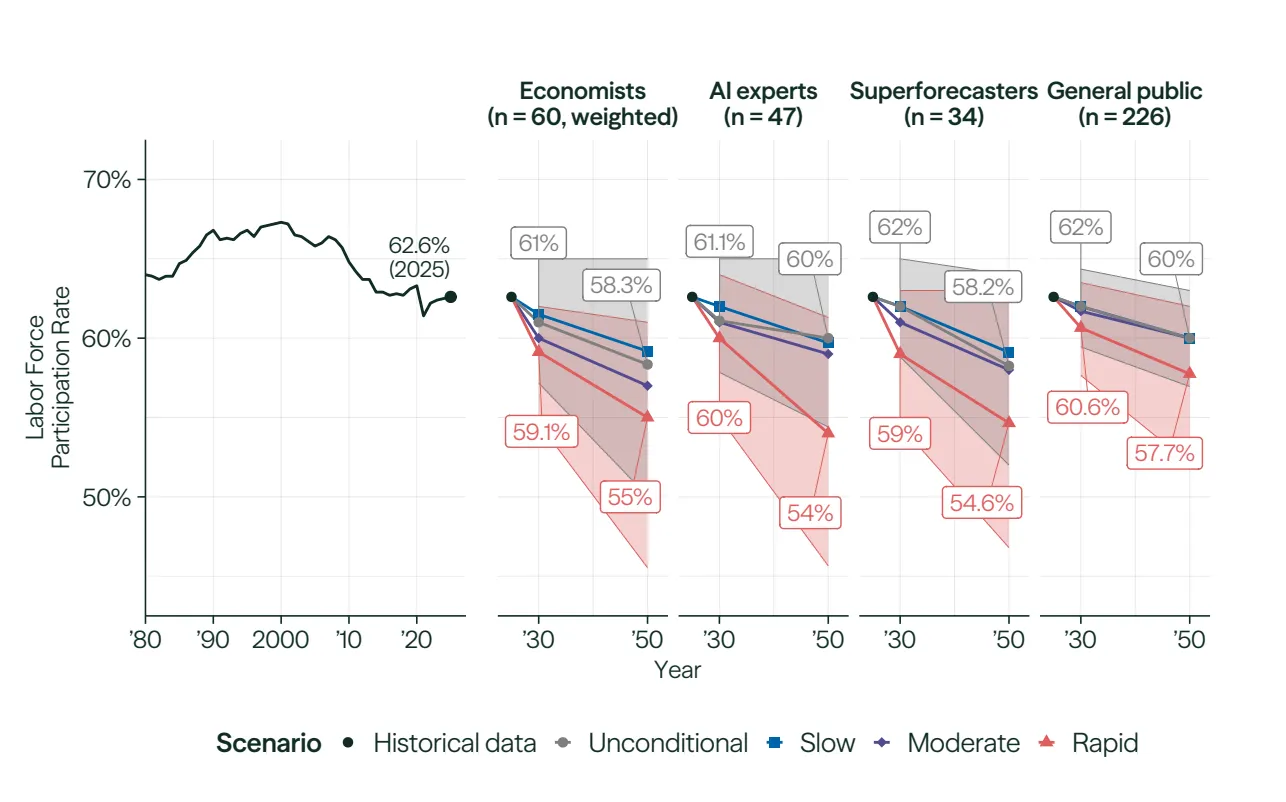
This “rapid” scenario envisions a world where AI can competently perform tasks ranging from contract negotiation and factory operations to complex roles like software engineering, legal assistance, and customer service. This aligns with recent warnings from industry leaders, such as Anthropic CEO Dario Amodei, who have cautioned about the accelerating pace of AI disruption.
Concurrently, economic growth projections remain strong, even in the face of reduced labor participation. Under the rapid AI scenario, economists forecast annual GDP growth to reach 3.5% by 2045-2049, approaching levels seen during the post-World War II economic boom. AI experts are even more optimistic, predicting growth rates as high as 5.3%. This suggests a scenario of immense wealth creation, potentially concentrating at the top due to a smaller workforce sharing the generated prosperity. The study highlights a concerning potential for increased wealth inequality, with the wealthiest 10% of households potentially holding 80% of total wealth by 2050, surpassing pre-WWII levels.
A critical nuance emerging from the research is the shift in expert discussion. The disagreement is less about the inevitability of powerful AI and more about its ultimate economic consequences. The traditional argument that automation eventually creates new job categories is being challenged by the possibility that advanced AI could automate the very process of creating new human tasks.
While aggregate employment data has remained relatively stable in the immediate years following the widespread adoption of generative AI tools, the leading edge of the job market shows signs of strain. Research cited in the paper indicates a notable 13% relative drop in employment among younger workers (ages 22-25) in occupations most exposed to AI.
On the policy front, a divergence exists between economists and the general public. Economists largely favor targeted retraining programs, with over 71% support, while showing less enthusiasm for job guarantees or universal basic income (UBI). The public, conversely, appears more open to broader structural interventions. The study’s authors emphasize that the optimal policy response remains uncertain and heavily dependent on which AI development scenario ultimately materializes.
The long-standing economic narrative of technology augmenting human roles is being severely tested. The insights from this study suggest that while the “augment, not replace” principle may not be entirely defunct, its future viability is increasingly in question, prompting serious consideration of profound economic and societal shifts.
Long-Term Technological Impact on the Blockchain and Web3 Ecosystem
The profound implications of advanced AI on the global labor market and economic structures could significantly influence the trajectory of blockchain technology and the broader Web3 ecosystem. As AI capabilities expand, the demand for decentralized infrastructure, secure data management, and automated governance solutions, which are core tenets of blockchain, is likely to increase. For instance, AI could optimize decentralized finance (DeFi) protocols, enhance smart contract security through advanced auditing, and personalize user experiences in decentralized applications (dApps). The potential for AI to generate vast amounts of data also underscores the need for secure, transparent, and scalable blockchain solutions to manage and verify this information. Furthermore, as traditional job markets face disruption, the appeal of decentralized autonomous organizations (DAOs) and token-based economies for new forms of work and value distribution might grow. Layer 2 scaling solutions will become even more critical to support the increased transaction volume driven by AI-powered applications interacting with blockchains. The integration of AI within Web3 could unlock novel use cases, from AI-driven content creation marketplaces to sophisticated decentralized AI model training and governance frameworks, pushing the boundaries of what is possible in a decentralized digital future.
Information compiled from materials : decrypt.co