

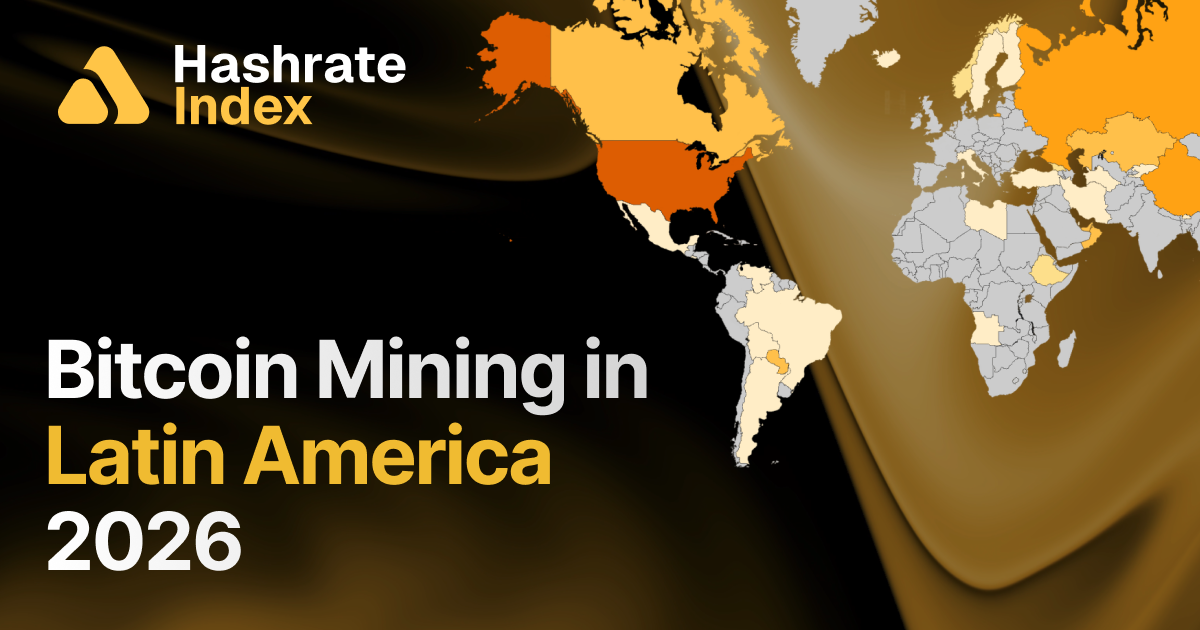
Latin America possesses significant renewable energy resources that could position it as a major global hub for Bitcoin mining operations, yet its current contribution to the global hash rate remains comparatively small. The region boasts abundant hydroelectric power from sources like the Paraná River and the Itaipú Dam, shale gas reserves in Argentina’s Vaca Muerta, and geothermal potential in Central America. Furthermore, several countries offer competitive industrial electricity rates, theoretically ideal for energy-intensive mining activities.
Despite this potential, Latin America collectively accounts for approximately 5-6% of the global Bitcoin mining hash rate. In contrast, the United States alone commands 37.4%, as indicated by recent hash rate distribution data. This disparity between energy capacity and actual mining output is a defining characteristic of Bitcoin mining within the region, prompting an examination of the factors influencing its development.
Key Takeaways
- Paraguay is currently the most significant Bitcoin mining market in Latin America, contributing approximately 4.3% of the global hash rate, largely due to exceptionally low electricity costs derived from the Itaipu Dam.
- Brazil is showing substantial growth in its mining sector, with a significant year-over-year increase in hash rate, potentially driven by market deregulation that favors large energy consumers.
- Bolivia experienced an extraordinary surge in mining activity attributed to subsidized natural gas for power generation, but this trend is anticipated to reverse as these subsidies are temporary.
- Argentina, despite possessing strong energy assets like the Vaca Muerta shale gas, has seen a decline in its mining hash rate, primarily due to macroeconomic instability, although recent deregulation efforts could alter this trajectory.
- Venezuela and El Salvador have minimal current mining contributions but present unique long-term opportunities related to stranded hydroelectric and flared gas resources, and geothermal expansion, respectively.
- The recent global downturn in mining profitability highlighted the difference between sustainable mining operations in regions with consistently low energy costs, such as Paraguay, and more speculative arbitrage-driven activities, as seen in Bolivia’s rapid but short-lived expansion.
Impact on Network Security and Miner ROI
The global Bitcoin mining hash rate saw a decrease in Q2 2026, falling to 1,004 EH/s from 1,066 EH/s in the preceding quarter. This contraction was primarily a response to a significant drop in Bitcoin’s price, which compressed the hashprice to near all-time lows of $27.89 per PH/s per day. Consequently, approximately 252 EH/s of older mining hardware, characterized by energy efficiencies exceeding 25 J/TH, became unprofitable and were taken offline. This dynamic directly impacts miner Return on Investment (ROI), forcing operators to reassess the viability of their existing ASIC and GPU fleets. Smaller miners, often operating with less efficient hardware or on tighter margins, are disproportionately affected, potentially leading to a consolidation of mining power among larger, more efficient industrial farms with access to cheaper energy and newer generation ASICs.
The concentration of hash rate among a few dominant countries – the United States (37.4%), Russia (16.9%), and China (12.0%) – underscores the importance of energy infrastructure and regulatory environments in sustaining large-scale mining operations. The emergence of Paraguay at #4 globally with 4.3% (~43 EH/s) illustrates how access to low-cost, stable energy, such as the hydro surplus from the Itaipú Dam at approximately $0.037–0.050/kWh, can dramatically alter a nation’s position in the mining landscape. This has direct implications for network security, as a more geographically distributed hash rate can enhance decentralization and resilience against single points of failure. However, the current dominance of a few jurisdictions also raises concerns about potential censorship or regulatory influence. For industrial mining farms, the key to sustained ROI lies in securing long-term, low-cost energy contracts and investing in the most efficient ASIC miners available to withstand periods of price volatility and increasing network difficulty.
Information compiled from materials : hashrateindex.com