

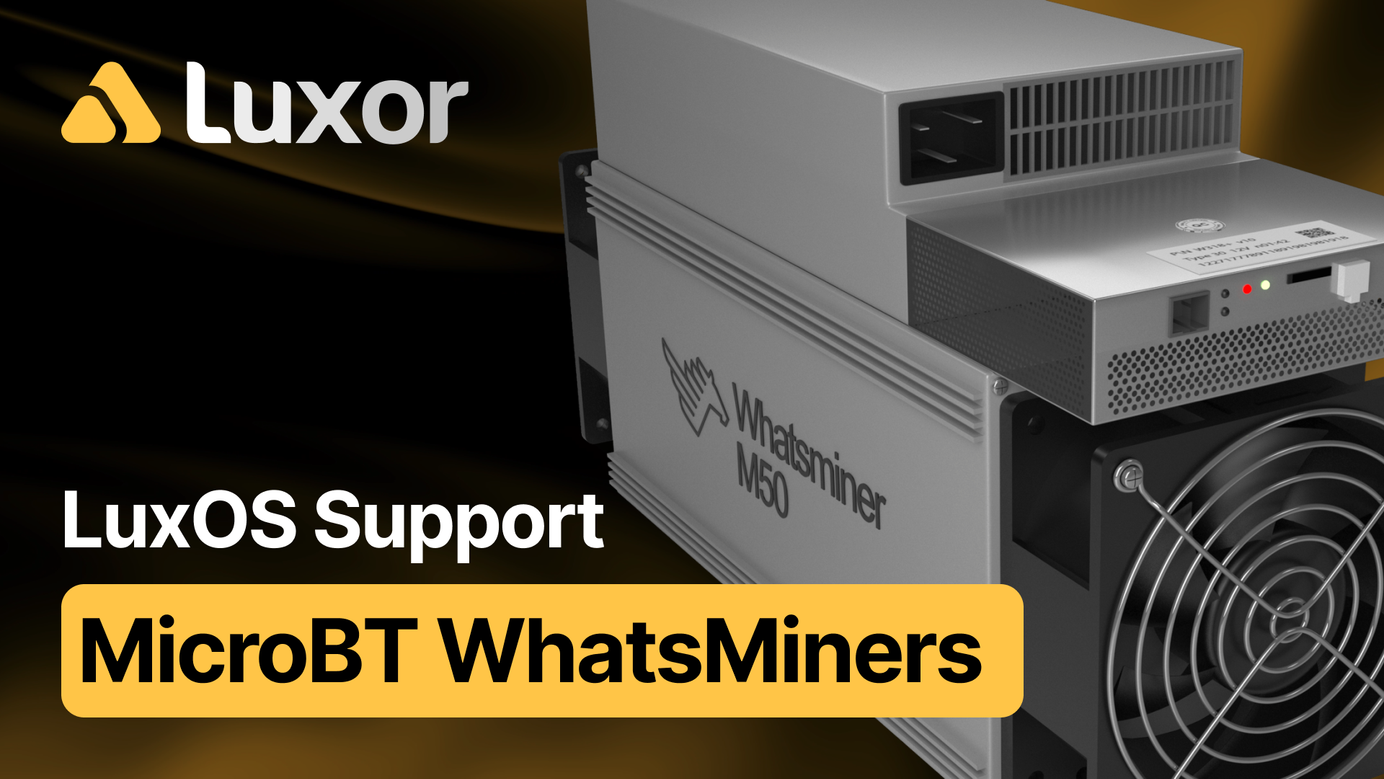
Luxor Technology Corporation has announced a significant expansion of its proprietary firmware, LuxOS, to include MicroBT’s WhatsMiner hardware. This marks a pivotal moment, extending LuxOS beyond its established presence on Bitmain Antminer machines and enabling its deployment on a new ASIC architecture. Previously exclusive to a single original equipment manufacturer (OEM), LuxOS is now transitioning into a multi-OEM platform, aiming to support over 300,000 machines and more than 35 exahashes per second (EH/s) globally.
The initial rollout focuses on the WhatsMiner M50 series, with plans to incorporate additional models, including the M60 and M60S, in subsequent phases. This phased approach is designed to ensure product quality through rigorous validation in diverse, real-world operational conditions and to provide dedicated support to early adopters. Unlike a broad public release, onboarding is managed directly by Luxor’s firmware team, starting with a select group of partner operations. This controlled deployment allows for detailed data collection and product hardening, ensuring a robust experience for WhatsMiner operators.
Key Takeaways
- LuxOS firmware is now compatible with MicroBT WhatsMiner hardware, expanding Luxor’s reach beyond Bitmain.
- The initial launch supports the WhatsMiner M50 series, with broader model compatibility to follow.
- Onboarding is capacity-gated and managed directly by Luxor’s firmware team for initial partner operations.
- New features for WhatsMiner operators include Advanced Thermal Management (ATM), fast hashrate ramp, safe rapid curtailment, dynamic power targeting, and integration with the Luxor ecosystem.
- This development signifies a strategic shift for LuxOS from a single-OEM product to a multi-OEM mining software solution.
This strategic move introduces five core functionalities that are entirely new for WhatsMiner operators. These advancements aim to enhance operational efficiency, improve hardware longevity, and unlock new revenue streams, particularly for large-scale mining farms and operations involved in grid-balancing or demand-response programs.
Impact on Network Security and Miner Profitability
The expansion of advanced firmware like LuxOS to a broader range of mining hardware has multifaceted implications. From a network security perspective, increased software sophistication can lead to more stable and efficient mining operations. Features like Advanced Thermal Management (ATM) and dynamic power targeting can reduce downtime and prevent thermal throttling, ensuring consistent hash rate contribution to the network. This stability is crucial for maintaining the integrity and security of the blockchain. For miners, especially industrial-scale operations, the enhanced control and optimization offered by LuxOS can directly translate to improved profitability. Faster hashrate ramp times and safe, rapid curtailment reduce revenue loss during grid events. Dynamic power targeting allows for more granular control over energy consumption in response to real-time energy prices or hashprice fluctuations. While these advanced features are primarily geared towards large industrial farms that can leverage the full suite of capabilities, the underlying improvements in stability and efficiency could indirectly benefit smaller miners by contributing to a more robust and secure network.
1. Advanced Thermal Management (ATM)
WhatsMiner hardware, particularly in environments with fluctuating ambient temperatures, has often faced challenges with thermal stability. Stock firmware typically employs a binary response to heat: either operate within a set profile or switch to a low-power mode or shut down entirely when internal sensors are tripped. LuxOS’s ATM introduces a continuous, progressive adjustment mechanism. By constantly monitoring thermal conditions, the firmware dynamically modulates the operating profile, allowing for overclocking when thermal headroom is available and progressively underclocking when conditions demand it. This approach aims to minimize hashrate loss due to thermal-induced shutdowns and enhance hardware longevity by keeping machines within a safe operational envelope. This feature is particularly valuable for off-grid operations or those in regions with significant temperature variations.
2. Fast Hashrate Ramp
For mining operations that engage in curtailment strategies, such as participating in demand-response programs or managing energy consumption against fluctuating prices, the time it takes for a machine to return to its target hashrate after a pause is a direct determinant of lost revenue. Stock WhatsMiner firmware initiates a conservative ramp-up process. LuxOS accelerates this transition, enabling machines to reach their target hashrate more quickly. This compressed ramp time translates into recovered hashrate and, consequently, improved revenue for operations that frequently cycle their fleets.
3. Safe Rapid Curtailment
Frequent curtailment cycles can place significant stress on ASIC hardware. Stock firmware may exhibit inconsistent ramp behavior and lack a truly safe idle state, making frequent shutdowns and restarts a managed risk for operators involved in grid programs. LuxOS facilitates a safer and more repeatable curtailment process. Machines can be quickly brought down to an ultra-low idle power state without causing stress, remain in this state indefinitely, and then reliably ramp back to full operational capacity upon command. This enhanced reliability transforms curtailment from a risk-mitigation strategy into a viable operational tool, crucial for compliance with energy contracts and participation in grid-interactive initiatives.
4. Dynamic Power Targeting
A notable limitation of stock WhatsMiner firmware is the requirement for a reboot and retune cycle whenever a machine’s power target needs to be adjusted. While this constraint is often unnoticeable during steady-state operation, it becomes a significant drawback for operations that need to dynamically adjust power consumption in response to real-time hashprice signals, intraday energy price volatility, or grid-balancing events. Each adjustment necessitates a costly reboot. LuxOS’s Dynamic Power Targeting eliminates this bottleneck. Operators can set a desired wattage target, and the firmware will continuously adjust frequency and voltage to maintain that target without requiring a reboot or retune. This capability unlocks practical workflows for demand charge avoidance, interval-based energy trading, and real-time load management, enabling selective demand response without compromising subsequent uptime.
5. Access to the Luxor Ecosystem
The integration of LuxOS onto WhatsMiner hardware serves as an entry point to Luxor’s comprehensive full-stack mining platform. Operators can leverage this unified system for fleet management through Commander, automated profitability optimization, hashprice and capital hedging via Fixed and Upfront Payouts on Luxor Pool, hardware trading and upgrades through Luxor’s Hardware desk, and power procurement via Luxor Energy. This consolidation offers a significant advantage for operators who have traditionally pieced together services from multiple vendors, providing a streamlined and integrated approach to mining operations.
The primary beneficiaries of this release are fleet operators managing substantial WhatsMiner M50 hardware deployments, especially those involved in grid programs or operating in variable thermal conditions. Mixed-fleet operations that currently utilize both Bitmain and MicroBT hardware are also a key target audience, as LuxOS now enables unified firmware management across different ASIC manufacturers. Additionally, hosting providers managing multi-tenant data center environments stand to gain from the standardized control and optimization capabilities.
Future developments will focus on expanding the range of supported WhatsMiner models, further validating data across diverse operational deployments, and continuing product iteration based on field feedback. Interested WhatsMiner operators are encouraged to express their interest in LuxOS access via luxor.tech/firmware.
About Luxor Technology Corporation
Luxor Technology Corporation provides a suite of hardware, software, and financial services tailored for the global compute and energy sectors. Their offerings encompass Bitcoin Mining Pools, ASIC Firmware, Hardware trading, Hashrate Derivatives, Energy services, the Miner Management software “Commander,” and the Bitcoin mining data platform “Hashrate Index.”
Information compiled from materials : hashrateindex.com