


April 2026 marked a shift in Bitcoin mining economics, exhibiting a modest recovery in hashprice and a stabilization of network difficulty after a period of significant fluctuation. This report details the key market activities, including hashrate trends, forward market participation, and trading dynamics, offering insights into the operational landscape for both industrial mining farms and smaller-scale operations.
Key Takeaways
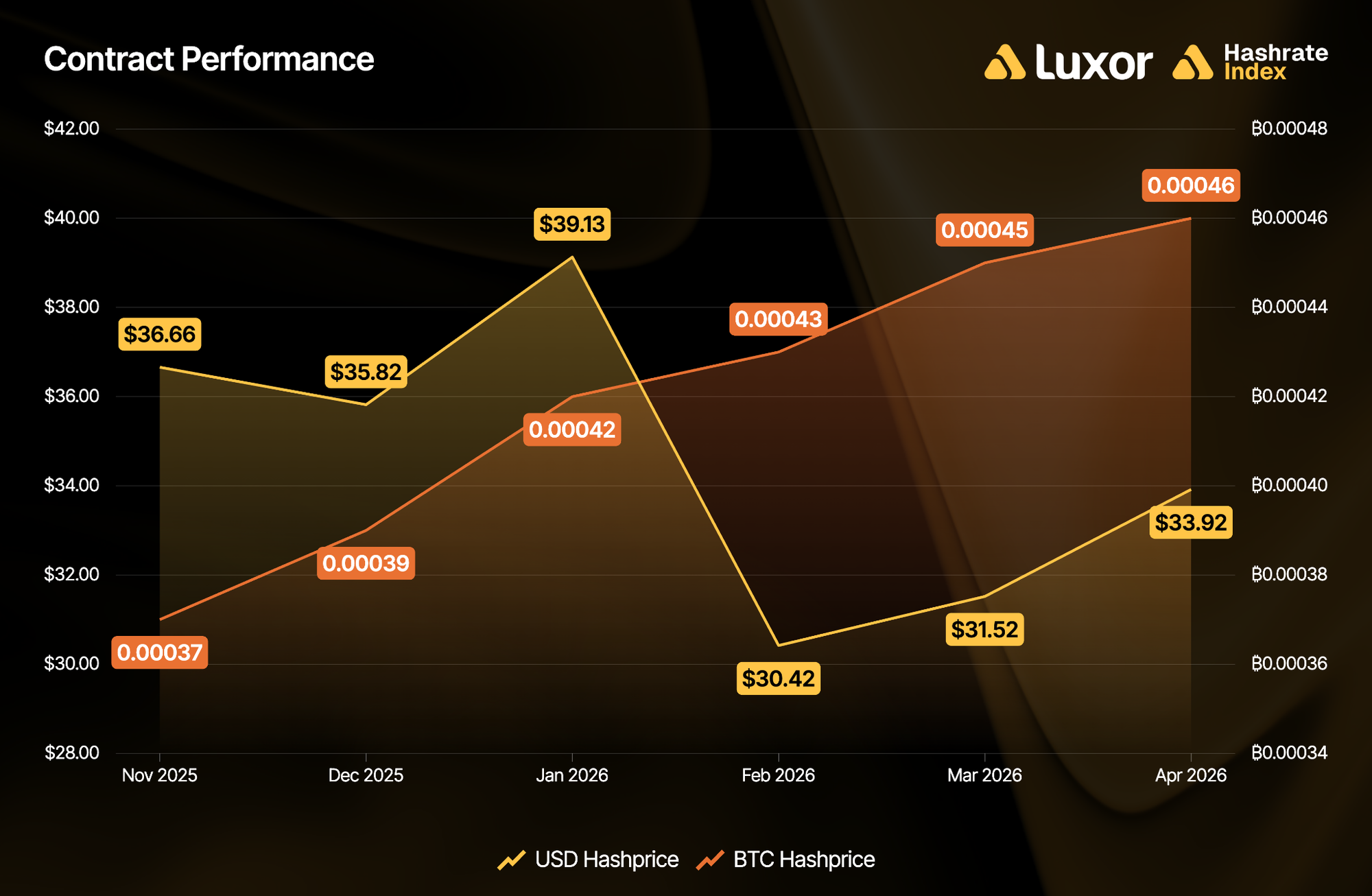
- The monthly average USD hashprice saw an increase of 8.5% to $33.92 per PH/s/day, breaking a streak of declines.
- Network difficulty remained below the 1 ZH/s threshold for four consecutive epochs, indicating that hashrate offline during lower revenue periods has not yet returned.
- Hedging strategies yielded mixed results: USD-denominated forward sellers captured premiums for longer-term contracts but experienced losses on shorter terms due to BTC price recovery.
- BTC-denominated buyers consistently outperformed, driven by ongoing reductions in network difficulty.
- Forward market curves were repriced higher, reflecting an anticipation of BTC price recovery, though market expectations for hashrate growth remained subdued.
April 2026 Spot Hashprice and Market Drivers
The overall mining economy experienced a positive turn in April 2026. The average USD hashprice rose by 8.5% to $33.92 per PH/s/day, the first monthly increase since February. This rebound was primarily supported by a 5.6% rise in the average BTC price to $73,507 and a decrease in network difficulty by 2.7% to 137.07 TH. Consequently, BTC hashprice also saw a modest gain of 2.7% to 0.00046 BTC per PH/s/day.
The BTC price itself experienced an 11.4% rally throughout April, closing at $76,120, its highest level since early February. This performance closely mirrored the broader equity market, particularly the tech and semiconductor sectors, which saw significant gains driven by strong earnings and forward-looking guidance. This correlation suggests a market sentiment shifting towards risk-on assets, which has a direct impact on Bitcoin’s valuation and, subsequently, mining revenue.
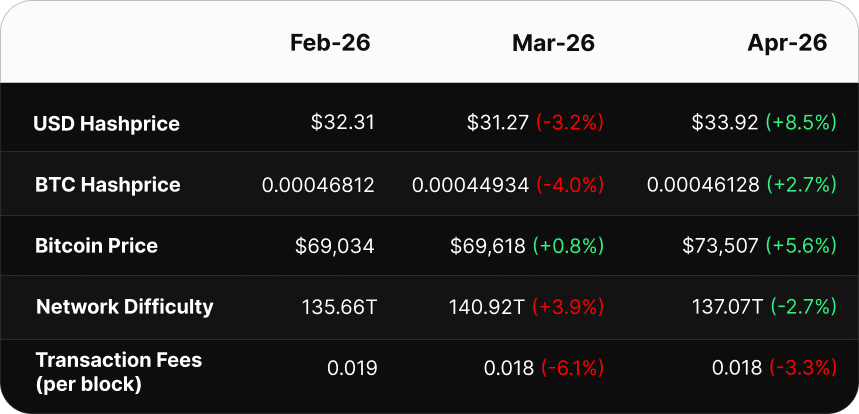
Despite the positive price action, BTC remained approximately 40% below its October 2025 peak, indicating that the market is still working through previous drawdowns.
Network Difficulty Stabilization
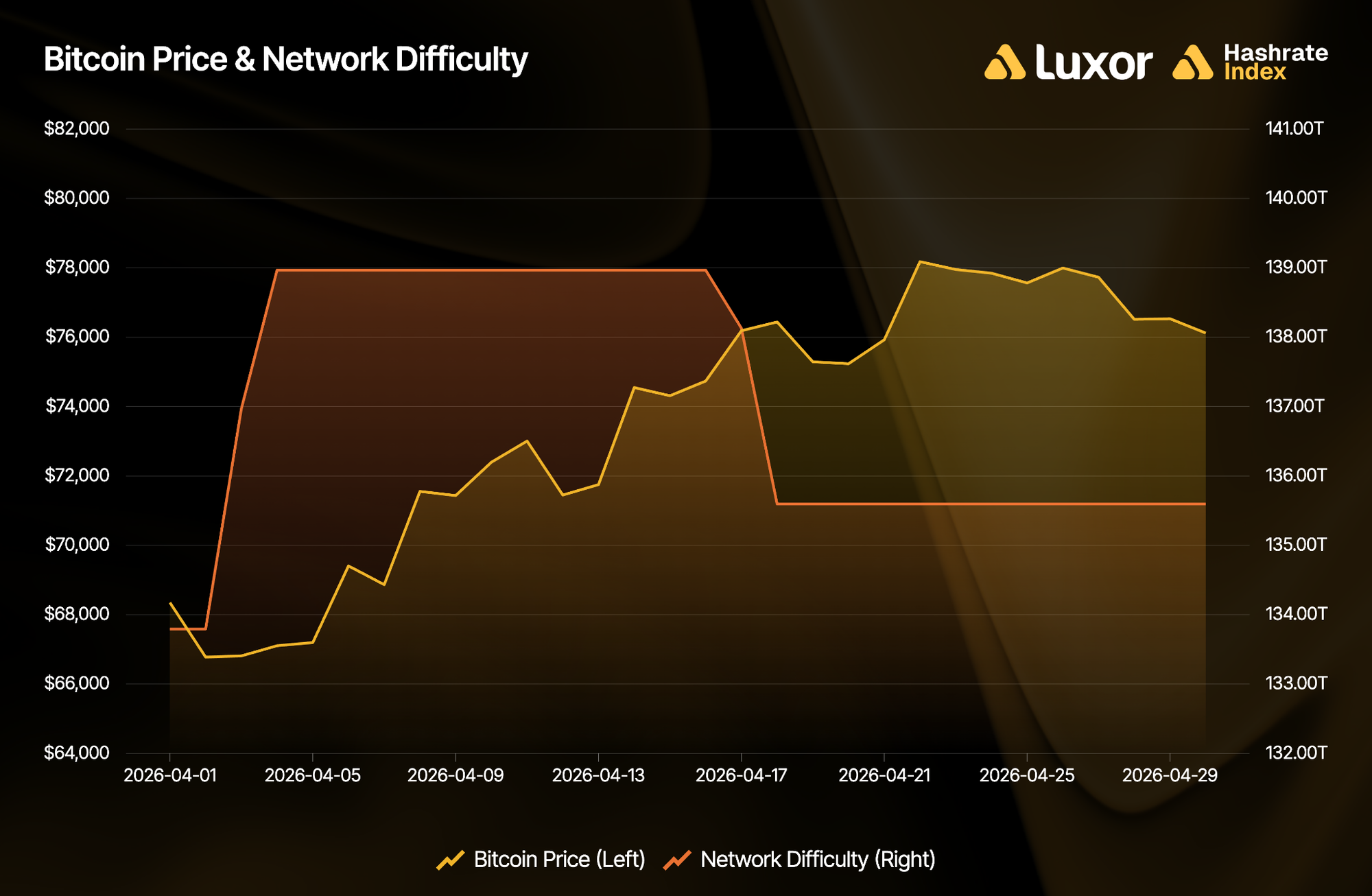
April saw only two minor difficulty adjustments: a +3.87% increase on April 3 and a −2.43% decrease on April 17. Critically, the network difficulty has remained below the 1 ZH/s equivalent (139.70T) for four consecutive epochs, spanning from March 20 to May 2. This is the longest period below this threshold since September 2025.
The May 2 adjustment of −2.30% reduced difficulty to 132.47T (approximately 948 EH/s), bringing it close to the March 20 lows. This suggests that the marginal hashrate that was taken offline during periods of critically low hashprice has not yet returned to the network. For industrial mining operations with access to the latest generation ASICs (e.g., S21 series) operating at efficient energy costs (e.g., below $0.05/kWh), profitability remains viable. However, older generation machines or those with higher energy costs (e.g., S19j Pro operating above $0.05/kWh) are likely operating at or near breakeven, making them vulnerable to any further drop in hashprice.
Block times averaged 9.86 minutes for the month, indicating a network operating close to its target. The subdued fee environment, with fees accounting for less than 1% of total block rewards, continues to put pressure on profitability, especially for smaller miners who cannot achieve the economies of scale seen in industrial operations.
Hashrate Market Activity and Hedging
April 2026 presented a bifurcated outcome for hashrate hedging strategies. USD-denominated forward contracts saw mixed performance depending on the contract duration. Sellers of longer-dated contracts (5, 4, and 3 months) generally secured premiums relative to the spot settlement price of $33.92 per PH/s/day. This was driven by the fact that these contracts were often initiated when BTC prices were significantly higher. Conversely, sellers of shorter-dated contracts (2 and 1 month) experienced losses, as the BTC price recovery outpaced the forward market’s pricing over those shorter horizons.
BTC-denominated contracts showed consistent wins for buyers. This outperformance was predominantly attributed to the unexpected and sustained contraction in network difficulty over six consecutive months, which boosted BTC hashprice beyond forward contract expectations.
The forward market saw significant repricing in April. USD-denominated contracts rose approximately 17% within the month, while BTC contracts saw a more modest ~4% increase. The market appears to be pricing in continued BTC price recovery, but not a commensurate surge in network hashrate, as implied network hashrate expectations decreased slightly.
Impact on Miners and Network Security
The recent market dynamics present a complex picture for different tiers of miners. Industrial-scale operations, equipped with the latest energy-efficient ASIC hardware and benefiting from low electricity costs, are better positioned to capitalize on the current hashprice levels. The stability in difficulty, while not declining significantly, prevents a rapid increase in profitability that could occur with a major difficulty reduction. However, the positive trend in hashprice provides a more stable operating environment compared to the preceding months.
For smaller-scale miners or those operating with less efficient hardware or higher energy costs, the current environment remains challenging. The sustained period below 1 ZH/s difficulty suggests that marginal capacity is still offline. Any significant drop in BTC price or an increase in network difficulty without a corresponding rise in transaction fees could render these operations unprofitable. The relative stability in transaction fees (contributing less than 1% of block rewards) means that the primary driver of profitability remains the BTC price and the mining difficulty adjustments.
From a network security perspective, the prolonged period of difficulty below 1 ZH/s indicates a potential reduction in the total security offered by the network compared to its peak hashrate. While the current hashrate is still substantial, a continued contraction or a significant decline in the number of active mining participants could theoretically make the network more susceptible to certain types of attacks, though the sheer scale of the network makes this a low-probability event in the near term. The return of hashrate is contingent on sustained periods of higher hashprice, driven by a combination of BTC price appreciation and further difficulty adjustments.
The forward market offers tools for miners to manage this uncertainty. Selling forward can lock in predictable revenue streams, crucial for financial planning, fleet upgrades, and securing financing. The yield observed in deliverable hashrate forwards (6-13% annualized) indicates the cost of capital in hashrate-based lending, allowing miners to finance expansion without diluting equity. Conversely, buyers of these contracts are hedging against price volatility or seeking to secure future hashrate capacity at predictable costs.
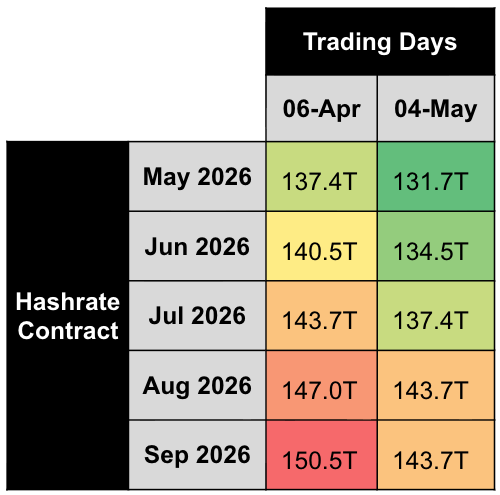
The forward market’s implication of a slight decrease in difficulty expectations suggests that the market does not anticipate an immediate rush of marginal hashrate returning online, even with the observed BTC price recovery. This cautious outlook on hashrate growth may reflect ongoing challenges in securing competitive energy sources or the capital required for new hardware deployments, particularly for entities operating at the edge of profitability.
The sustainability of the current hashprice levels will depend on the interplay between BTC price movements, the network’s difficulty adjustments, and the activation of previously sidelined mining capacity. For large-scale miners, strategic deployment of efficient hardware and hedging remains paramount. For smaller miners, the focus will be on operational efficiency and potentially exploring off-chain financing options tied to hashrate performance.
Original article : hashrateindex.com