


Tether Unveils Compact Medical AI for Edge Devices
Tether, a company widely recognized for its stablecoin USDT, has introduced a groundbreaking medical artificial intelligence model, QVAC MedPsy. This innovative AI is designed to operate efficiently on smartphones, wearables, and other edge devices, eliminating the need for cloud infrastructure. Developed by Tether’s AI Research Group, QVAC MedPsy represents a significant advancement in making sophisticated AI capabilities accessible and deployable in localized environments, particularly within the healthcare sector.
Key Takeaways
- Tether’s 1.7 billion-parameter QVAC MedPsy model demonstrates superior performance on clinical benchmarks compared to larger competitors.
- The AI achieves a remarkable reduction in response length, using approximately 3.2 times fewer tokens than comparable systems.
- This efficiency enables practical deployment on consumer hardware and local systems, enhancing data privacy and reducing operational costs.
- The models are available in quantized GGUF format, with compressed file sizes suitable for on-device execution without cloud dependency.
- This development aligns with the broader trend of decentralized AI and efficient blockchain-integrated solutions.
The 1.7 billion-parameter QVAC MedPsy model has reportedly surpassed Google’s MedGemma-4B and even outperformed the larger MedGemma-27B on the HealthBench Hard benchmark. This benchmark, created by OpenAI, assesses AI performance in realistic, multi-turn clinical conversations, with evaluations conducted by 262 physicians. This achievement highlights a paradigm shift from simply increasing model size to optimizing for computational efficiency and real-world applicability.
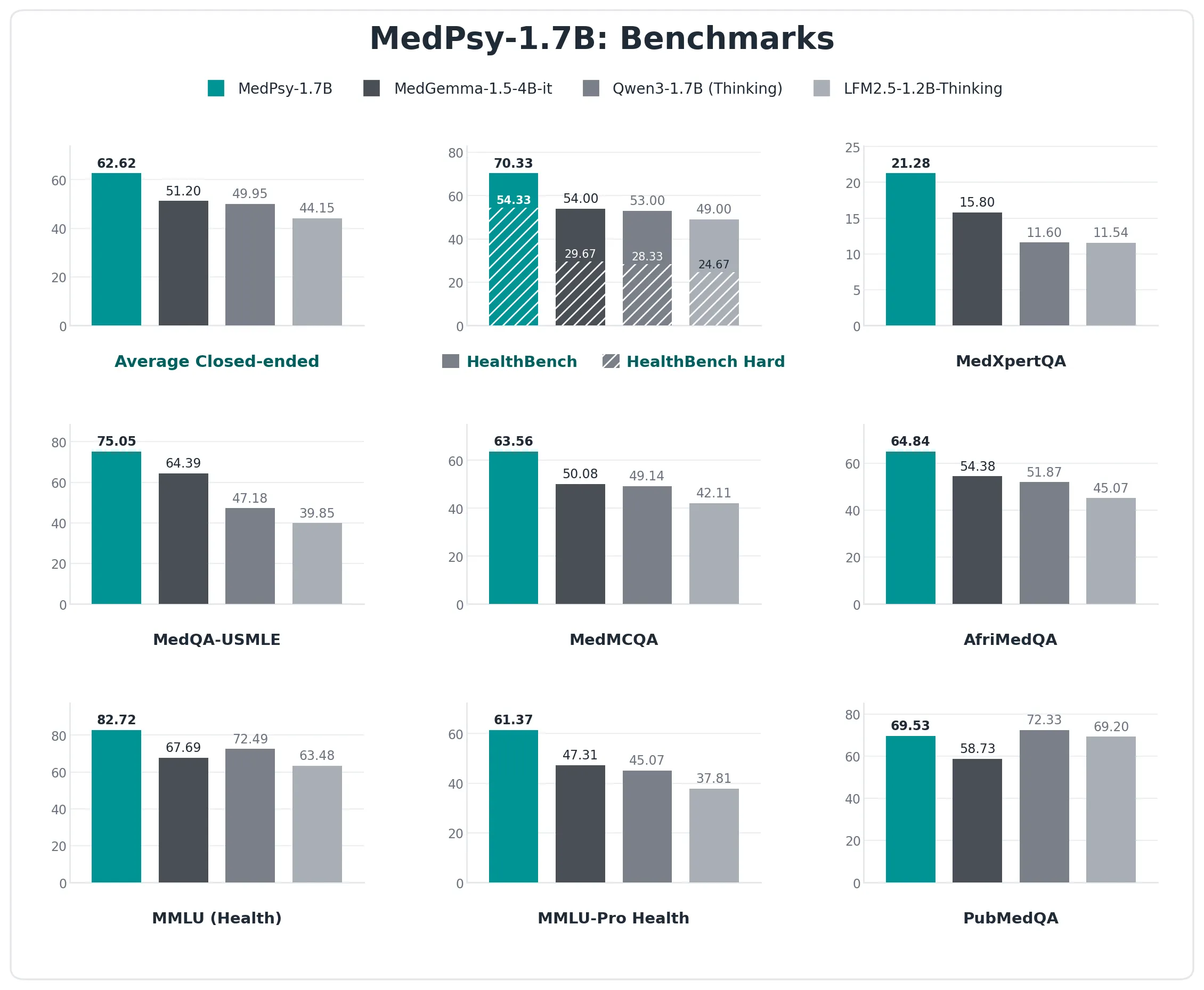
The benchmark suite for QVAC MedPsy includes MedQA-USMLE, which tests clinical knowledge through U.S. medical licensing exam-style questions, and AfriMedQA, designed to evaluate performance in African healthcare settings. This broad testing scope underscores the model’s versatility across different medical contexts.
Tether CEO Paolo Ardoino emphasized the company’s strategy, stating, “With QVAC MedPsy, our focus was improving efficiency at the model level, rather than scaling up size. Our 4 billion model exceeded results from models nearly seven times its size, while using up to three times fewer tokens per response.” This focus on efficiency is crucial for enabling AI on resource-constrained devices.
The significant reduction in token usage—averaging around 909 tokens per response compared to 2,953 for comparable systems—directly translates to lower computational costs, faster processing times, and the feasibility of local, offline deployment. This capability is particularly valuable for healthcare applications where data privacy and immediate access are paramount.
Ardoino further elaborated on the privacy benefits: “You can run medical reasoning where the data already exists, inside a hospital system or on a device, without moving sensitive information through the cloud or waiting on external processing.” This addresses critical concerns regarding HIPAA compliance and the security of patient data.
The QVAC MedPsy models are distributed as quantized GGUF files. The 1.7 billion-parameter model is 1.2 GB, and the 4 billion-parameter model is 2.6 GB. These compressed versions maintain substantial performance while fitting onto standard consumer hardware. This allows healthcare facilities and individual practitioners to run the AI on-site, ensuring sensitive patient information remains within their control and is not exposed to third-party cloud services.
While the privacy advantages are significant, the deployment of AI for medical advice remains a complex issue. Research, such as a study from Oxford, has indicated that large language models can sometimes provide inaccurate or potentially harmful medical guidance. These findings suggest that AI’s current role may be best suited as an assistant rather than a primary diagnostic tool. The challenge of regulatory compliance, especially concerning data privacy laws like HIPAA, is also a major hurdle for widespread adoption.
The QVAC MedPsy release follows Tether’s recent introduction of the QVAC SDK, an open-source toolkit for building local, offline AI applications across various operating systems. Additionally, Tether launched QVAC Health, a wellness application that prioritizes on-device biometric data processing. QVAC MedPsy marks the first QVAC model specifically engineered for clinical reasoning tasks.
Long-Term Technological Impact on Blockchain and AI
The release of QVAC MedPsy by Tether has profound implications for the intersection of artificial intelligence and blockchain technology, particularly within the context of Web3 development and Layer 2 solutions. By demonstrating the capability to run sophisticated AI models, like those for medical reasoning, entirely on edge devices with minimal computational resources, Tether is paving the way for a more decentralized and efficient AI ecosystem. This approach resonates strongly with the core principles of Web3, which emphasizes user control, privacy, and distributed infrastructure. The ability to process sensitive data locally, without reliance on centralized cloud servers, directly enhances data sovereignty and security – key selling points for blockchain-based solutions. Furthermore, the development of highly efficient AI models like QVAC MedPsy could lead to more practical applications for Layer 2 scaling solutions on various blockchains. These solutions are designed to increase transaction speed and reduce costs, and embedding AI functionalities within them could unlock new possibilities for decentralized applications (dApps). Imagine dApps that can analyze user data securely on-device, leveraging blockchain for verification and smart contract execution, all without compromising privacy. This fusion could accelerate the adoption of AI in areas requiring high data integrity and low latency, such as decentralized finance (DeFi), supply chain management, and secure digital identity solutions. The efficiency gains highlighted by QVAC MedPsy also suggest a future where AI-powered services can be integrated into the blockchain infrastructure itself, rather than being separate, cloud-dependent entities. This could lead to more intelligent, autonomous decentralized systems capable of complex decision-making and real-time adaptation, fundamentally altering how decentralized networks operate and interact with users.
The medical AI market is projected to grow significantly, with estimates suggesting it could surpass $500 billion by 2033. QVAC MedPsy’s models and GGUF weights are now available for download at qvac.tether.io/models.
Learn more at : decrypt.co