

In a significant development for private equity and the burgeoning digital asset space, both leading AI firms Anthropic and OpenAI have recently updated their stock transfer policies, declaring any unauthorized share transactions as null and void. This move directly challenges the proliferation of Special Purpose Vehicles (SPVs) and other complex financial instruments used to trade private company shares, particularly those in high-growth technology sectors.
Anthropic has taken a more aggressive stance, publishing a list of unauthorized platforms and facilitators, including established secondary market players like Forge Global and Hiive. This signals a strong intent to regain control over their shareholder registry and prevent the dilution of ownership through opaque channels. OpenAI has echoed similar sentiments, emphasizing that any stock transfer lacking explicit board consent is void and carries no economic value.
Key Takeaways
- Both Anthropic and OpenAI have invalidated stock transfers executed without board approval.
- Anthropic has blacklisted specific platforms, including regulated marketplaces like Forge Global and Hiive, for facilitating unauthorized transactions.
- Special Purpose Vehicles (SPVs), tokenized interests, and forward contracts are explicitly targeted as void transaction methods if not board-approved.
- The $6.6 billion OpenAI employee share sale was a board-authorized tender offer and is considered legitimate.
- This action underscores a push for greater transparency and control in the private markets for high-value technology companies.
Special Purpose Vehicles (SPVs) have become a common mechanism for investors to gain exposure to private companies that are not yet publicly traded. An SPV essentially acts as a shell company, pooling investor funds to acquire shares in the target company. This workaround circumvents the direct transfer restrictions typically imposed by private companies, which require board approval for any change in share ownership. However, as PitchBook analyst Emily Zheng noted, the layering of multiple SPVs can create significant complexity, leading to increased management fees and making it difficult to verify the legitimacy of the underlying share acquisitions.
Anthropic’s updated policy states unequivocally that any sale or transfer of its stock without board approval is “void,” meaning it has no legal standing from the outset. This applies to direct sales, SPVs, tokenized interests, and forward contracts. OpenAI’s statement mirrors this, asserting that such unauthorized transfers “will not be recognized and carry no economic value.” The implications are stark: buyers in these unauthorized transactions may find they possess no actual ownership rights.
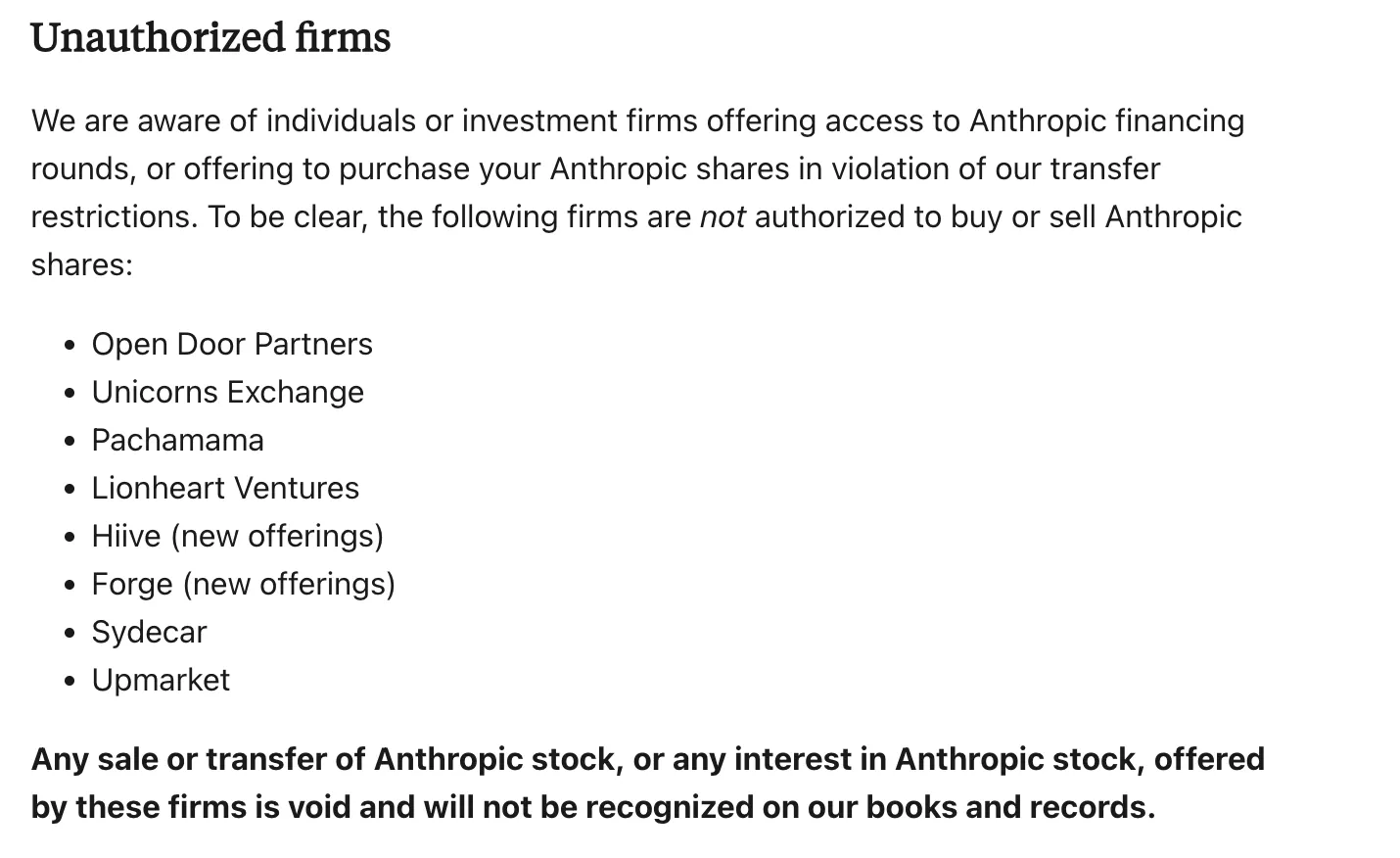
The inclusion of Forge Global and Hiive on Anthropic’s blocklist is particularly noteworthy. These are not fringe operators but regulated platforms facilitating secondary market transactions for private companies. By invalidating transfers on these platforms, Anthropic is signaling that the board’s consent is paramount, irrespective of the regulatory status of the trading venue. This has sent ripples through the tokenized market, with reported price drops for related tokens on platforms like PreStocks.
The contrast with legitimate share sales is clear. OpenAI recently facilitated a $6.6 billion cash-out for its employees through a board-authorized tender offer. This process involved direct engagement with institutional buyers and explicit company approval for every transfer, adhering strictly to its internal policies. This event highlights that the companies are not inherently against secondary market activity, but rather against the unauthorized and opaque methods that have emerged.
Robinhood Ventures Fund I’s recent purchase of $75 million in OpenAI common stock also falls under scrutiny, given its disclosure of using SPVs and a prior dispute over tokenized stock airdrops. While Robinhood maintains its current OpenAI investment is direct and free of intermediary structures, the incident underscores the broader challenges in ensuring compliance and transparency in the evolving landscape of private market investments and their intersection with digital assets.
Long-Term Technological Impact on the Industry
This stringent enforcement by leading AI firms like Anthropic and OpenAI is poised to have a profound impact on the future of blockchain innovation, AI integration, and Web3 development. Firstly, it establishes a crucial precedent for how companies in the high-growth tech sector will manage their private share ownership. The emphasis on explicit board approval over indirect or tokenized methods could steer future developments towards more transparent and auditable on-chain solutions, potentially leveraging blockchain for secure and verifiable shareholder registries.
Secondly, it highlights the ongoing tension between traditional finance structures and the decentralized ethos of Web3. While blockchain offers tools for tokenization and fractional ownership, the underlying corporate governance and legal frameworks must be respected. This situation may push innovators to develop Layer 2 solutions and smart contract functionalities that can seamlessly integrate with existing corporate governance, rather than bypass it. The demand for access to high-value private assets is immense, as evidenced by Anthropic’s rapid revenue growth and Amazon’s substantial investment commitment. This demand will continue to drive exploration of new financial technologies.
Ultimately, the industry may see a bifurcation: one path focusing on strict adherence to traditional corporate approval for any share-related transactions, and another exploring novel, blockchain-native methods for proving and transferring ownership that are fully compliant with corporate governance. The success of the latter will depend on its ability to offer verifiable security, regulatory compliance, and clear economic value, potentially integrating AI for enhanced due diligence and risk management within decentralized finance (DeFi) and Web3 platforms. The clear message from Anthropic and OpenAI is that while innovation is welcome, it must be built on a foundation of recognized legal and corporate authority.
Source: : decrypt.co