


The ERCOT Four Coincident Peak (4CP) pricing mechanism is fundamentally reshaping the economic calculus for Bitcoin miners operating within Texas. This system, which dictates a site’s transmission charges for the subsequent year based on its energy consumption during the four highest 15-minute system-wide demand periods between June and September, introduces a significant variable into operational cost management. For large-scale industrial miners, understanding and strategizing around these peaks is transitioning from an operational hurdle to a crucial competitive advantage, directly impacting their effective power costs in $/MWh.
- The 4CP mechanism establishes annual transmission charges based on a facility’s average load during four specific 15-minute intervals each summer.
- These charges can escalate to approximately $50,000 per MW annually, potentially imposing substantial costs on operations running at full capacity during peak events.
- Strategic curtailment during 4CP periods allows miners to significantly reduce their overall electricity expenditures.
- The synchronized reduction in hashrate from Texas-based miners during these peaks is now a discernible factor in the broader network hashrate dynamics.
The 4CP framework is designed by the Electric Reliability Council of Texas (ERCOT) to allocate transmission infrastructure costs among its largest industrial consumers. The core principle is that a facility’s contribution to system-wide peak demand during a limited number of short intervals directly determines its fixed transmission cost obligation for the ensuing twelve months. These transmission charges, while only one component of a comprehensive electricity bill that includes energy, distribution, and ancillary services, can exert a profound influence on an operation’s overall cost structure. The financial impact scales linearly with peak load participation; zero participation during the four identified peaks can result in minimal to no transmission charges, whereas sustained high load during these intervals can lead to substantial annual costs. Miners face the challenge of predicting these peak intervals, as ERCOT only confirms them retrospectively. However, historical data suggests a predictable clustering of these events, typically within a late afternoon window (e.g., 16:00 to 18:00 Central Time). Traditionally, these peaks are distributed across the summer months, with one prominent interval often occurring within each month. While manual curtailment by monitoring real-time load forecasts is a common practice, it introduces inefficiencies. Overly aggressive curtailment can lead to missed revenue opportunities from unutilized hashrate, whereas insufficient curtailment risks incurring higher transmission charges. The speed at which a mining operation can resume full capacity after a curtailment event also impacts the total hashrate harvested. The strategic advantage lies in precisely timing these curtailments and rapidly restoring operations, thereby maximizing hashrate revenue while minimizing the 4CP liability. Advanced mining operations are increasingly adopting automated systems that integrate real-time load forecasting, predictive modeling of peak likelihood, and direct connections with fleet management software to execute automated curtailment signals based on predefined thresholds.
Impact on Network Security and Miner ROI
The widespread adoption of 4CP avoidance strategies by a significant portion of the Texas hashrate has tangible implications for the Bitcoin network’s overall security and the return on investment (ROI) for individual miners. Texas’s substantial share of the global hashrate means that coordinated curtailment events can lead to noticeable fluctuations in network-wide block production times, potentially causing downward adjustments in mining difficulty. This phenomenon, observed in recent summers, creates a predictable seasonal pattern in network difficulty and hashprice volatility. Consequently, forward hashrate markets often reflect this seasonality, with contracts trading at a premium during the 4CP months to account for the anticipated reduction in available hashrate and the corresponding increase in hashprice. For miners who effectively manage their 4CP strategy, the reduction in energy costs directly enhances profitability, improving their ROI. Conversely, those unable to implement effective curtailment strategies may find their margins squeezed by higher transmission charges, potentially impacting their long-term viability. The optimization of energy consumption and cost management, particularly in response to regulatory mechanisms like 4CP, is becoming a critical factor in the competitive landscape of industrial-scale Bitcoin mining and its contribution to network security.
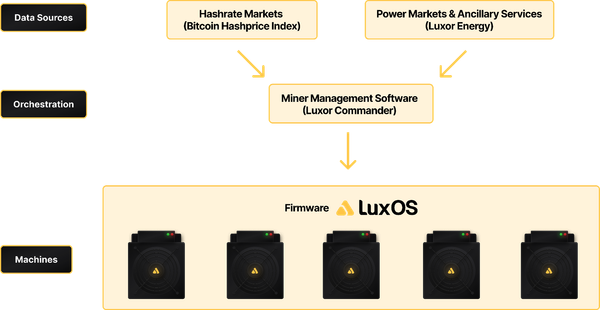
The effect of these 4CP-driven curtailments is clearly visible in network metrics. For instance, summer months have historically shown lower average difficulty adjustments compared to the rest of the year, with a notable rebound in hashrate and difficulty adjustments typically occurring in October as the curtailment pressure subsides. This predictable ebb and flow of hashrate impacts the economics of forward-looking hashrate contracts, where sellers may price in higher rates during peak 4CP periods due to anticipated scarcity and stronger hashprice performance. Luxor’s 4CP Optimizer is designed to automate this process. It functions by continuously monitoring ERCOT’s real-time grid load, employing probabilistic models to forecast potential coincident peaks, and automatically dispatching curtailment commands to mining sites via their Commander fleet management software. This automated approach aims to provide miners with a more precise and efficient method for managing 4CP events, thereby optimizing their energy costs and enhancing their operational profitability.
About Luxor Technology Corporation
Luxor Technology Corporation is a comprehensive provider of hardware, software, and financial services tailored for the global compute and energy sectors. Their offerings encompass Bitcoin mining pools, specialized ASIC firmware, hardware trading platforms, hashrate derivative markets, energy management solutions, miner management software (Commander), and a data analytics platform for Bitcoin mining (Hashrate Index).
Based on materials from : hashrateindex.com