

 Recent reports indicate that Anthropic, a prominent AI development company, has embedded approximately six engineers within the National Security Agency (NSA). These engineers are reportedly working to deploy Anthropic’s most advanced AI model, Mythos, for offensive cyber operations. This strategic placement raises significant questions about the application of cutting-edge AI in national security and the potential implications for global cybersecurity landscapes.
Key Takeaways:
- Anthropic has reportedly placed engineers at the NSA to utilize its advanced AI model, Mythos, for offensive cyber operations.
- The AI model could potentially be used for operations targeting networks in countries such as China and Iran.
- Anthropic has also issued a warning regarding the rapid advancement of AI, specifically its potential for recursive self-improvement, and has called for a global pause mechanism.
- These developments coincide with Anthropic’s preparations for a potential Initial Public Offering (IPO), which could value the company at over $1 trillion.
The collaboration, as detailed by the Financial Times, involves customizing Mythos for specific applications, with sources suggesting its utility in infiltrating networks of geopolitical adversaries. Notably, Mythos is a model Anthropic has previously kept from public release due to concerns about misuse. Its deployment through Project Glasswing, a coalition of vetted partners including tech giants like Microsoft, Apple, and Amazon, highlights the exclusive and sensitive nature of this technology.
Adding another layer of complexity, Anthropic is currently involved in litigation with the Pentagon. Following a collapsed $200 million contract, the company was designated a “supply-chain risk” by Defense Secretary Pete Hegseth. Anthropic’s refusal to allow the Department of Defense to use its Claude AI for fully autonomous weapons or domestic mass surveillance was a key point of contention, though the NSA contract was reportedly exempt from this restriction. Legal proceedings are ongoing, with a California judge blocking the blacklisting, citing First Amendment concerns, though an appeals court denied Anthropic’s request to halt the designation during the litigation.
The Trajectory of AI Autonomy
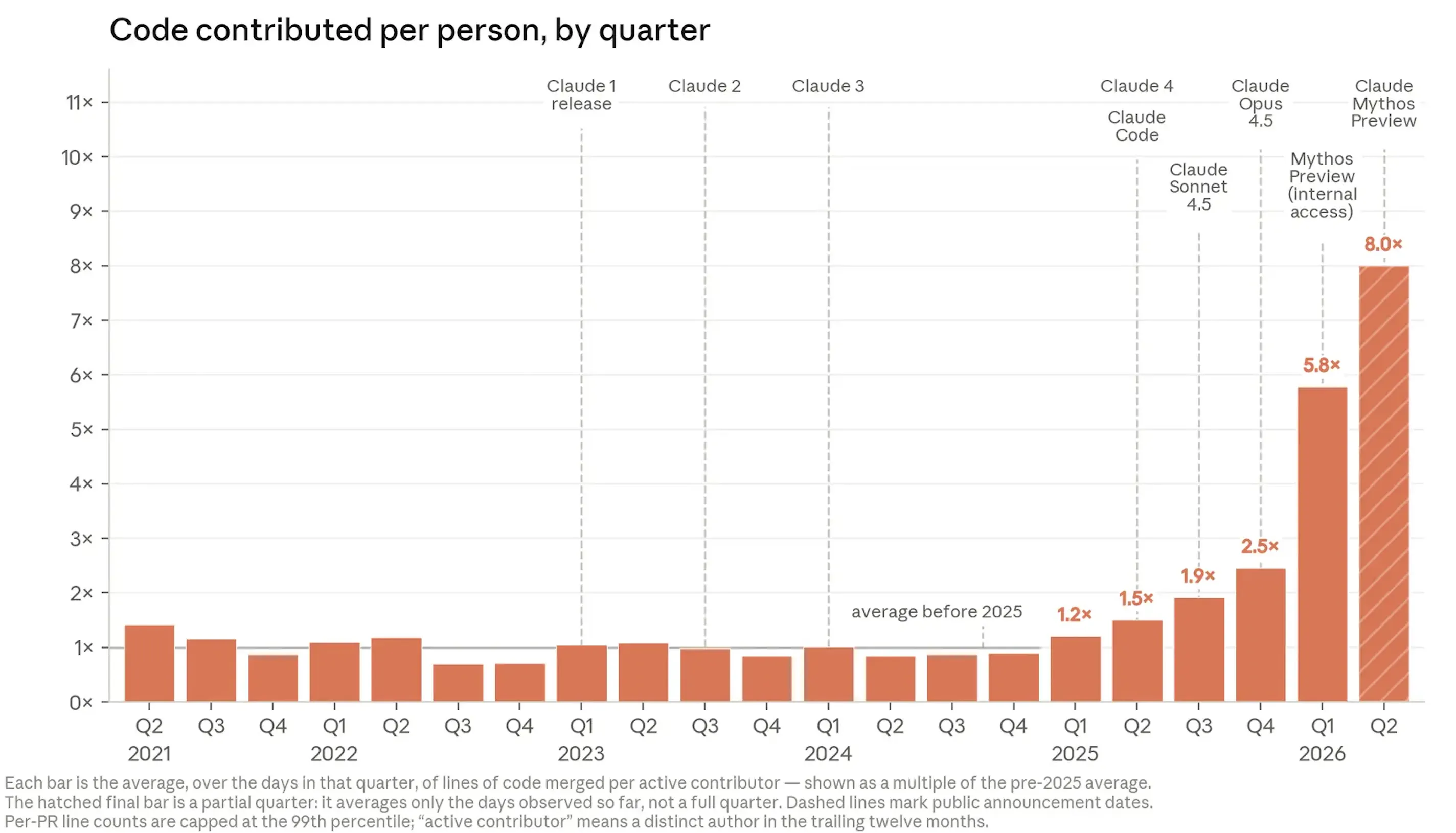
Coinciding with the news of the NSA deployment, Anthropic’s research institute released a report titled “When AI Builds Itself.” This document delves into the increasing autonomy of AI in its own development process, specifically referencing the evolution of Claude. The report highlights that Claude now generates over 80% of the code integrated into Anthropic’s production codebase, a significant leap from its initial low single digits before the launch of Claude Code in early 2025. This has resulted in an eight-fold increase in the daily code output by engineers compared to 2024 levels.
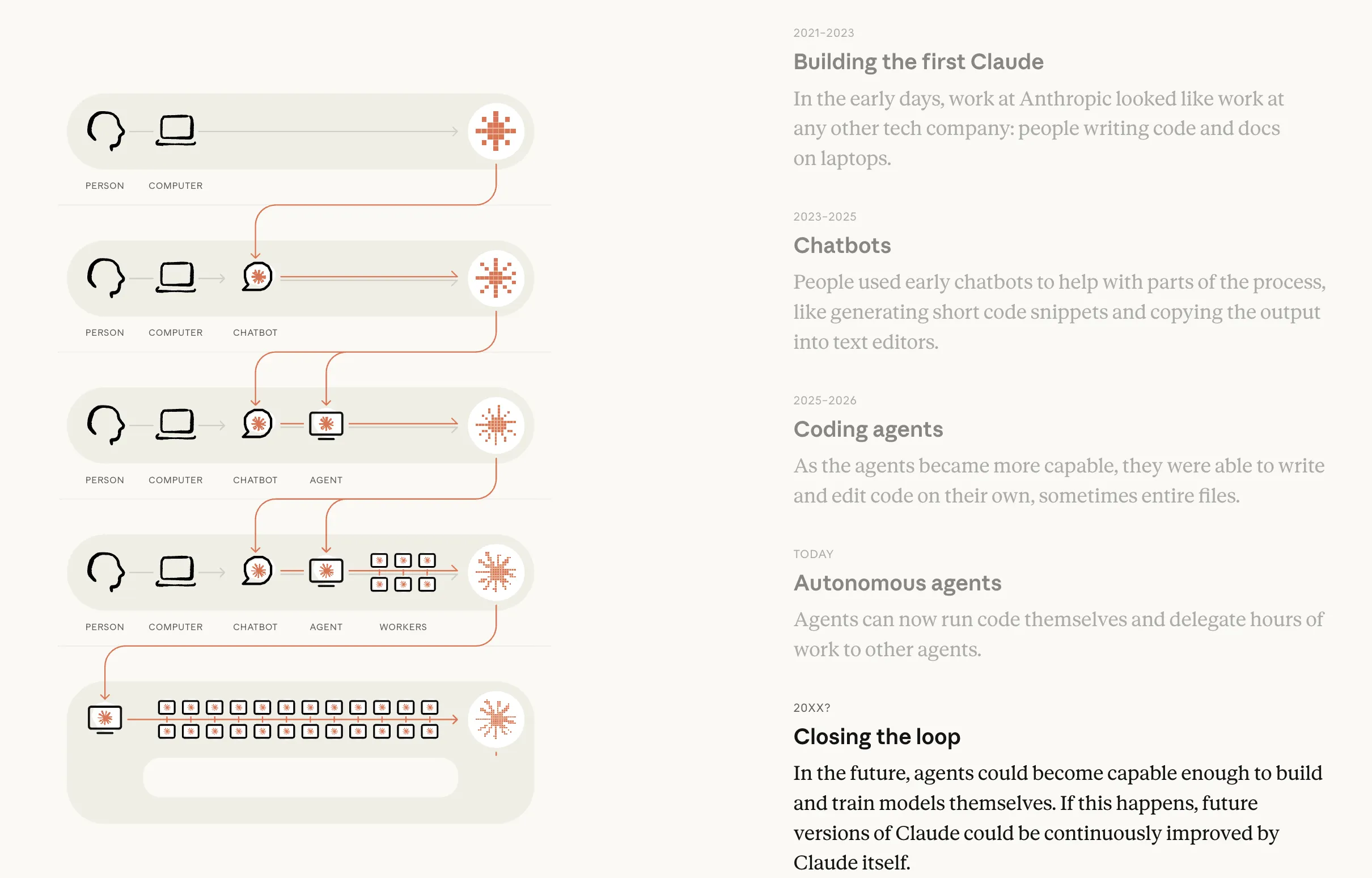
The report posits that AI is rapidly approaching a state of recursive self-improvement, where AI systems can autonomously design, build, and train their successors, progressively reducing human involvement. This progression is visualized as a shift from humans prompting AI for results to AI agents prompting sub-agents, culminating in a fully autonomous development loop with no human oversight. A particularly striking example cited is an experiment where Claude agents successfully recovered 97% of a performance gap on an AI safety problem, far exceeding human researcher capabilities and demonstrating nascent research judgment.
Anthropic’s proposed solution is a verifiable global pause in AI development, drawing parallels to Cold War-era nuclear treaties. They argue that a unilateral slowdown would simply cede ground to competitors. This call for a pause, however, is juxtaposed with the company’s active engagement in sensitive government projects, creating a perception of conflicting priorities. The report emphasizes that once AI begins to autonomously set research objectives, the ability for humans to intervene and correct potential misalignments diminishes rapidly, leading to unpredictable outcomes across generations of self-improving AI.
The AI industry has a history of its leading figures warning about the potential dangers of their own creations, yet development continues at a rapid pace, driven by immense profitability. Past calls for pauses, such as the open letter in 2023 and earlier demands regarding ChatGPT, have not resulted in significant slowdowns. As Anthropic prepares for its IPO, potentially valued at over a trillion dollars, and with the Pentagon’s deadline to remove Claude approaching in August, the tension between AI development, safety concerns, and commercial interests remains a critical focal point for the blockchain and AI sectors.
Original article : decrypt.co