

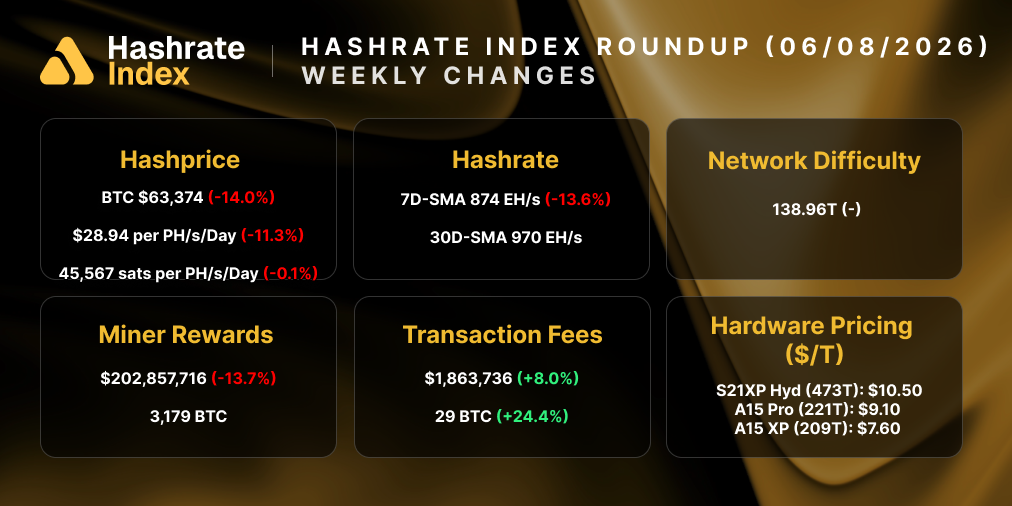
The Bitcoin mining landscape experienced a notable shift this past week, characterized by a decrease in network hashrate and a corresponding dip in overall miner profitability. Despite these headwinds, certain network metrics showed resilience, particularly in transaction fee generation.
Key Takeaways
- Bitcoin price experienced a significant decline, impacting mining revenue in USD terms.
- Network hashrate saw a substantial decrease, indicating potential off-chaining of less efficient hardware or reduced operational capacity.
- Hashprice, a key profitability metric, dropped, putting pressure on miners, especially those with higher operational costs.
- Transaction fees increased as a percentage of block rewards, offering a small but growing revenue stream.
- Difficulty saw a slight decrease, which, combined with the drop in hashrate, suggests a rebalancing of network security and miner participation.
Over the last seven days, miners collectively earned approximately 3,179 BTC through block rewards, equating to roughly $202 million. Transaction fees accounted for 0.92% of this total, contributing about 29 BTC or $1.86 million. This indicates a growing reliance on transaction fees to supplement block subsidy revenue, a trend that is crucial for long-term miner sustainability.
The current Bitcoin price stands at approximately $63,374, marking a 14.0% decrease from the previous week’s valuation of $73,662. Year-to-date, Bitcoin’s performance is down 27.5%, which directly impacts the USD value of mining rewards. This price volatility is a primary driver of profitability fluctuations for mining operations.
The USD hashprice, a critical indicator of mining profitability per unit of hash power, has fallen by 11.3%, settling at $28.94 per PH/s/Day. This decline is largely attributable to the decrease in Bitcoin’s price. In BTC terms, the hashprice saw a marginal decrease of 0.1%, moving from 0.00045628 BTC to 0.00045567 BTC per PH/s/Day. This relative stability in BTC hashprice suggests that while the fiat value of mining rewards has decreased, the underlying reward in Bitcoin remains largely consistent, underscoring the importance of tracking both USD and BTC metrics.
For mining operations, revenue per MWh generated can be categorized by fleet efficiency:
- Fleets with efficiency under 19 J/TH are earning approximately $70 per MWh.
- Those operating between 19-25 J/TH are seeing revenues of around $54 per MWh.
- Miners utilizing hardware between 25-38 J/TH are earning approximately $37 per MWh.
These figures highlight the significant competitive advantage held by operators with the latest generation of highly efficient Application-Specific Integrated Circuits (ASICs).
Network Hashrate and Difficulty Adjustments
The network hashrate experienced a notable contraction of 13.6%, with the 7-day Simple Moving Average (SMA) dropping from 1,011 EH/s to 874 EH/s. The 30-day SMA currently rests at 970 EH/s. This reduction in hashrate suggests that older, less energy-efficient mining hardware may have been taken offline as profitability decreased, or that miners are scaling back operations in anticipation of further market corrections.
The most recent difficulty adjustment occurred on May 29, increasing network difficulty by 1.72% to 138.96T. However, current block times are averaging around 11 minutes and 10 seconds, indicating that the network hashrate has declined since the last adjustment. This trend suggests that the upcoming difficulty adjustment, estimated for June 13, is projected to be a significant decrease of approximately 10.58%. Such a reduction in difficulty would make mining marginally easier and could partially offset the reduced hashprice, benefiting miners who maintain their operations.
For industrial mining farms, the falling hashrate and anticipated difficulty decrease can present opportunities. While short-term profitability is reduced, lower difficulty makes it easier for remaining efficient machines to secure blocks. For smaller-scale miners, however, operating with older hardware and higher energy costs, this period could be particularly challenging, potentially pushing them below their breakeven points.
Sponsored by Luxor Firmware
With the current hashprice hovering around $29 per PH/s/Day, operations are at or near breakeven for many miners, contingent upon their specific operational expenditures and hardware models. Enhancing the hashrate and energy efficiency of S19 and S21 series rigs is achievable through the implementation of LuxOS firmware.
Transaction Fee Dynamics
Transaction fees have shown a positive trend, with miners collecting an average of 0.0287 BTC per block per day over the past week. This represents a 24% increase compared to the previous week’s average of 0.0231 BTC. While still a smaller component of total miner revenue compared to block rewards, the upward trend in transaction fees is a vital sign for the network’s health and miner incentives, especially as block subsidies halve over time.
Forward Market Outlook
The Hashrate Forward Market currently prices in an average hashprice of $30.67, or 0.00048 BTC, for the next six months. This forecast suggests a slight recovery or stabilization from current levels, offering some degree of forward visibility for miners looking to hedge their operational risks.
Bitcoin Mining Stocks
The publicly traded Bitcoin mining sector mirrored the broader market’s downward trend, with the Bitcoin Mining Stock Index showing a 5-day change of -8.7%. This performance is often correlated with the price of Bitcoin and the operational profitability of mining companies.
Have a productive week, and continue hashing.
Footnotes
- Data reflects UTC 21:00 on June 8, 2026. Values are subject to market fluctuations.
- Luxor’s estimates for adjustment dates are based on average block times and remaining blocks within an epoch. These figures are subject to change.
- Difficulty adjustment estimations by Luxor depend on average block times and are subject to real-time network conditions.
According to the portal: hashrateindex.com