


DiffusionGemma Introduces Novel Text Generation Speed with Block-Based Diffusion
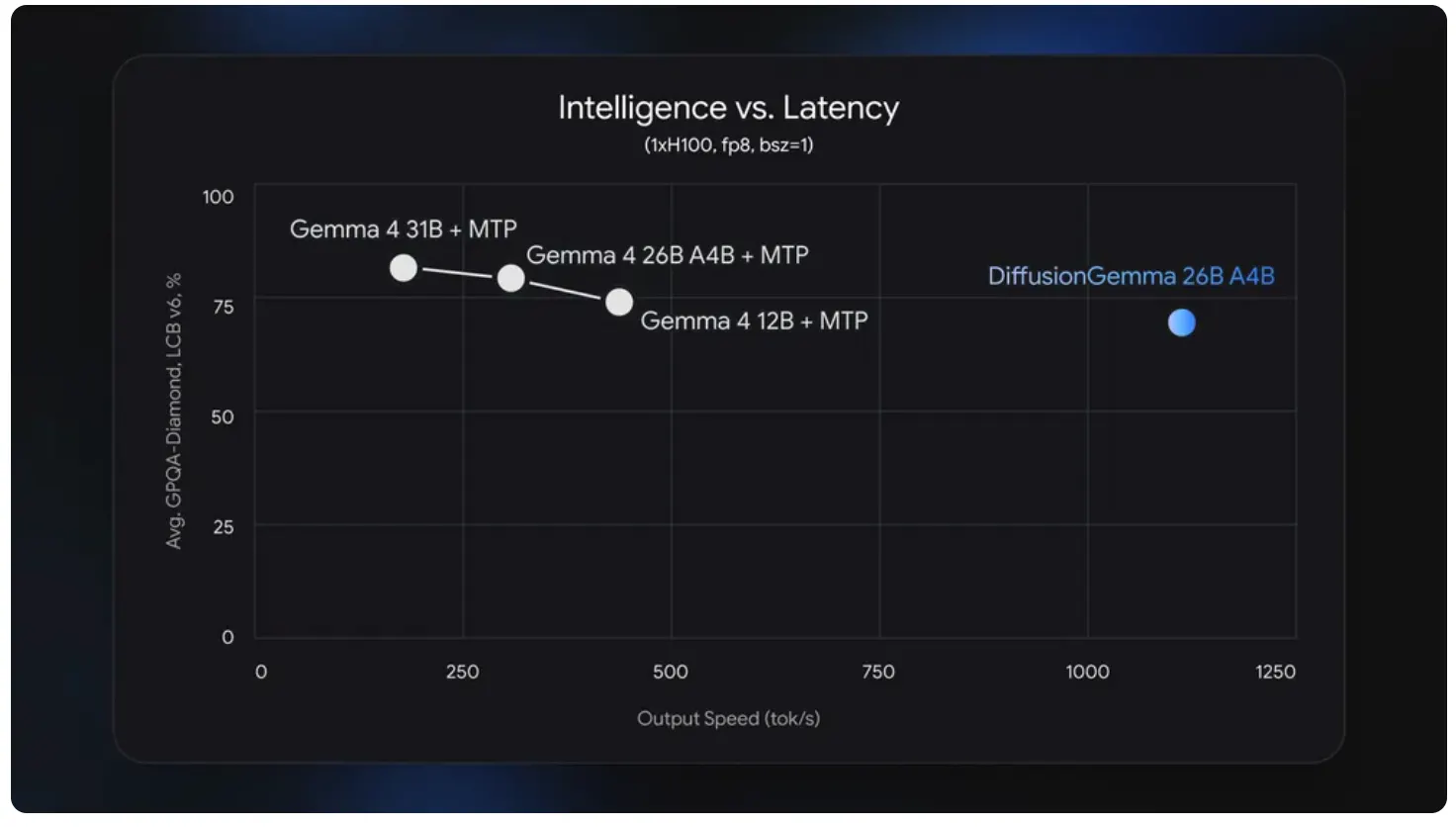
Google has unveiled DiffusionGemma, a groundbreaking open-weight AI model that departs from traditional sequential text generation. Instead of producing tokens one by one, DiffusionGemma generates entire blocks of 256 tokens simultaneously using a text diffusion process, similar to how image generators create visuals from noise. This novel approach achieves an impressive speed of over 1,000 tokens per second on high-end hardware like the NVIDIA H100, marking a significant fourfold increase compared to standard autoregressive models.
While the raw speed of DiffusionGemma is a major leap forward, its immediate practical application is currently limited. The model requires a specialized “drafter” module for efficient local inference, a component that is not yet available in common public runtimes like mlx-lm or LM Studio, rendering it largely inaccessible for users with standard consumer hardware.
Furthermore, when deployed on platforms like NVIDIA NIM, the model is preconfigured with a context window of 8,192 tokens, which is insufficient for advanced agentic frameworks that often require a minimum of 64,000 tokens. This necessitates manual reconfiguration for autonomous workflows, adding another layer of complexity for users aiming for sophisticated applications.
Key Takeaways
- DiffusionGemma utilizes a text diffusion method to generate text in parallel blocks, achieving speeds over 1,000 tokens per second on high-performance GPUs.
- This approach drastically differs from traditional autoregressive models, which generate text token by token.
- The model’s requirement for a custom “drafter” module currently limits its usability on most consumer-grade machines.
- Initial deployments may face limitations with context window size, impacting compatibility with advanced agentic frameworks without manual adjustments.
- Despite current limitations, DiffusionGemma represents a significant advancement in AI model architecture, focusing on speed and parallel processing.
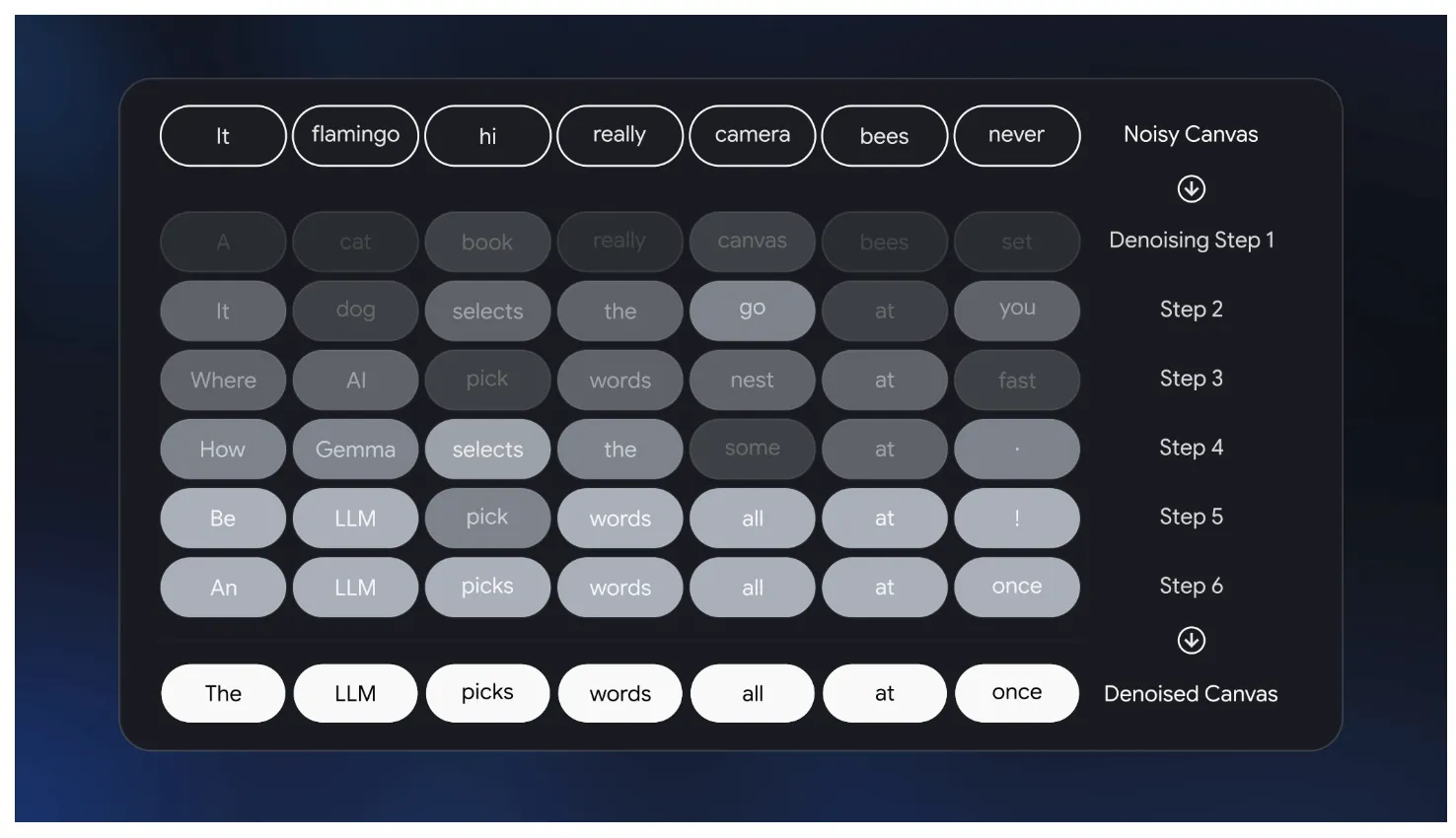
The underlying mechanism of DiffusionGemma involves starting with a “canvas of random placeholder tokens” that are progressively refined until they form coherent text. This process allows the model to process 256 tokens in a single forward pass, keeping the GPU highly utilized. A key advantage of this diffusion-based generation is its “bidirectional attention,” where every token generated can consider all other tokens simultaneously. This contrasts sharply with autoregressive models, which operate linearly and cannot “see” future tokens during generation.
This bidirectional capability makes DiffusionGemma particularly adept at tasks requiring an understanding of the entire context, such as code infilling, generating structured outputs, and solving problems with complex constraints. Google demonstrated this by fine-tuning a version of the model to solve Sudoku puzzles, achieving an 80% success rate, a significant improvement over the base model’s roughly 0% accuracy.
Text diffusion for language models has been an area of academic research for years, with projects like MDLM, SEDD, and LLaDA proving the concept at smaller scales. Commercial applications like Inception Labs’ Mercury 2 have also emerged, claiming substantial speed improvements. However, DiffusionGemma stands out as the first major open-weight release from a leading AI lab, offering broad accessibility through platforms like Hugging Face Transformers and integration with popular inference engines like vLLM and Unsloth.
There is an interesting historical parallel: image generation models, initially diffusion-based (like Stable Diffusion), are now exploring autoregressive approaches for quality, while language models like DiffusionGemma are adopting diffusion for speed. This cross-pollination of techniques highlights the dynamic nature of AI research and development.
The Current Hurdle: Deployment and Integration Challenges
The primary obstacle to widespread adoption of DiffusionGemma lies in its specialized inference requirements. Efficient execution hinges on a “drafter” module—a lightweight component that rapidly proposes token blocks, which are then validated by the main model in a single, accelerated forward pass. Frameworks like DFlash, introduced earlier in 2026, have demonstrated the efficacy of using small diffusion models as drafters, enabling significant speedups. However, DiffusionGemma’s specific implementation necessitates a custom drafter compatible with MLX, Apple’s machine learning framework for Apple Silicon. This particular module is not yet integrated into public versions of mlx-lm, open pull requests, or bundled with tools like LM Studio.
Our attempts to run DiffusionGemma with advanced agentic systems, such as Hermes Agent via NVIDIA NIM, highlighted these integration challenges. While the model loaded, initialization failed due to the context window mismatch: “agent init failed: Model google/diffusiongemma-26b-a4b-it has a context window of 8,192 tokens, which is below the minimum 64,000 required by Hermes Agent.” It’s important to note that DiffusionGemma’s architectural context window is actually 256K tokens; the 8,192 figure reflects NVIDIA’s default configuration, not the model’s inherent limitation. Effectively utilizing its full potential for agentic applications requires manual configuration, a process that is currently complex and not yet widely documented or supported by user-friendly tools. Until the toolchain matures and community resources become more robust, the speed advantages of DiffusionGemma may remain theoretical for many potential users.
Long-Term Technological Impact: Shifting Paradigms in AI Generation
The advent of DiffusionGemma signifies a potential paradigm shift in how artificial intelligence generates sequential data, particularly text. By moving away from the inherently sequential nature of autoregressive models towards a parallel, diffusion-based approach, Google is pushing the boundaries of computational efficiency. This architectural innovation could profoundly impact the development of real-time AI applications, accelerating processes in areas like code completion, dynamic content generation, and interactive AI agents. The ability to process large chunks of data in parallel fundamentally alters the speed-accuracy trade-off, potentially enabling more sophisticated and responsive AI systems that were previously constrained by processing latency.
The open-source nature of DiffusionGemma, following the release of Gemma 4, is crucial for its long-term influence. By making the model and its weights publicly available under an Apache 2.0 license, Google is fostering a collaborative environment for innovation. As the surrounding software ecosystem, including inference engines and developer tools, catches up to support this new architecture, DiffusionGemma and similar diffusion-based language models are poised to become accessible to a much wider range of developers and researchers. This democratization of advanced AI capabilities can spur novel applications across various sectors, from enhancing productivity tools to enabling new forms of creative expression and scientific discovery. The parallel generation paradigm, particularly its bidirectional attention mechanism, opens up new avenues for research into complex data structures and context-dependent tasks that were difficult to address with previous models.
Who This is For
DiffusionGemma is primarily targeted at developers equipped with high-end NVIDIA GPUs (such as the RTX 4090 or 5090) who are focused on building real-time applications. This includes developers working on inline editors, advanced autocompletion systems, code infilling tools, and applications requiring structured text generation. Google’s ongoing efforts to enhance local AI inference speed without requiring new hardware make DiffusionGemma a key component in this strategy.
For researchers, the bidirectional generation capability of DiffusionGemma unlocks new possibilities. It allows for exploration in domains where sequential dependencies are not strictly linear, such as in the generation of protein sequences, complex mathematical graphs, or any data where relationships span across distant positions. This capacity goes beyond the limitations of traditional autoregressive models.
Continuing the open-source strategy established with Gemma 4, DiffusionGemma’s release under Apache 2.0, alongside community efforts like a draft PR for llama.cpp, indicates a rapid development trajectory for its supporting toolchain. As these tools mature, DiffusionGemma’s potential to achieve real-time performance—approaching 1,000 tokens per second on capable hardware—will become a tangible reality for a broader audience.
According to the portal: decrypt.co