


OpenRouter has introduced a novel API called Fusion, designed to challenge the dominance of premium AI models by intelligently combining multiple lower-cost options. This approach aims to achieve comparable or even superior performance to leading proprietary models like Anthropic’s Claude Fable 5, but at a significantly reduced cost. The Fusion API operates by distributing a single prompt across a panel of diverse AI models. These responses are then analyzed by a “judge” model to identify consensus and discrepancies, before a “synthesizer” model compiles the best elements into a final, cohesive answer.
Key Takeaways
- OpenRouter’s new Fusion API aggregates responses from multiple AI models, using a judge and synthesizer to produce a unified output.
- On the Perplexity DRACO benchmark, a cost-effective panel of AIs achieved results within 1% of Fable 5, at roughly half the price.
- This innovation arrives amid export control directives that have led to restrictions on prominent models like Fable 5.
- The strategy showcases the potential of ensemble AI techniques to enhance performance and reduce costs in AI applications.
The launch of Fusion comes at a strategically opportune moment. Following Anthropic’s recent release of its Fable 5 and Mythos 5 models, a U.S. export control directive led to their suspension for international users. OpenRouter seized this opening, announcing Fusion with the promise of “Fable-level intelligence at half the price.” This development underscores a growing trend in the AI space: optimizing performance not solely through larger, more expensive models, but through sophisticated orchestration of existing, more accessible technologies.
Introducing the Fusion API, the smartest compound model in the market.
Fusion achieves Fable-level intelligence at half the price.
How it works 👇
— OpenRouter (@OpenRouter) June 13, 2026
The Mechanics of Compound AI
When a prompt is submitted to the Fusion API, it is simultaneously sent to a curated selection of AI models. Crucially, each model in this panel is equipped with web search and bash tool capabilities, enabling them to access real-time information and execute commands. This parallel processing allows for a broad range of perspectives and data retrieval.
Following the individual model responses, a designated “judge” model meticulously analyzes each output. It identifies areas of agreement, points of contradiction, and any knowledge gaps present across the different responses. This analytical step is vital for understanding the nuances and potential biases of each model. Subsequently, a “synthesizer” model, by default Claude Opus 4.8, constructs the final answer. This synthesis process is grounded in the judge model’s analysis, ensuring the final output is a well-rounded and accurate representation of the aggregated information.
This entire process is managed server-side, offering developers a seamless integration experience. Users can activate Fusion by simply changing their model string to “openrouter/fusion.” For more granular control, developers can implement a fusion tool that allows their own models to selectively invoke Fusion. Additionally, a no-code interface is available for building custom model panels within the Fusion chatroom environment.
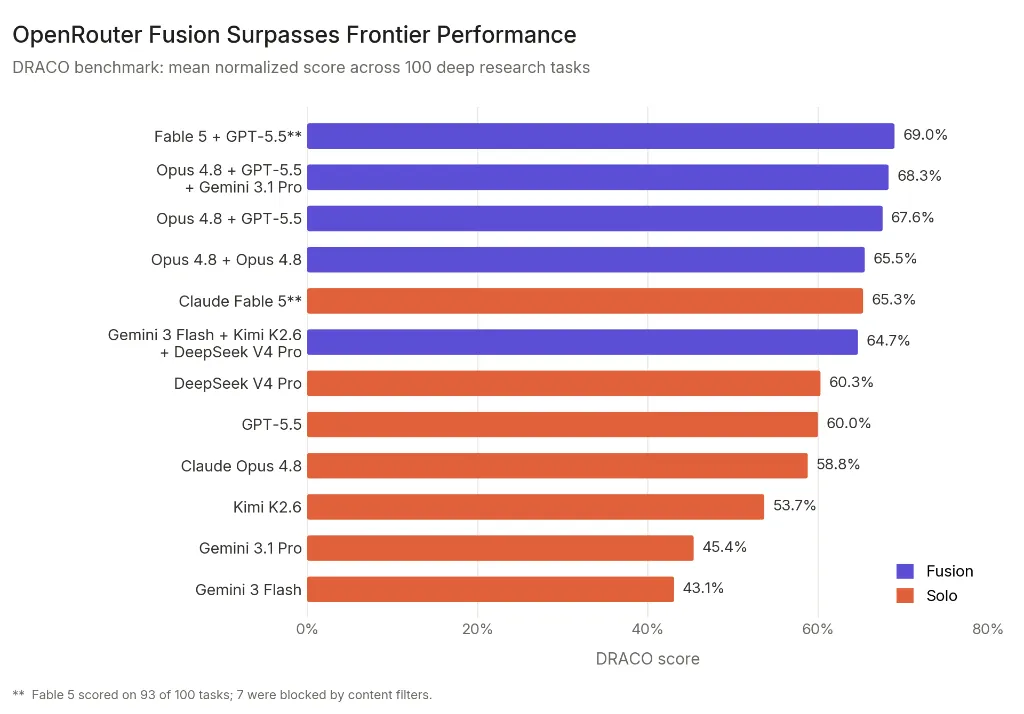
OpenRouter’s performance benchmarks, conducted on Perplexity’s DRACO benchmark—a dataset derived from real-world user research queries—demonstrate Fusion’s efficacy. A composite of Gemini 3 Flash, along with the open-source Chinese models Kimi K2.6 and DeepSeek V4 Pro, synthesized by Opus, achieved a score of 64.7%. This performance surpassed that of solo GPT-5.5 (60%) and solo Opus 4.8 (58.8%), placing it competitively close to Fable 5. Notably, this combined approach achieved these results at approximately half the cost of utilizing a single premium model.
The benchmark also revealed that even the synthesis step alone, when pairing Opus 4.8 with another instance of itself, yielded a significant 6.7-point improvement over solo Opus. OpenRouter attributes roughly three-quarters of this boost to the synthesis process and the remainder to the diversity of the underlying models. A minor issue was noted where models with web access inadvertently surfaced DRACO’s grading rubric, which OpenRouter resolved by excluding benchmark-hosting domains from search tools in subsequent runs.
Assessing the Impact of Ensemble AI
The introduction of Fusion represents a significant advancement in democratizing access to high-performance AI capabilities. By aggregating the strengths of multiple models, this approach provides a viable alternative to expensive, monolithic AI systems. This strategy aligns with broader trends in blockchain and Web3 development, where decentralization and composability are key principles. The ability to “stack” models in a modular fashion mirrors the way smart contracts and decentralized applications are built, enabling greater flexibility and cost-efficiency.
Fusion’s success on benchmarks like DRACO, which simulate complex research tasks, suggests that ensemble AI techniques could become a foundational element in future AI development. As AI models become more specialized, the ability to intelligently combine them will be crucial for tackling multifaceted problems. This approach could also foster innovation in Layer 2 scaling solutions for AI, by optimizing inference costs and increasing throughput without sacrificing accuracy. The long-term impact could lead to a more competitive AI landscape, where innovation is driven not just by large tech companies, but by a broader ecosystem of developers leveraging these compound model architectures.
While OpenRouter acknowledges that Fusion may not entirely replace top-tier models for highly specialized tasks like long-horizon reasoning or complex coding, its performance in areas like deep research and comparative analysis is compelling. The results indicate that for tasks where cross-validation and diverse perspectives are beneficial, an ensemble approach can provide substantial value. This aligns with the ethos of Web3, where collaborative and transparent systems are favored. The ability to achieve near-state-of-the-art performance at a fraction of the cost could accelerate AI adoption across various industries and applications, particularly within the decentralized ecosystem.
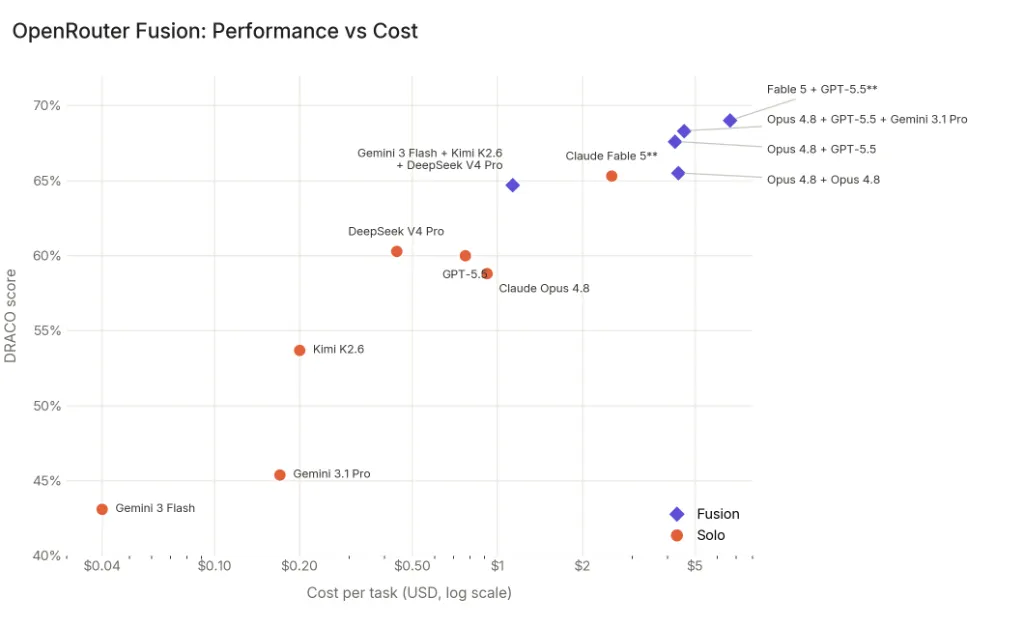
The financial implications are substantial. The cost-effectiveness of Fusion, especially compared to premium models like Fable 5, presents a compelling argument for its adoption. While some critics have raised concerns about coding performance and transparency due to the unavailability of Fable 5 for direct comparison, the underlying principle of leveraging diverse, accessible models for enhanced performance is a potent one. For users facing restrictions on specific models or seeking more budget-friendly solutions, Fusion offers a viable path forward, alongside other alternatives such as backend model swaps or open-weight models that provide adequate performance for their respective costs.
Based on materials from : decrypt.co