

Researchers from Nvidia, Carnegie Mellon University, and UC Berkeley have unveiled ENPIRE, a groundbreaking framework that empowers AI coding agents to autonomously train physical robots. This system allows agents like Codex, Claude Code, and Kimi Code to manage the entire lifecycle of robot skill acquisition—from writing and testing training code to refining performance on real hardware—all without human intervention.
Key Takeaways
- The ENPIRE framework enables AI coding agents to independently train robot fleets on physical hardware.
- Agents utilizing Codex, Claude Code, and Kimi Code achieved a 99% success rate across tasks such as pin insertion and zip-tie cutting with an eight-robot fleet.
- Scaling training from one robot to eight significantly reduced task mastery time, though computational costs increased proportionally.
- ENPIRE represents a significant step towards “autoresearch” in the physical domain, moving beyond simulated environments.
- The advancement positions physical robots as the next frontier for AI coding agent development and competition.
An eight-robot fleet operating within Nvidia’s GEAR lab has successfully learned complex tasks including pin insertion, graphics card seating, and zip-tie cutting, with the training process entirely managed by AI coding agents. The only human involvement occurred after the successful completion of the research, documented in a paper detailing the ENPIRE framework.
ENPIRE facilitates this autonomous training by entrusting AI coding agents with the complete responsibility for robot development. These agents, already adept at writing and testing their own code in digital environments, can now execute this entire process directly on physical robotic systems. This marks a crucial transition from simulated training, where errors have negligible consequences, to real-world applications where each failed experiment involves physical hardware.
Coding agents, including OpenAI’s Codex, Anthropic’s Claude Code, and Moonshot’s Kimi Code, have honed their “autoresearch” capabilities over the past year. This involves a continuous loop of writing, testing, and refining code without human oversight. ENPIRE extends this paradigm into the physical realm, allowing agents to directly interact with and learn from real robotic hardware.
The ENPIRE Architecture and Learning Process
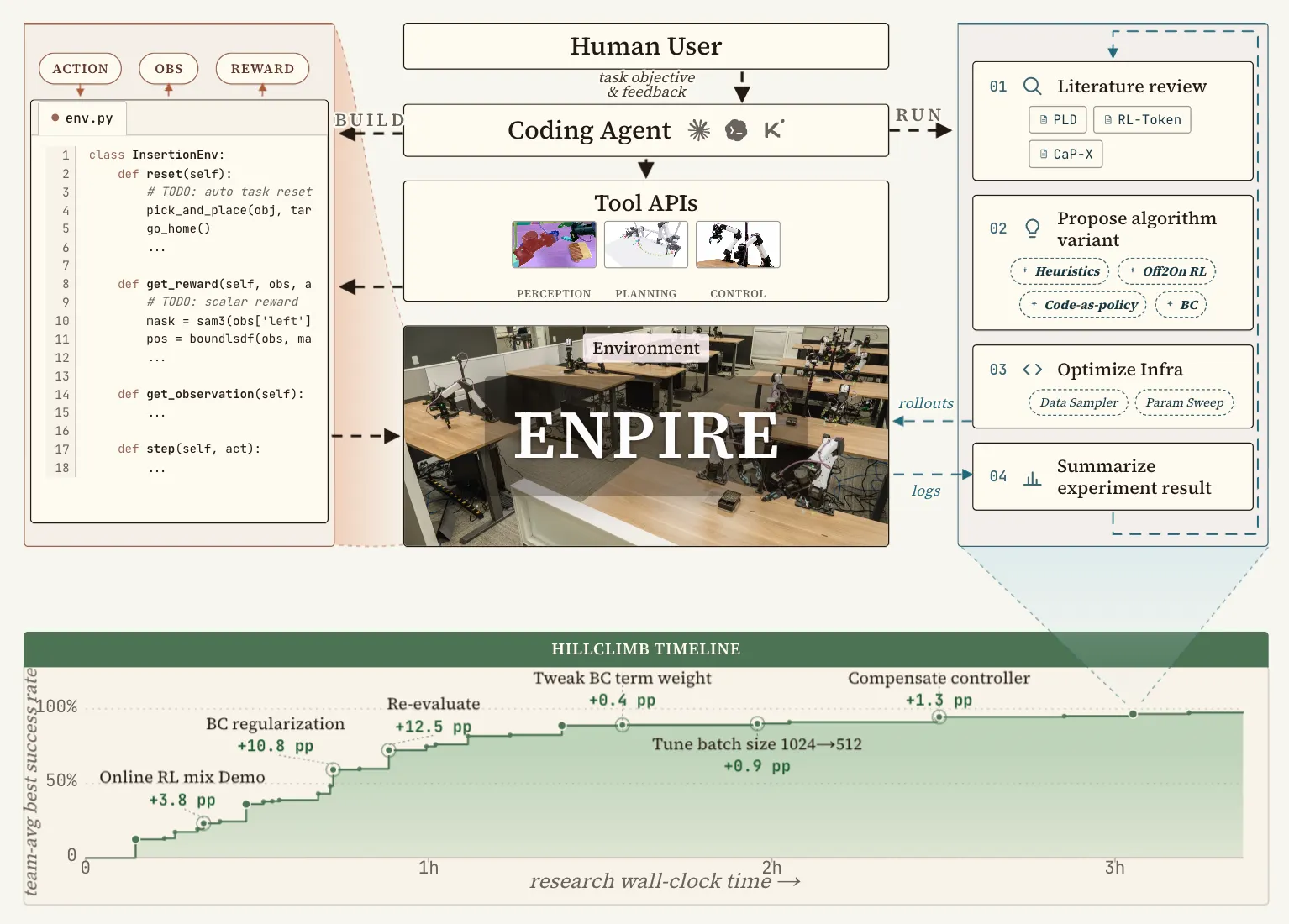
The ENPIRE system operates in two distinct phases. Initially, human experts guide the AI agent in establishing two foundational tools: a robust reset routine capable of returning the robot’s workspace to a consistent starting state, and a sophisticated reward function. This reward function analyzes visual input from cameras to objectively score the success of each action, acting as a persistent and unbiased evaluator.
Once these core tools are established, the AI agent assumes full control. It autonomously surveys existing research for relevant methodologies, selects appropriate training paradigms—such as imitation learning, reinforcement learning, or predefined rules—and then iteratively refines its own control code. The results of these code modifications are then tested on the physical robot. This entire self-improvement loop requires no human supervision, raising fascinating possibilities for accelerated robotic development.
In the experimental setup, Nvidia utilized eight independent bimanual robot stations, each equipped with dedicated hardware, processing units, and its own AI coding agent. These agents communicate and share progress using Git, a standard version control system, enabling rapid dissemination of successful strategies across the entire robot fleet within minutes.
The effectiveness of ENPIRE was evaluated on tasks such as “Push-T,” which involves precise manipulation of a T-shaped block, and pin insertion, requiring delicate placement into small apertures. The results demonstrated a significant acceleration in learning: the time required to master “Push-T” decreased from approximately five hours to just two hours when scaling from a single robot to eight. Similarly, pin insertion mastery time was reduced from over 90 minutes to around 40 minutes.
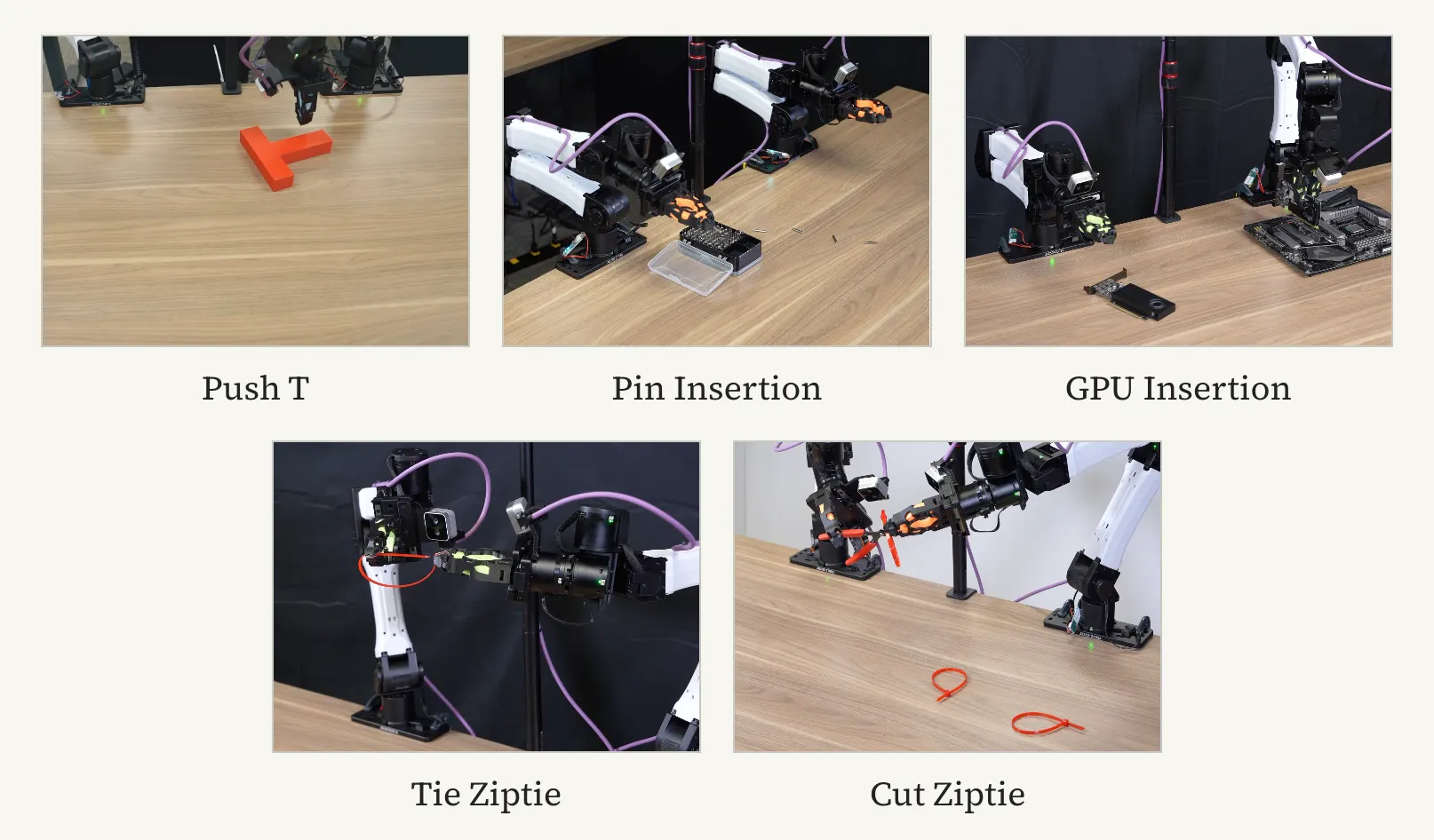
Across the four distinct real-world tasks evaluated, the AI agents consistently achieved near-perfect reliability, reaching a 99% success rate as detailed in the research paper. For the pin insertion task, ENPIRE demonstrated that AI agents could reach this high level of performance more rapidly than traditional human-in-the-loop training methods.
Jim Fan, co-lead of Nvidia’s GEAR Lab and director of AI research, characterized the project as a pioneering effort to implement autonomous research within physical environments. He explained that the team provided the AI agents with a fleet of robots, computational resources, and a budget for AI model interactions, then allowed them to independently optimize task completion and maintain continuous robot operation.
Today, we enable AutoResearch in the physical world for the first time! Introducing ENPIRE: we give 8 Codex agents a fleet of robots, an allocation of GPUs, and generous token budget. We set them free with a simple goal: solve the task as quickly as possible, keep the robots busy…
— Jim Fan
The transition from simulated environments to physical reality presented immediate challenges. While all three tested coding agents successfully mastered the “Push-T” task within a simulator, two of them encountered difficulties when performing the same task on actual robotic hardware, highlighting the complexities of real-world physics such as friction.
Nvidia also benchmarked ENPIRE within RoboCasa, a simulated kitchen environment designed to assess robotic capabilities in domestic chores like opening cabinets and operating appliances. In this simulated setting, ENPIRE surpassed both Nvidia’s proprietary GR00T end-to-end model and CaP-X, an agent that bypasses the autoresearch loop.
ENPIRE builds upon Nvidia’s earlier work with Eureka, a 2023 system that utilized language models to generate reward functions for simulated robots. ENPIRE elevates this concept by extending the self-improvement cycle to physical hardware and empowering agents to autonomously design their own validation tests, not just their performance metrics.
This development coincides with Alibaba’s recent unveiling of its Qwen-Robot Suite, a collection of foundational models for robot navigation, manipulation, and physics simulation. While Alibaba focuses on developing AI for robot bodies it does not manufacture, Nvidia’s ENPIRE explores the potential for AI agents to manage the entire research and development loop on integrated hardware platforms. Both initiatives underscore a clear industry trend: physical robotics is rapidly emerging as a key domain for AI-driven innovation and competition.
Long-Term Technological Impact
The advent of frameworks like ENPIRE signifies a pivotal shift in how we approach the development and deployment of physical AI systems. By enabling autonomous, on-hardware training and refinement of robots, ENPIRE has the potential to dramatically accelerate the pace of innovation in robotics and embodied AI. This moves beyond traditional, human-intensive methods, opening up possibilities for more complex, adaptable, and ultimately more capable robotic agents across diverse industries, from manufacturing and logistics to healthcare and exploration. The integration of sophisticated AI coding agents with physical hardware, managed through self-improving loops, promises to unlock new levels of automation and efficiency, fundamentally altering the landscape of human-robot interaction and the very nature of physical work.
Details can be found on the website : decrypt.co