


Google Research has unveiled TurboQuant, a novel compression algorithm designed to significantly reduce the memory footprint of large language models (LLMs) during inference. This breakthrough addresses a critical bottleneck in AI deployment, particularly as context windows expand towards millions of tokens. The technique promises to decrease the memory required for these operations by at least sixfold without any discernible loss in accuracy, a feat that has already sent ripples through the technology and hardware sectors.
Key Takeaways
- Google’s TurboQuant algorithm can reduce LLM inference memory requirements by a factor of six or more.
- The method claims zero loss in accuracy during inference, a significant advancement for AI deployment.
- The technology focuses on compressing the KV cache, not the model weights themselves.
- Initial market reactions saw declines in memory stock prices, indicating the potential impact of such efficiency gains.
- While promising, TurboQuant has been tested on research benchmarks with open-source models, and its real-world production impact is yet to be fully realized.
The paper, slated for presentation at ICLR 2026, introduces a method that tackles the substantial memory demands of the KV cache—the crucial component that stores conversational history for LLMs. As AI models process longer texts and interactions, this cache can swell to hundreds of gigabytes, creating a significant constraint on deployability and cost. Traditional quantization methods, which reduce data precision (e.g., from 32-bit floats to 8-bit integers), often introduce overheads from “quantization constants” needed to maintain accuracy. TurboQuant bypasses this by employing two sub-algorithms: PolarQuant, which separates vector magnitude and direction, and QJL (Quantized Johnson-Lindenstrauss), which efficiently compresses residual errors to a single bit, eliminating the need for stored constants.
In benchmarks using models like Gemma and Mistral, TurboQuant demonstrated the ability to match full-precision performance under 4x compression. Notably, it achieved perfect retrieval accuracy on challenging “needle-in-a-haystack” tasks extending up to 104,000 tokens. This capability is vital for LLMs that need to recall specific information from extensive documents or long conversations, a persistent challenge in the field.
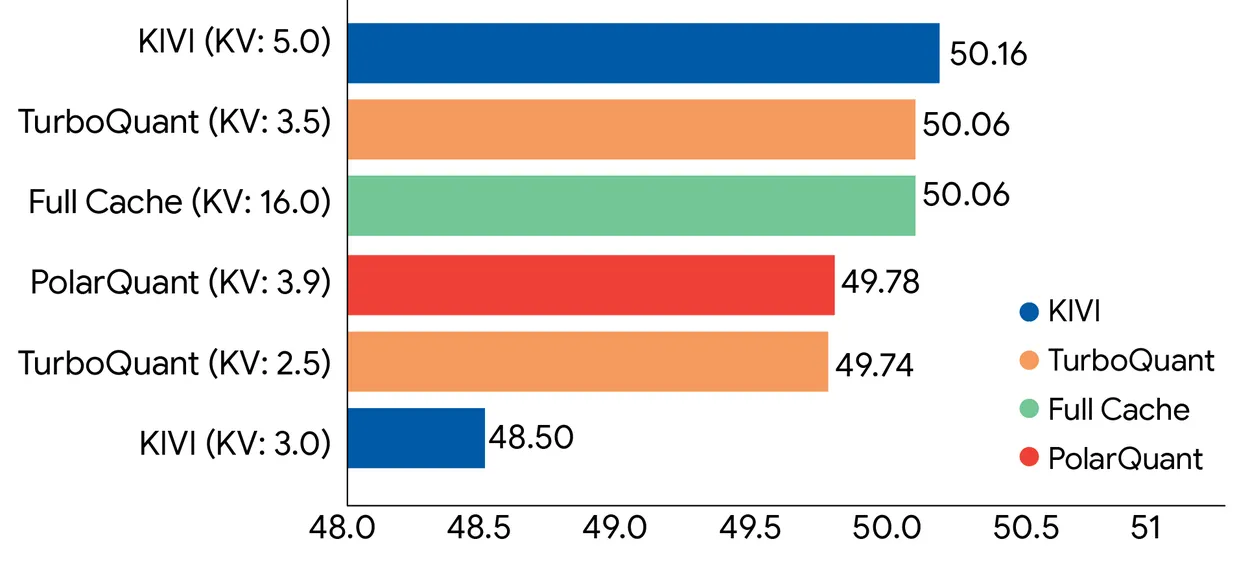
It is crucial to note that TurboQuant targets the compression of inference memory, specifically the KV cache, and not the foundational model weights. Compressing weights is a distinct and more complex challenge that remains largely unaddressed by this method. Furthermore, the “zero accuracy loss” claim pertains to the inference phase and the reconstructed data, not the permanent model parameters. The algorithm was tested on well-known open-source models rather than Google’s proprietary Gemini stack at scale, leaving room for further validation in diverse production environments.
Unlike approaches that require significant model retraining, TurboQuant is designed to be integrated into existing inference pipelines with minimal overhead and no need for fine-tuning. This ease of implementation is what has particularly concerned hardware manufacturers, as it suggests that existing GPU infrastructure could support significantly more demanding LLM applications with the same hardware, potentially altering the demand for new memory hardware.
Potential Long-Term Technological Impact
The long-term implications of TurboQuant, if successfully deployed in production, could be profound for the blockchain, AI, and Web3 ecosystems. By drastically reducing memory requirements for LLM inference, it lowers the barrier to entry for developing and deploying sophisticated AI agents and decentralized applications that leverage advanced language understanding. This could accelerate innovation in areas like AI-powered smart contracts, decentralized autonomous organizations (DAOs) with enhanced decision-making capabilities, and more intuitive user interfaces for blockchain platforms. Furthermore, improved efficiency could lead to more cost-effective Layer 2 scaling solutions, as the computational and memory overhead associated with running complex AI models on-chain or in off-chain computation nodes is reduced. Ultimately, technologies like TurboQuant could be instrumental in bridging the gap between cutting-edge AI research and practical, widespread application across the decentralized web.
Source: : decrypt.co