

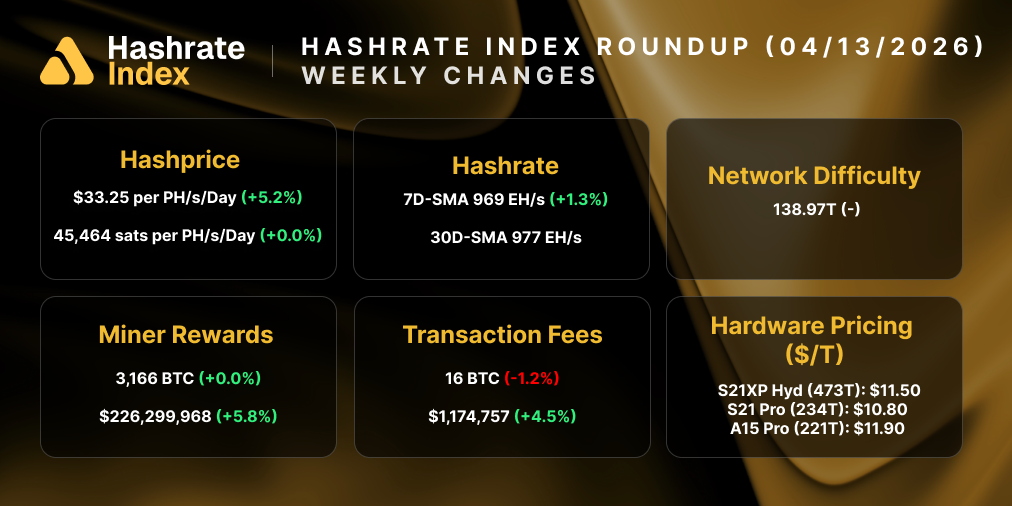
The Bitcoin mining sector has experienced a period of increased network hashrate and a rise in miner rewards, despite a slight dip in the USD hashprice. The total Bitcoin collected by miners in block rewards over the past week reached approximately 3,166 BTC, equating to around $226 million. Transaction fees contributed a smaller portion, totaling 16 BTC, or roughly $1.2 million.
Key Takeaways
- Network hashrate saw a significant increase of 4.73%, reaching a 7-day average of 930 EH/s.
- Miner rewards surged by 6.51% to 3,251 BTC due to a rise in fee income.
- Network difficulty experienced a minor decrease of -0.45%.
- Hardware pricing remained stable, with the S21XP valued at $25.70/TH.
- USD hashprice saw a slight decline of 1.05%.
Bitcoin’s price movement shows a positive trend, with an 8.0% increase from approximately $68,748 to $74,247. This contrasts with a year-to-date performance of -15.1%.
Impact on Network Security and Miner Profitability
The upward trend in network hashrate is a positive indicator for Bitcoin’s security. A higher hashrate means more computational power is dedicated to securing the network, making it more resistant to potential attacks. For industrial mining farms, the increased hashrate, coupled with a stable or slightly declining difficulty, suggests improved operational efficiency and potentially higher returns on investment, especially if they are utilizing newer, more energy-efficient ASICs. However, the slight drop in USD hashprice at $33.25 per PH/s/Day indicates that profitability may be hovering around the breakeven point for miners with higher operational costs or older, less efficient hardware. Small-scale miners, often operating with less advanced equipment and higher electricity costs, may find it increasingly challenging to remain profitable under current market conditions. The efficiency of mining hardware, measured in Joules per Terahash (J/TH), is a critical determinant of profitability. Fleets with efficiency ratings below 19 J/TH are currently earning an estimated $79 per MWh, while those in the 19-25 J/TH range earn $61 per MWh, and older machines (25-38 J/TH) are at $42 per MWh. This disparity highlights the growing importance of hardware upgrades and access to low-cost energy for sustained mining operations.
The BTC hashprice remained stable at 0.00045465 BTC per PH/s/Day. This metric is crucial for miners as it directly reflects their earnings in Bitcoin, irrespective of the USD exchange rate. The stability in BTC hashprice, despite fluctuations in the USD value, suggests that the overall economics of mining in terms of Bitcoin accumulation remain relatively consistent for the period.
Transaction fees, while a smaller component of miner revenue, showed a slight decrease, averaging 0.0163 BTC per block per day. This indicates a potential cooling in network congestion or a shift in user activity away from fee-intensive transactions during this specific week.
Looking ahead, the forward market is pricing in an average hashprice of $32.10 or 0.00044 BTC over the next six months. This suggests a cautious outlook, with expectations of slightly lower profitability in the near to medium term, reinforcing the need for efficient operations and strategic energy procurement.
Original article : hashrateindex.com