


Gen Z’s Waning Enthusiasm for AI Amidst Rising Usage
A recent study reveals a complex relationship between Generation Z and artificial intelligence, with a notable increase in AI usage coinciding with a significant decline in overall enthusiasm and hopefulness towards the technology. While Gen Z continues to integrate AI tools into their daily lives, particularly for academic and professional tasks, their sentiment has shifted towards skepticism and concern.
Key Takeaways
- Despite increased weekly usage, Gen Z’s excitement and hopefulness regarding AI have decreased substantially.
- Concerns are growing about potential cognitive decline and over-reliance on AI, impacting learning and skill development.
- Workplace anxiety is intensifying as AI adoption raises fears about job displacement and career trajectory.
- Trust in AI for accurate information and creative idea generation is diminishing among this demographic.
- Educational institutions are rapidly implementing AI policies, yet student perceptions of academic dishonesty are on the rise.
The survey, conducted by the Walton Family Foundation, GSV Ventures, and Gallup, polled 1,572 Americans aged 14 to 29. The findings indicate that approximately 51% of this demographic now utilize generative AI at least weekly, marking a 4% increase from the previous year. However, this rise in utility has not translated into greater optimism. Excitement surrounding AI has plummeted by 14 percentage points to just 22%, while hopefulness has fallen by 9 points, now resting at 18%. Conversely, feelings of anger or frustration towards AI have climbed by 9 points, reaching 31%.
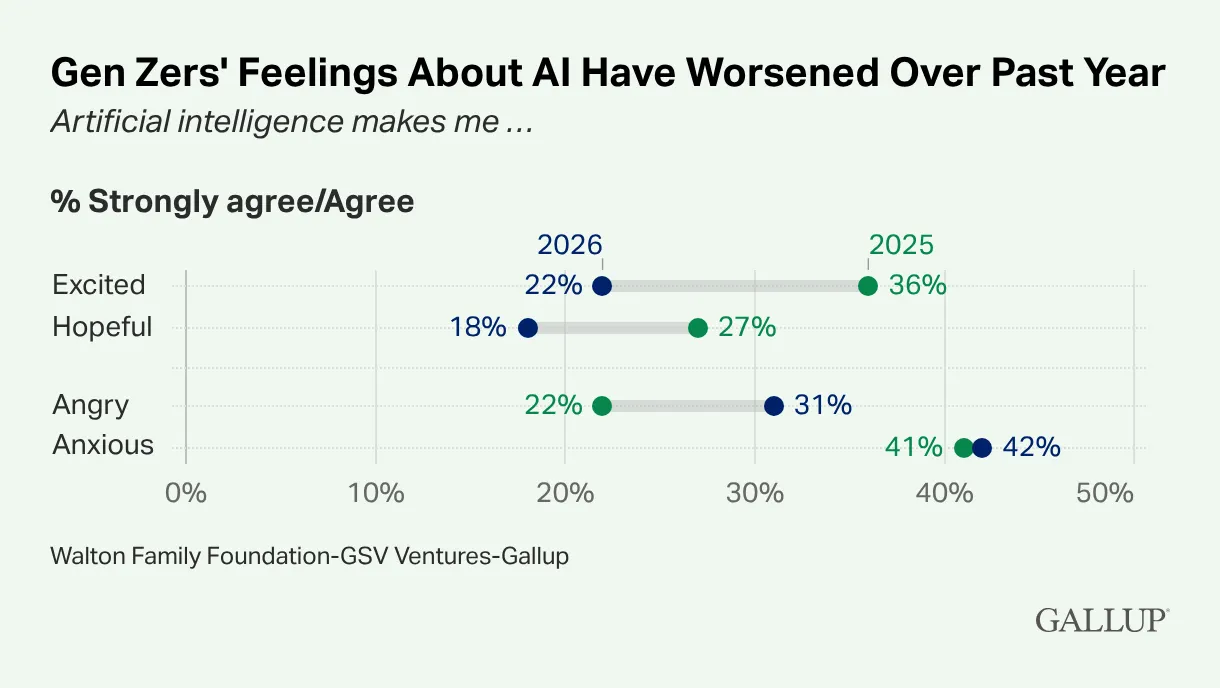
Even among the most frequent users—those engaging with AI daily—excitement levels have seen an 18-point year-over-year drop. Researchers note that Gen Z has become increasingly skeptical, moving from a neutral or slightly positive stance to a more negative outlook on AI’s long-term implications.
A significant concern highlighted by the study is the fear of dependency. Eight in 10 Gen Z individuals believe that relying on AI for faster task completion will impede their future learning capabilities, suggesting a worry that the tools designed to assist may ultimately diminish their inherent skills. This echoes earlier discussions on whether AI contributes to intellectual atrophy, with research linking overreliance on tools like ChatGPT to procrastination and memory impairment among students.
The impact on creativity and trust is also a growing apprehension. Only 31% of Gen Z respondents feel AI aids in generating new ideas, a decrease from 42% last year. Similarly, trust in AI for accurate information has declined from 43% to 37%. This trend aligns with research suggesting that while generative AI can boost individual output, it may simultaneously narrow the diversity and originality of creative work.
Within the professional sphere, skepticism is even more pronounced. Nearly half of employed Gen Zers (48%) now perceive AI’s risks as outweighing its benefits at work, an 11-point increase from the previous year. Only 15% view AI as a net positive for their careers, and a significant majority would prefer human interaction for services like tutoring, financial advice, or customer support over AI assistance. Trust in AI-augmented work stands at a mere 28%, starkly contrasting with the 69% trust level for exclusively human-driven tasks.
This apprehension is compounded by the visible impact of AI on white-collar jobs, which is occurring at a faster pace than anticipated. As Gen Z enters the workforce, they witness firsthand the potential for AI to displace roles they might aspire to. This sentiment is reflected in educational choices, with a separate Gallup study indicating that 42% of bachelor’s degree students have reconsidered their major due to AI’s evolving landscape.
Educational institutions are responding by rapidly implementing AI policies, with nearly three-quarters of K-12 schools now having such guidelines, a notable increase in a short period. However, these policies have not fostered greater trust. Instead, they appear to have solidified perceptions of academic dishonesty, with 41% of students believing their peers are using AI inappropriately for schoolwork.
“What we’re seeing in the data is a generation that recognizes AI’s utility but is increasingly concerned about its long-term impact on learning, trust, and career readiness,” stated Stephanie Marken, senior partner at Gallup. “Their growing skepticism signals a need for more thoughtful integration of these tools in both school settings and the workplace.”
The initial expectation was that Gen Z, as digital natives, would readily embrace AI, leading to seamless adoption and sustained enthusiasm. Instead, the data suggests a generation that utilizes AI primarily out of necessity, harbors growing distrust in its outputs, and fears that the convenience offered by AI comes at the cost of fundamental skill development. This cautious outlook is further influenced by observations of experts admitting AI’s significant role in their own work, which may be contributing to Gen Z’s overall reserve.
Long-Term Technological Impact and Web3 Integration
The evolving sentiment of Gen Z towards AI presents a critical inflection point for technology development and adoption, particularly within the blockchain and Web3 ecosystems. As this digitally native generation grows more wary of centralized AI solutions and their potential downsides—such as cognitive dependency and job displacement—their focus may shift towards decentralized alternatives that promise greater user control, transparency, and ethical alignment. This could accelerate the demand for Web3 technologies that inherently leverage blockchain for secure data management, decentralized AI models, and verifiable digital identity solutions. The growing skepticism might also fuel interest in AI applications that augment, rather than replace, human capabilities, fostering innovative collaborations between AI and blockchain-powered platforms. For instance, decentralized autonomous organizations (DAOs) could utilize AI for more efficient governance and decision-making, while AI agents could interact with smart contracts on various Layer 2 solutions to automate complex processes and enhance scalability. The development of AI models trained on verifiable, decentralized datasets could also mitigate concerns about bias and data privacy, making them more palatable to a generation that values authenticity and control. Ultimately, this shift in perspective could drive greater synergy between AI and blockchain, paving the way for a more robust, ethical, and user-centric Web3 future.
Details can be found on the website : decrypt.co