

Miners considering a pivot into AI infrastructure often report a significant experiential shift, describing it as entering an entirely different business. This divergence stems not solely from the increased complexity of managing compute resources, but more fundamentally from the distinct methodologies for procuring, deploying, and operating such infrastructure.
The discrepancy lies in conceptual understanding rather than technical capability. Grasping this distinction prior to committing resources can prevent considerable frustration and misallocation of capital.
Key Takeaways
- ASIC mining involves procuring standardized, off-the-shelf products (like t-shirts) where units are identical and performance is predictable.
- GPU infrastructure for AI requires assembling custom solutions from components (akin to tailored suits), with every decision impacting the final configuration.
- Reference architectures for GPU systems provide a blueprint but necessitate detailed configuration of storage, networking, and compute elements, unlike the plug-and-play nature of ASICs.
- The procurement and deployment of GPU infrastructure are significantly more complex due to interdependencies between hardware, facility build-out, and connectivity, leading to longer timelines and higher costs.
- Operational differences include ongoing software and driver management for GPUs, contrasting with the more static nature of ASIC mining operations.
- Monetization for GPU infrastructure demands a distinct go-to-market strategy and customer management, unlike the automated process of Bitcoin mining.
- Existing mining operations possess valuable assets, particularly in power infrastructure, but must adapt their mindset to the custom build requirements of AI compute.
The Core Difference: Standardization vs Customization
Fundamentally, ASIC procurement involves acquiring a finished product. A specific ASIC model arrives fully specified and tested, ready for deployment. Each unit is identical, simplifying ordering, scaling by quantity, and straightforward integration into existing racks. Configuration is limited to network pool assignment, representing a standardized, rapid, and predictable process.
Conversely, establishing GPU infrastructure for AI workloads involves sourcing individual components. While pre-configured servers may be available, specific storage, networking, and interconnect solutions are often required, tailored to the unique demands of AI applications. This necessitates a custom build approach, where no single solution is universally off-the-shelf.
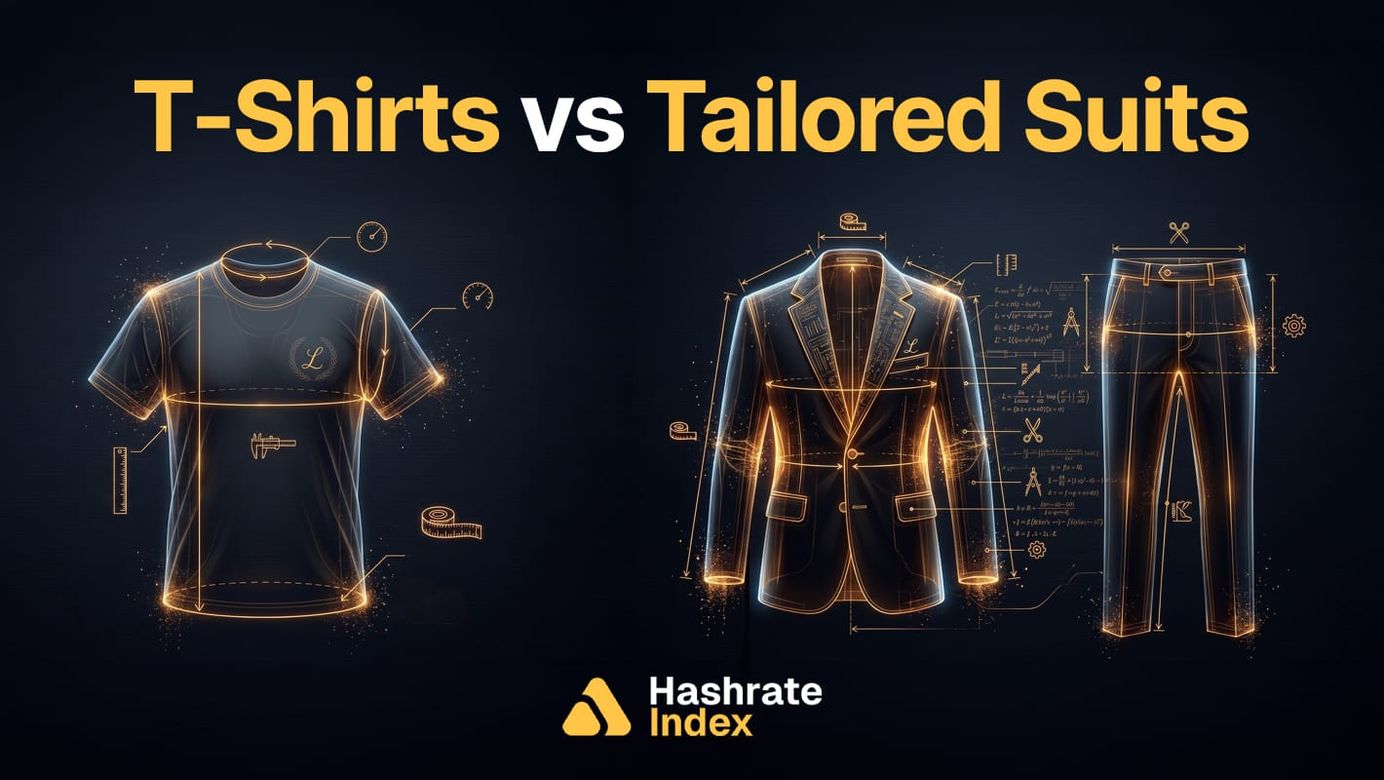
This contrast is analogous to the difference between purchasing a standard t-shirt and commissioning a bespoke tailored suit.
T-Shirts (ASICs): Pick a Size, Get Dressed
The scalability of ASIC mining is directly attributable to its standardized nature. Miners select from established models (e.g., S21, M53), choosing quantity and delivery schedules. Each unit adheres to precise specifications, exhibiting uniform power consumption, cooling requirements, and physical footprint. This uniformity mirrors the standardization found in t-shirt sizing, where an ‘XL’ from any reputable brand offers a consistent fit and utility across various settings.
The growth trajectory of mining operations, scaling from tens to thousands of units, was enabled by this lack of increasing complexity. Repeatable processes were feasible because each hardware unit was identical, ensuring that scaling simply involved increasing order volume.
Tailored Suits (GPU Infrastructure): Reference Architectures Are Like Suit Styles—Dependent on Their Use
While reference architectures, such as NVIDIA’s DGX BasePOD, exist for GPU infrastructure, they function as foundational blueprints rather than complete, ready-to-deploy products. Building GPU infrastructure necessitates selecting specific configurations for storage capacity, CPU count, RAM, network interface card (NIC) throughput, power delivery, cooling systems, and interconnect topology. Each selection has cascading effects on other components.
This process is akin to tailoring a suit. A reference architecture provides a starting template, but the final configuration must be adapted to specific use cases and requirements. The process is time-intensive and capital-intensive, with misconfigurations leading to immediate and significant operational inefficiencies. An improperly configured GPU cluster, like a tuxedo worn to a casual event, may possess excellent components but fail to meet the demands of its intended workload, often requiring substantial rework.
The industry commonly employs the SCORN acronym (Storage, CPUs, Operating System, RAM, NICs) to denote the critical variables in GPU server specifications. Each variable influences workload compatibility. While reference architectures streamline initial design choices, the configuration decisions remain substantial and are absent in ASIC procurement. Industry discussions highlight that procurement complexity, including these interdependencies, frequently impedes AI infrastructure transitions more than technical challenges alone.
Why This Matters in Practice
This fundamental difference becomes acutely apparent during procurement. Issues such as colocation facility readiness, fiber connectivity lead times, fluctuating component costs (e.g., RAM), and network bandwidth limitations can collectively derail deployment schedules. Unlike ASICs, where power delivery issues might be resolved by upgrading electrical circuits, GPU infrastructure misalignments in networking, storage, or compute-to-memory ratios can necessitate complete system rebuilds.
Scaling these operations exacerbates these challenges. High-bandwidth interconnects are critical for training clusters, while low-latency connections are essential for inference. Site selection, which was less critical for mining due to its isolation tolerance, becomes paramount for AI inference workloads requiring proximity to end-users. The coordination of hardware acquisition, facility development, and network provisioning represents a complex, interdependent system with procurement timelines often extending from six to eighteen months.
The Operational Complexity Extends Beyond Procurement
Post-deployment, operational differences become pronounced. ASIC mining operations are relatively static, focusing on hashrate monitoring and hardware replacement. GPU infrastructure demands continuous management of operating systems, drivers, firmware, and component compatibility. Diagnosing underperformance in GPU servers requires expertise in a broader range of potential issues, including software configuration, thermal management, and network saturation.
Monetization strategies also diverge significantly. While ASIC mining offers an automated revenue stream through pool participation, GPU infrastructure requires a defined go-to-market approach, whether through capacity rental, cloud services, or proprietary application development. This involves managing customer expectations, service-level agreements (SLAs), and sales cycles, transforming infrastructure operation into a customer-facing business.
What This Means for Miners
Experienced ASIC miners possess valuable foundational skills in large-scale power management and data center operations, which are directly transferable. Existing power infrastructure represents a significant asset for AI/HPC facilities. However, certain mining-centric assumptions may prove detrimental.
Miners accustomed to rapid, weeks-long deployments and linear scaling may find the multi-quarter timelines and custom build requirements of GPU infrastructure challenging. Furthermore, operational norms in mining, such as minimal compliance overhead and the absence of export controls on equipment, do not translate to the GPU sector. Regulatory considerations are a critical factor in GPU procurement.
A successful transition hinges on recognizing that GPU infrastructure requires building bespoke solutions for specific workloads, rather than deploying standardized equipment at scale. This necessitates patience, specialized personnel, and a revised understanding of project completion criteria. While the market opportunity for AI compute is substantial, miners must carefully distinguish which operational instincts are transferable and which could hinder their progress.
The Bottom Line
The efficacy of ASICs lies in their commoditized nature, enabling mass replication. GPU infrastructure, conversely, is built upon understanding specific workload requirements and tailoring the solution accordingly. This custom approach involves extended timelines, increased costs, and a demand for different skill sets, yet offers significant market potential. Miners’ existing power assets provide a distinct advantage in this evolving landscape.
The critical challenge lies in adapting established mining operational paradigms to the unique demands of AI compute infrastructure. A thorough evaluation of site suitability against workload necessities, rather than relying solely on marketing projections, is imperative. The window for leveraging conversion advantages is narrowing as dedicated AI facilities proliferate.
The optimal time for such an assessment was in the past; the present offers the next best opportunity.
Original article : hashrateindex.com