


The Bitcoin network has reached block 945,000, marking the precise midpoint between the April 2024 and April 2028 halvings. This milestone provides a critical juncture for evaluating mining operational strategies over the preceding 23 months and for forecasting the necessary adjustments for the upcoming 105,000 blocks. Analysis of this period indicates that fixed pool payouts have consistently outperformed standard Full Pay Per Share (FPPS) mining for both Bitcoin and US Dollar denominated revenues. The data suggests that preparation and risk management, rather than speculative trading, will be paramount for miners navigating the latter half of the current halving epoch.
Key Takeaways
- Fixed pool payout strategies have demonstrated superior performance compared to spot FPPS mining during the first half of the current halving cycle (May 2024 – March 2026).
- BTC-denominated hedging strategies, particularly the 5-month hedge, offered the highest returns, yielding an estimated additional 50 BTC per 1 EH/s operation over 23 months compared to spot mining.
- Average USD hashprice has seen a significant decline, averaging $48.52/PH/s/day post-halving, a 38% decrease from the pre-halving average, reaching a low of $31.27 in March 2026.
- The second half of the halving epoch necessitates proactive operational improvements, cost reduction, and revenue certainty measures, with forward markets currently pricing a conservative hashprice.
- Acquiring advanced mining hardware at current depressed secondary market prices, combined with hedging strategies, presents a significant opportunity for enhanced profitability and competitive advantage.
The reduction in block subsidies from 6.25 BTC to 3.125 BTC, occurring at block 840,000 on April 20, 2024, fundamentally repriced the economics of Bitcoin mining. The subsequent 23 months, concluding with block 945,000, were shaped by a confluence of factors: the direct impact of the subsidy halving, a fluctuating difficulty adjustment arc influenced by the deployment of next-generation ASIC hardware, a notable BTC price compression from its cycle peak, and a sustained period of historically low transaction fees which represented a minimal fraction of total block rewards.
Under traditional spot hashprice (FPPS) conditions, miners bore the full brunt of these economic shifts. The average monthly USD hashprice across this period registered at $48.52 per PH/s/day, a substantial 38% reduction from the $78.43 average observed in the 21 months preceding the halving. This trend continued into early 2026, with March marking an all-time monthly low of $31.27.
Impact on Network Security and Miner ROI
The economic pressures detailed above have a direct correlation with both network security and miner Return on Investment (ROI). A sustained decline in hashprice, particularly below the operational breakeven point for older or less efficient ASIC models, leads to their deactivation. This can temporarily reduce the overall network hashrate. However, the difficulty adjustment mechanism inherently counteracts this by lowering the mining difficulty, which in turn increases the hashprice for the remaining active miners. This creates a dynamic equilibrium, but one that is increasingly tilted towards operators with access to the most energy-efficient hardware and the lowest electricity costs.
For industrial-scale mining farms, the reduced hashprice necessitates a sharpened focus on operational efficiency and capital expenditure optimization. Investments in newer ASICs, such as the S21 series, are critical for maintaining profitability, as their superior energy efficiency (e.g., hashcost of $21.00/PH/s/day at $0.05/kWh) significantly outpaces older models like the S19j Pro ($35.40/PH/s/day at the same energy rate). The data indicates that strategies like forward hashrate sales, which provide upfront capital, can facilitate these essential fleet upgrades, effectively de-risking ROI projections and improving access to capital for expansion or modernization.
Conversely, small-scale miners, often operating with older hardware and higher electricity costs, face a more precarious situation. The substantial drop in hashprice makes it increasingly difficult to cover operational expenses, let alone achieve a positive ROI. The strategies recommended, such as hedging hashprice through fixed payouts and acquiring hardware at lower market prices, are therefore not merely beneficial but potentially essential for their continued operation. Without these risk-mitigation tactics, small-scale miners are highly vulnerable to market volatility and economic downturns within the mining sector.
The period from May 2024 to March 2026 saw every form of rolling hedge strategy outperform spot mining, irrespective of the contract denomination or hedge duration. BTC-denominated strategies showed a more pronounced advantage, attributed to the forward market’s underestimation of network hashrate growth and overestimation of transaction fees, while USD-denominated strategies provided more moderate outperformance.
For an operation with 1 EH/s of hashrate, spot miners accumulated approximately 400 BTC over the 23 months. Implementing a 5-month rolling forward BTC hedge strategy yielded approximately 450 BTC, representing an additional ~50 BTC from the same hardware without incremental capital outlay. It is crucial to note that hedging is primarily a cost of business aimed at predictable cash flows and valuation enhancement, rather than a direct revenue-generating activity.
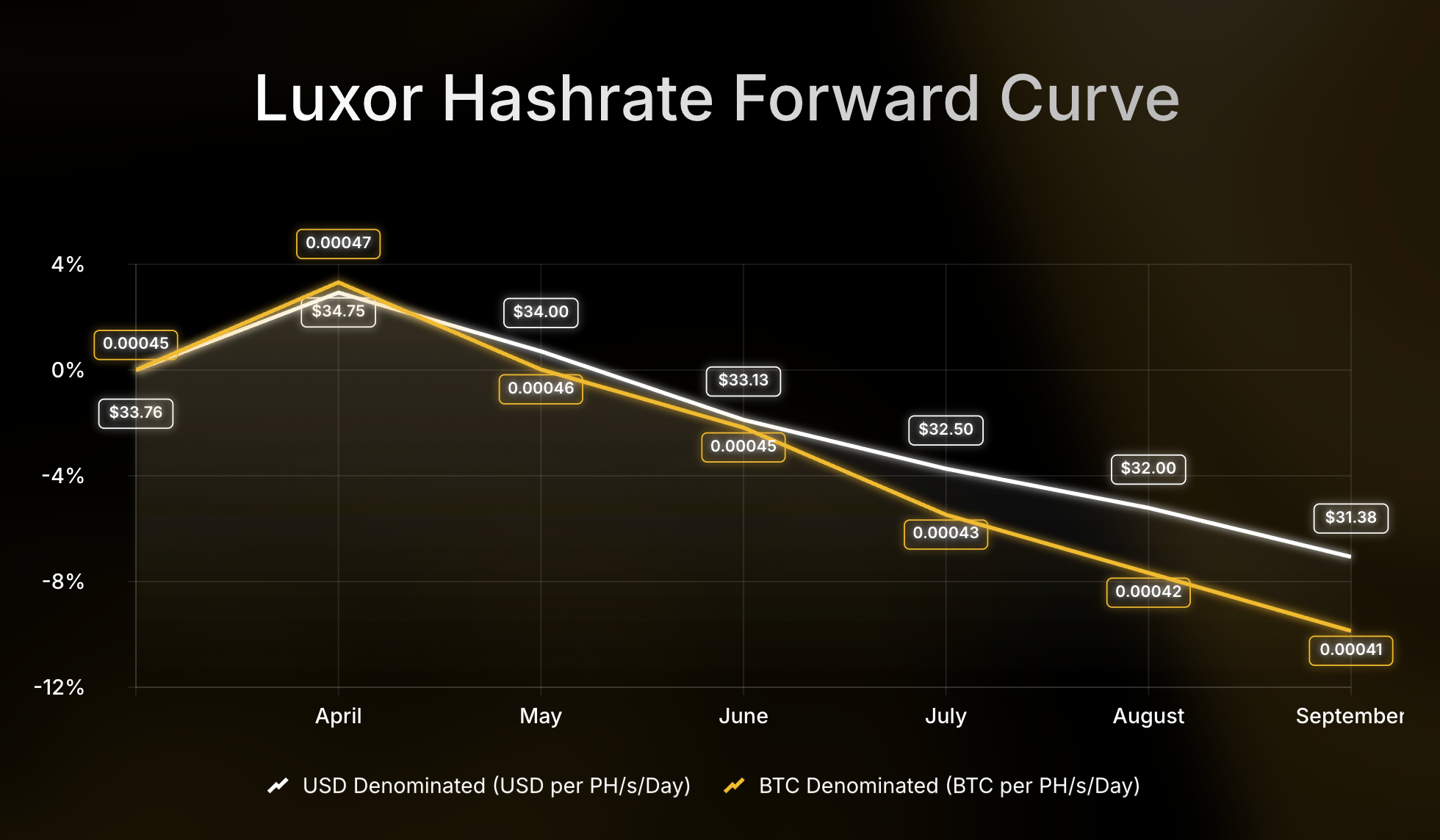
The conditions approaching the second half of the current halving epoch are marked by significant challenges. USD hashprice is hovering near all-time lows, with the forward market pricing approximately $32 per PH/s/day for the April–September 2026 period. While difficulty has seen recent downward adjustments, this also implies a rapid re-activation of marginal mining hardware when hashprice briefly improves, leading to recurring compression. BTC price action remains volatile, and transaction fees continue to represent a structurally small portion of mining revenue. Consequently, the second half will likely reward miners who focus on operational efficiency, cost reduction, and securing revenue certainty.
1. Hedge Hashprice with Fixed Payouts
For operations with tight margins, forward selling of hashrate can convert uncertain future revenue into predictable cash flow. This strategy provides a stable financial foundation, particularly during market downturns, and the upfront capital can be re-invested into more efficient hardware.
2. Finance Fleet Upgrades with Upfront Payouts
The cost differential between older and newer generation ASICs is substantial. Utilizing upfront pool payouts can provide non-dilutive capital to finance fleet upgrades, significantly reducing operational hashcosts and improving overall efficiency, which is critical for maintaining profitability in a declining hashprice environment.
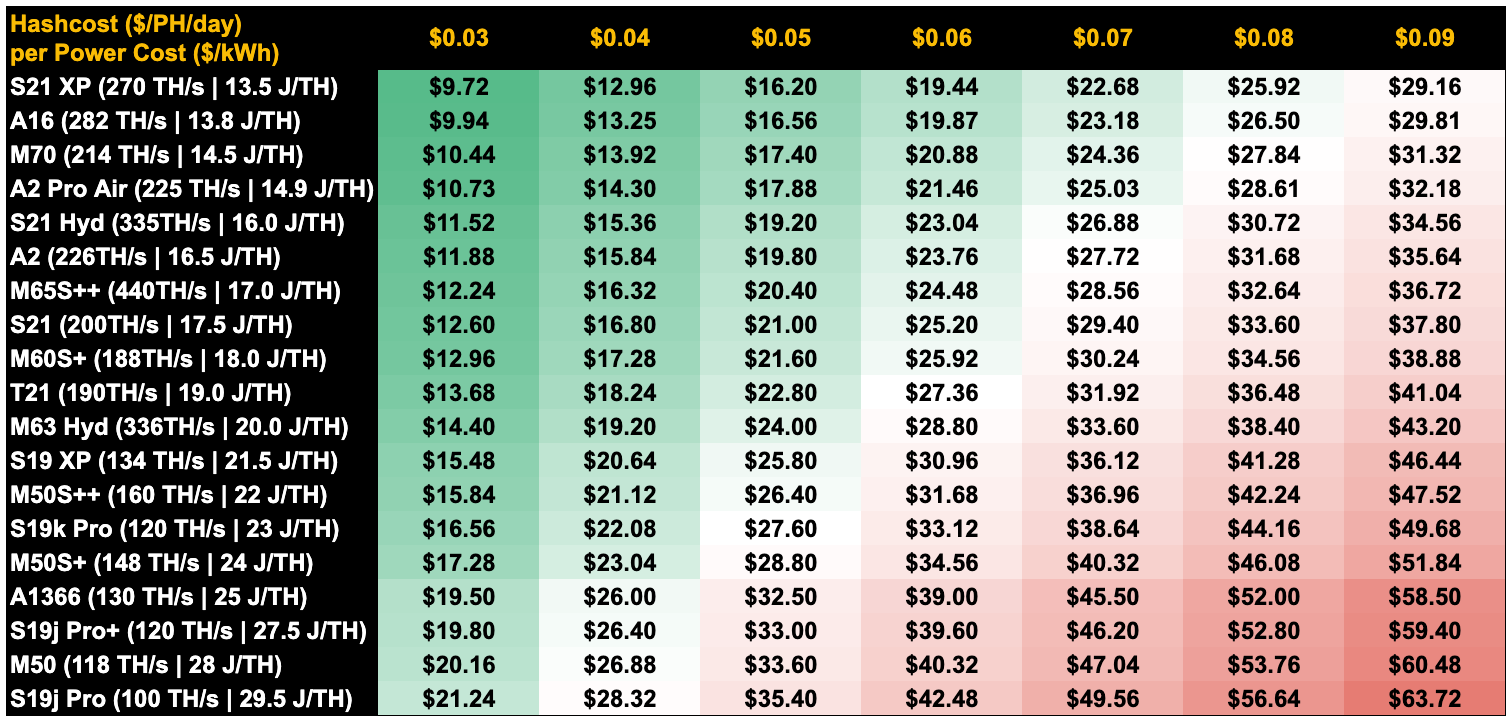
3. Lower Your Hashcost By Buying Hashrate
For miners operating legacy equipment with high hashcosts, acquiring hashrate directly from the forward market offers a strategic way to secure a predictable cost basis, preserving margins in the current low hashprice environment.
*Bonus* Buy Hardware While Everyone Else Is Selling
The secondary ASIC market is currently experiencing cycle lows. Operators have the opportunity to acquire advanced hardware at significantly reduced prices, which can lead to amplified returns, especially when combined with hedging strategies.
These strategies are synergistic and can compound an operator’s competitive advantage. An operator who hedges existing hashrate to fund the acquisition of new, more efficient hardware will enter the next phase of the halving epoch with improved margins and revenue stability. This approach can foster a continuous cycle of growth and operational enhancement.
The forward market is currently pricing an average hashprice of approximately $32.96 per PH/s/day over the next six months. This presents an opportunity for sellers to lock in this price today and for buyers to secure this hashcost through September 2026.
Original article : hashrateindex.com