


OpenAI has upgraded the core engine powering ChatGPT, replacing GPT-5.3 Instant with GPT-5.5 Instant as the default model for its vast user base. This subtle yet significant shift promises more accurate, concise, and context-aware interactions for hundreds of millions of users globally. The upgrade, while not accompanied by a flashy announcement, introduces substantial improvements, most notably a significant reduction in AI-generated inaccuracies, often referred to as hallucinations.
Key Takeaways
- GPT-5.5 Instant is now the default ChatGPT model, replacing GPT-5.3 Instant for all users.
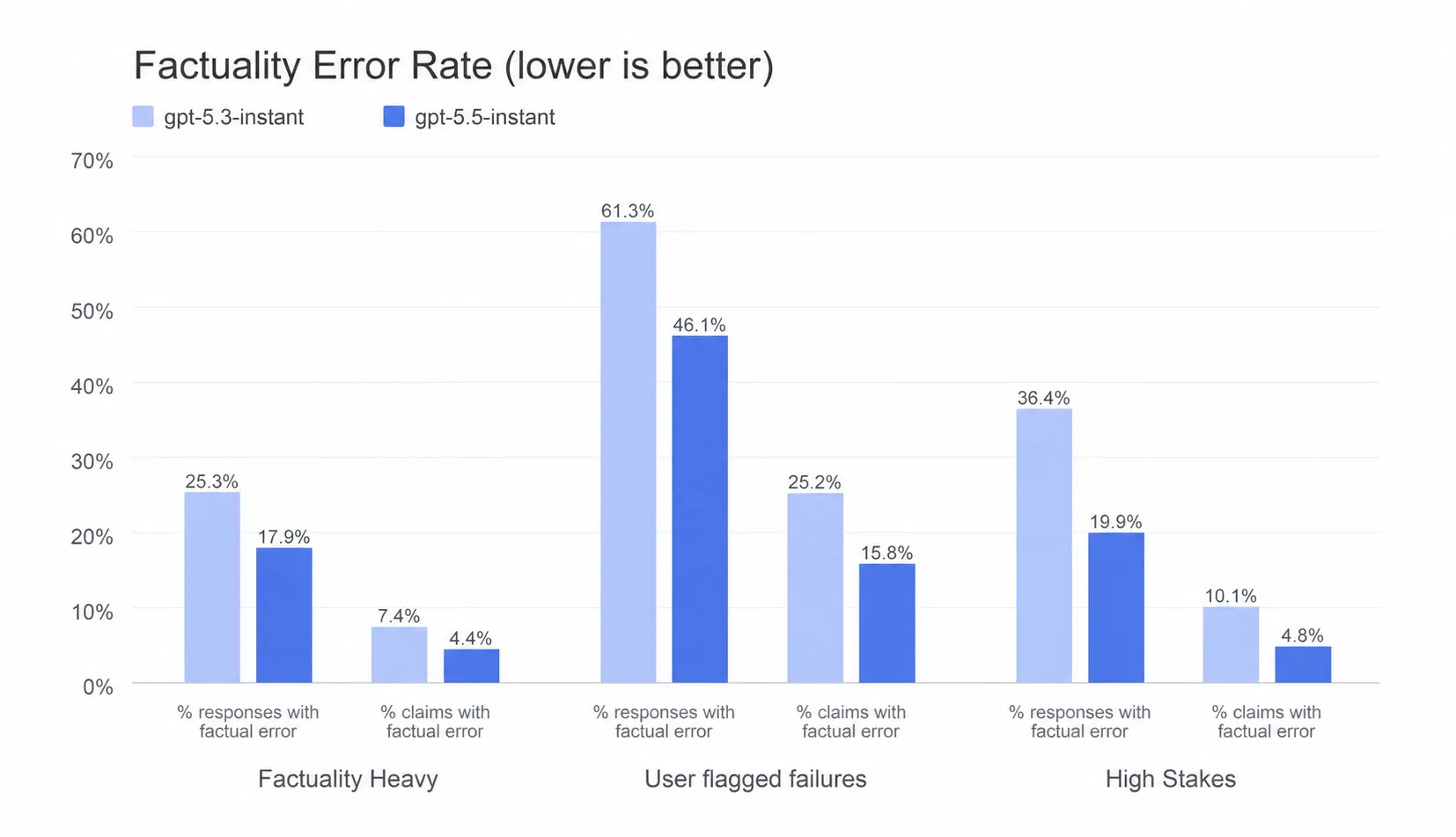
- Internal tests show a reduction of over 50% in hallucinated claims on high-stakes prompts.
- The model demonstrates enhanced accuracy on medical and factual queries.
- GPT-5.5 Instant introduces improved memory and personalization features with user control over context.
- It’s the first “Instant” tier model classified as “High Capability” in cybersecurity and biological domains, necessitating advanced safeguards.
The GPT family from OpenAI is structured into tiers designed for different use cases. The “Instant” tier, now represented by GPT-5.5 Instant, is optimized for speed and general-purpose applications, making it the workhorse for everyday user interactions. This contrasts with the “Thinking” tier, which is built for slower, more intensive analytical tasks, and the “Pro” tier, designed for maximum performance on complex, high-demand operations.
A persistent challenge for large language models has been their tendency to “hallucinate” or generate factually incorrect information. OpenAI reports that GPT-5.5 Instant has significantly improved in this area. In internal testing using prompts related to critical fields such as medicine, law, and finance, the new model produced 52.5% fewer inaccurate statements compared to its predecessor. Further analysis on prompts flagged by users for factual errors showed a 37.3% reduction in inaccuracies.
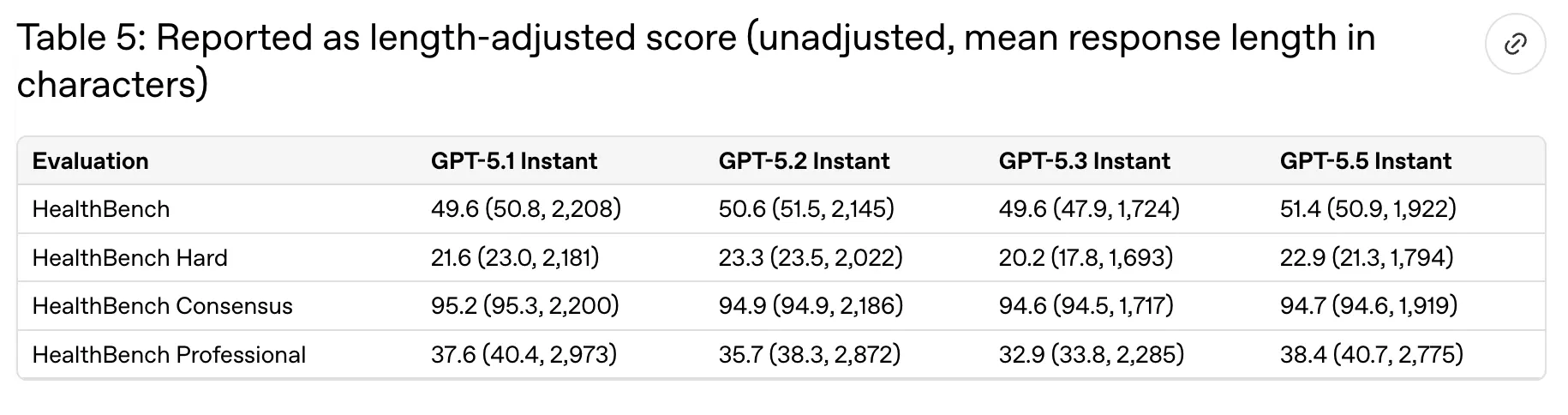
Performance on specialized benchmarks also reflects this improvement. On HealthBench, a test suite for AI responses to medical inquiries, GPT-5.5 Instant achieved a score of 51.4, an increase from the previous 49.6. The clinical-use version, HealthBench Professional, saw a more substantial jump from 32.9 to 38.4 points. Given that health-related questions are among the most frequent queries users pose to ChatGPT, these gains in accuracy are particularly impactful.
Beyond accuracy, GPT-5.5 Instant enhances user experience through improved context retention and personalization. The model can now more effectively leverage information from past conversations, user-uploaded files, and connected email accounts to provide relevant answers. Crucially, it provides transparency by showing users precisely which context was used and allows them to manage or correct this information, reinforcing user control over their data. Temporary chats remain opt-in for privacy.
Long-Term Technological Impact and AI Advancement
The deployment of GPT-5.5 Instant signifies a maturation in AI development, moving beyond raw generative capabilities to focus on reliability and user-centric features. For the broader blockchain and Web3 ecosystem, this advancement has several implications. Firstly, the reduction in AI hallucinations is critical for applications requiring factual accuracy, such as decentralized knowledge bases, AI-powered legal or financial advice platforms, and verifiable information systems within metaverses. Improved factual grounding can enhance trust and utility in these nascent Web3 services.
Secondly, the enhanced memory and personalization capabilities, coupled with user control, align with the Web3 ethos of data ownership and privacy. As AI agents become more integrated into digital lives, models that respect user control over data and context are essential for building decentralized applications (dApps) that are both powerful and ethical. This could spur innovation in AI-driven dApps that personalize user experiences without compromising privacy, potentially leveraging decentralized identity solutions.
Furthermore, GPT-5.5 Instant’s classification as “High Capability” in cybersecurity and biological domains, even within the “Instant” tier, highlights the accelerating pace of AI’s specialized advancements. This suggests that increasingly sophisticated AI tools will become accessible, potentially accelerating development in areas like smart contract auditing, threat detection for blockchain networks, and AI-driven drug discovery or bioinformatics projects leveraging decentralized compute resources. The integration of such robust AI models into AI Layer 2 solutions or blockchain-based AI marketplaces could unlock new paradigms for decentralized AI development and deployment, pushing the boundaries of what is possible in the intersection of AI and blockchain technology.
While the full GPT-5.5 model showcases advanced capabilities like complex command-line task performance on benchmarks like Terminal-Bench 2.0, the GPT-5.5 Instant focuses on bringing these iterative improvements to the everyday user. OpenAI continues to retire older models; users who preferred GPT-5.3 Instant will have a three-month grace period before its complete retirement. Features like Gmail integration are rolling out incrementally, starting with premium subscribers.
According to the portal: decrypt.co