

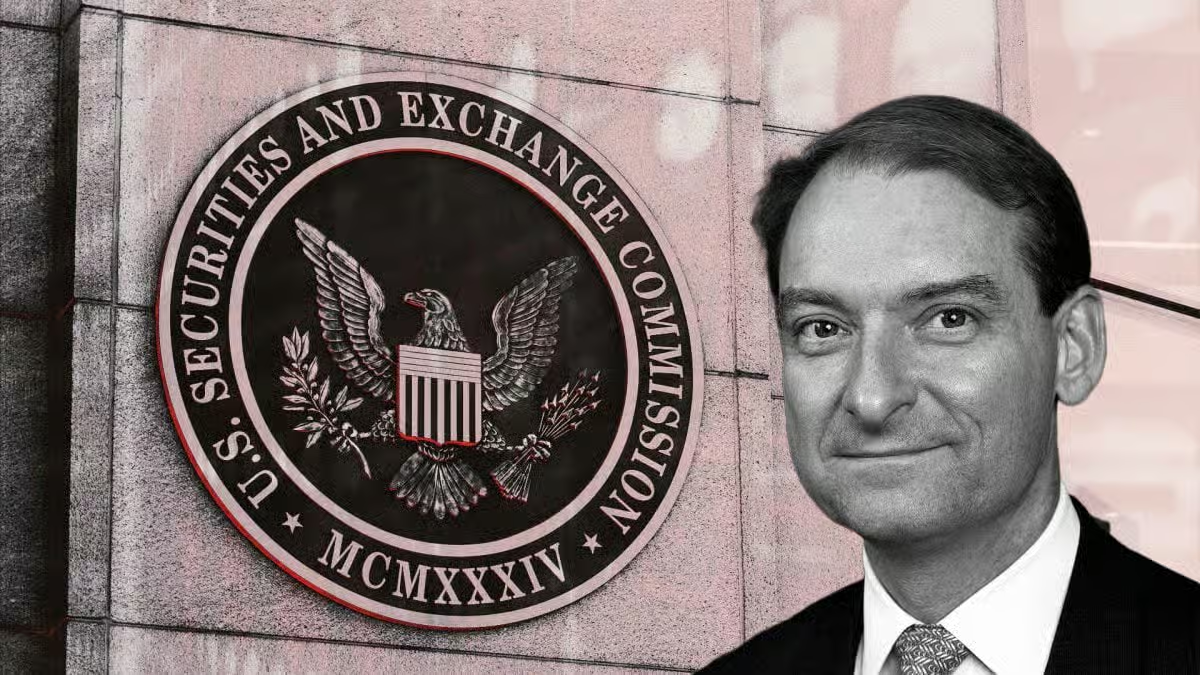
Securities and Exchange Commission (SEC) Chair Paul Atkins has indicated that the agency must clarify how its existing regulatory framework applies to software applications as it contemplates new rules for onchain financial markets. Atkins stated that current software applications do not align neatly with traditional SEC regulatory classifications such as clearing agencies, brokers, or exchanges.
Key Takeaways
- SEC Chair Paul Atkins has acknowledged that software applications do not fit easily into existing regulatory categories like clearing agencies, brokers, or exchanges.
- These remarks suggest a potentially more accommodating stance towards digital assets under Atkins compared to his predecessor, Gary Gensler.
- Industry representatives have reacted positively to the SEC Chair’s comments.
Speaking at an artificial intelligence expo, Atkins noted that a single protocol can now simultaneously perform functions including trade execution, collateral management, liquidity routing, and transaction settlement within a unified, automated system, often in a matter of seconds. This complexity challenges the established definitions the SEC uses for market participants and infrastructure.
The sentiment expressed by Atkins contrasts with the more cautious approach of former SEC Chair Gary Gensler, who had maintained that most cryptocurrencies fell under the SEC’s regulatory purview. Since assuming leadership, Atkins has explored concepts like an “innovation exemption” for tokenized securities and has supported the development of a taxonomy to help identify digital assets that may be classified as securities.
Further signaling a shift, the SEC’s Division of Trading and Markets recently issued a staff statement suggesting that interfaces like DeFi wallets would generally not be considered brokers. Atkins proposed that the SEC should consider a notice-and-comment rulemaking process to re-examine definitions pertaining to exchanges, clearing agencies, and brokers in the context of onchain trading systems. He also highlighted the need for greater clarity regarding crypto vaults, which are onchain applications designed for passive yield generation.
Atkins emphasized that onchain market structures are often hybrid, blending elements of both traditional finance and decentralized finance. He advocated for clarifying the SEC’s perspective on the various models that interact with securities laws. This clarification should involve the use of exemptive authorities where appropriate, ensuring active participation from innovators, investors, and the public.
Industry groups have welcomed Atkins’ remarks. The DeFi Education Fund described the comments as “powerful,” while the Hyperliquid Policy Center expressed encouragement that the SEC Chairman appears willing to align these systems with existing legal frameworks on their own terms, rather than attempting to force them into outdated categories.
Potential Regulatory Precedent
Chair Atkins’ comments signal a significant potential shift in how the SEC approaches digital assets and onchain financial infrastructure. By acknowledging the limitations of existing definitions and proposing a rulemaking process to adapt them, the SEC could establish a new precedent for regulatory clarity. This approach, which emphasizes a neutral and inclusive process involving stakeholders, might influence how other global regulatory bodies engage with the rapidly evolving digital asset space. If the SEC successfully revises its framework for onchain markets and software applications, it could provide a more predictable legal environment, potentially fostering innovation while addressing investor protection and market integrity concerns. This move could also set a benchmark for regulatory frameworks like Europe’s Markets in a Crypto-Asset (MiCA) regulation, encouraging a more dynamic and responsive approach to digital asset regulation worldwide.
Based on materials from : www.theblock.co