

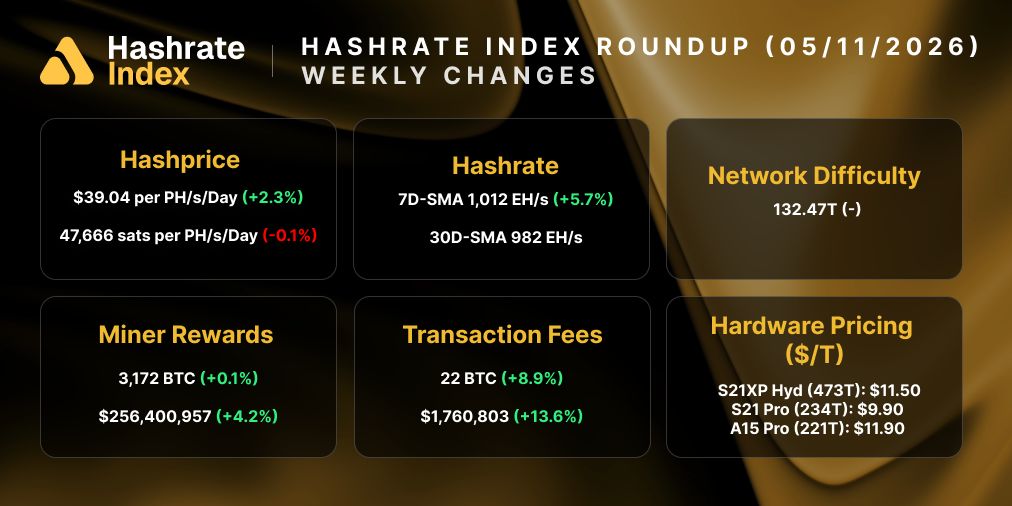
This week’s mining update indicates positive market dynamics, with Bitcoin prices experiencing an uptick and the network’s hashrate showing robust growth. Despite a marginal decrease in USD hashprice, an increase in transaction fees and a slight easing of network difficulty have collectively improved the revenue landscape for miners. Over the past week, Bitcoin miners collectively earned approximately 3,172 BTC, valued at roughly $256 million. Transaction fees contributed 0.69% to this total, amounting to about 22 BTC or $1.8 million.
Key Takeaways
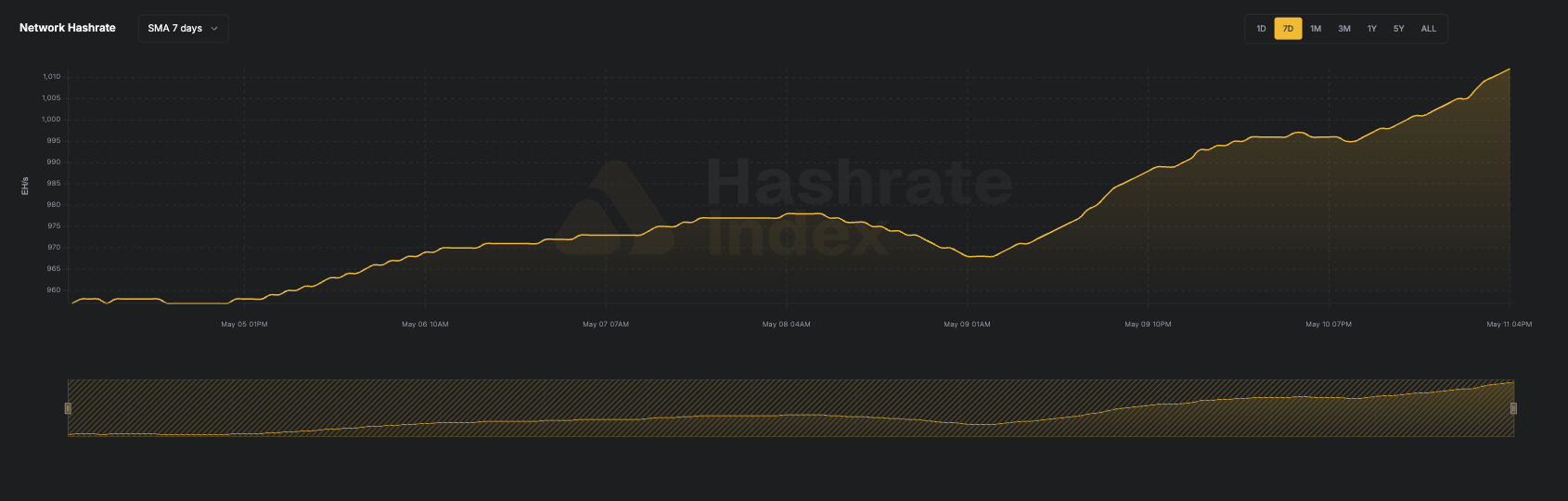
- Network hashrate has increased by 5.7%, reaching a 7-day simple moving average (SMA) of 1,012 EH/s.
- The Bitcoin price has risen, trading around $81,725.
- USD hashprice has seen a slight increase to $39.04 per PH/s/Day, while BTC hashprice remains relatively stable.
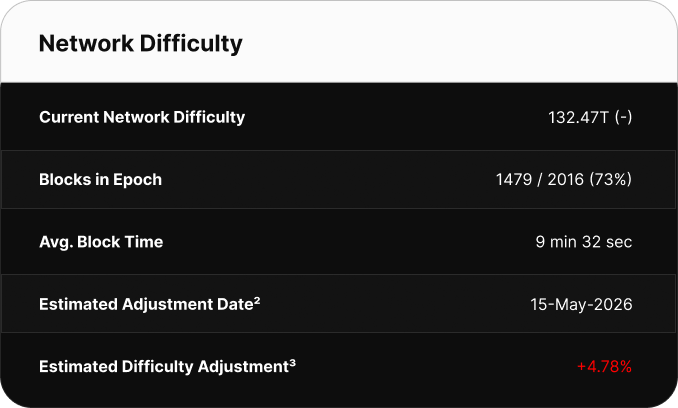
- Network difficulty adjusted downwards by -2.30% on May 1st, with an estimated increase of +4.78% expected for the upcoming adjustment on May 15th.
- Transaction fees have shown a modest increase, contributing more significantly to miner revenue.
Bitcoin Network Dynamics and Miner Economics
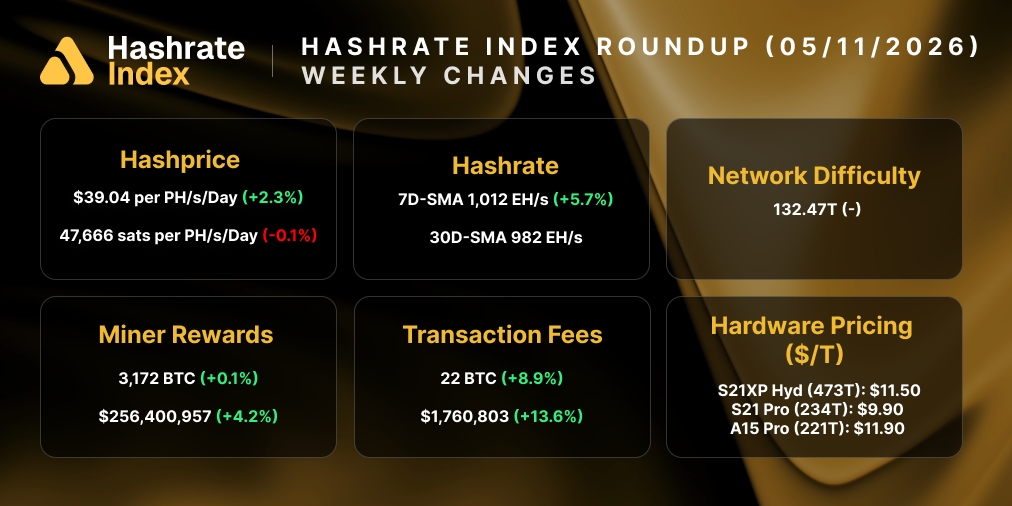
The Bitcoin network has demonstrated increased computational power, evidenced by a 5.7% rise in the network hashrate to a 7-day SMA of 1,012 EH/s. This surge in hashrate, while positive for network security, typically correlates with an increase in mining difficulty. However, the most recent difficulty adjustment on May 1st saw a decrease of -2.30% to 132.47T. Current projections suggest the next adjustment on May 15th may see an increase of +4.78%. Average block times have been around 9 minutes and 32 seconds, indicating a slight deviation from the target 10-minute block time, which the upcoming difficulty adjustment aims to correct.
Hashprice, a critical metric for miner profitability, has seen a slight increase in USD terms to $39.04 per PH/s/Day, a 2.3% rise. The BTC hashprice has remained relatively stable, currently at 0.00047666 BTC per PH/s/Day. This stability in revenue per unit of hashrate, coupled with an increasing network hashrate, suggests that miners with older, less efficient hardware may be operating closer to or below their breakeven points, especially if they have higher energy costs. Conversely, operations utilizing the latest generation ASICs, such as the S21XP which trades around $25.70/TH, are better positioned to capitalize on current market conditions.
The revenue generated per megawatt-hour (MWh) varies significantly based on hardware efficiency. Fleets under 19 J/TH are currently earning approximately $95 per MWh. Those in the 19-25 J/TH range are seeing returns of about $73 per MWh, while older hardware above 25 J/TH is earning around $50 per MWh. These figures underscore the importance of hardware efficiency in maintaining profitability, particularly for industrial-scale mining farms where energy expenditure is a primary operational cost.
Impact on Network Security and Miner ROI
The recent surge in network hashrate, an increase of 5.7% to over 1,000 EH/s, directly bolsters Bitcoin’s security. A higher hashrate makes the network more resilient against potential 51% attacks, as it requires a significantly greater amount of computational power to disrupt consensus. For industrial mining farms, this increased hashrate signifies a competitive environment. Investment in the most energy-efficient ASIC technology is paramount to maintaining a competitive edge and achieving a favorable Return on Investment (ROI). The current hashprice, while showing an upward trend in USD, remains sensitive to fluctuations in Bitcoin’s price and network difficulty. Small-scale miners, often operating with less efficient hardware and higher electricity costs, may find it increasingly challenging to remain profitable without access to cheap power or the ability to upgrade to newer ASIC models. The recent decrease in difficulty, however, provided a temporary buffer for all miners by reducing the computational effort required to find a block.
Transaction Fees and Market Outlook
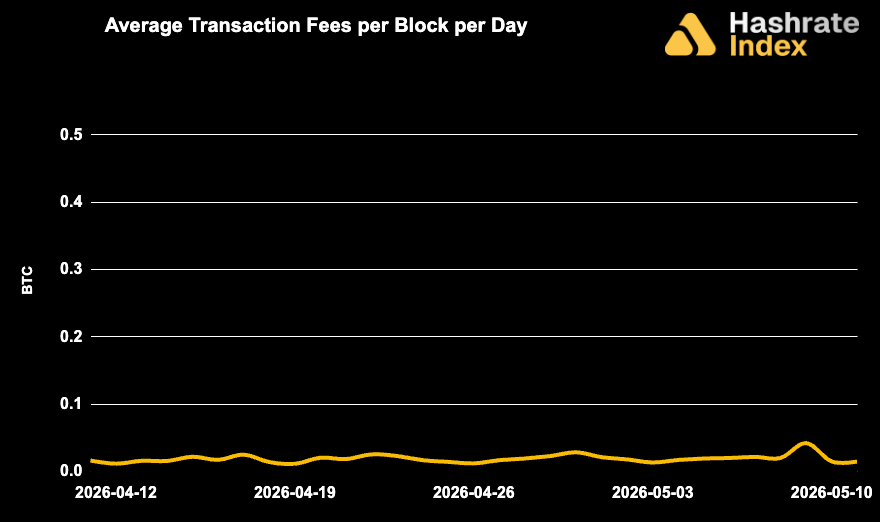
Transaction fees have seen a positive shift, increasing by 9% week-over-week to an average of 0.0216 BTC per block per day. This suggests a slight uptick in network activity or a greater demand for block space, which directly benefits miners by supplementing their block reward income. While still a smaller portion of total miner revenue compared to block rewards, the increase in fees is a welcome development.
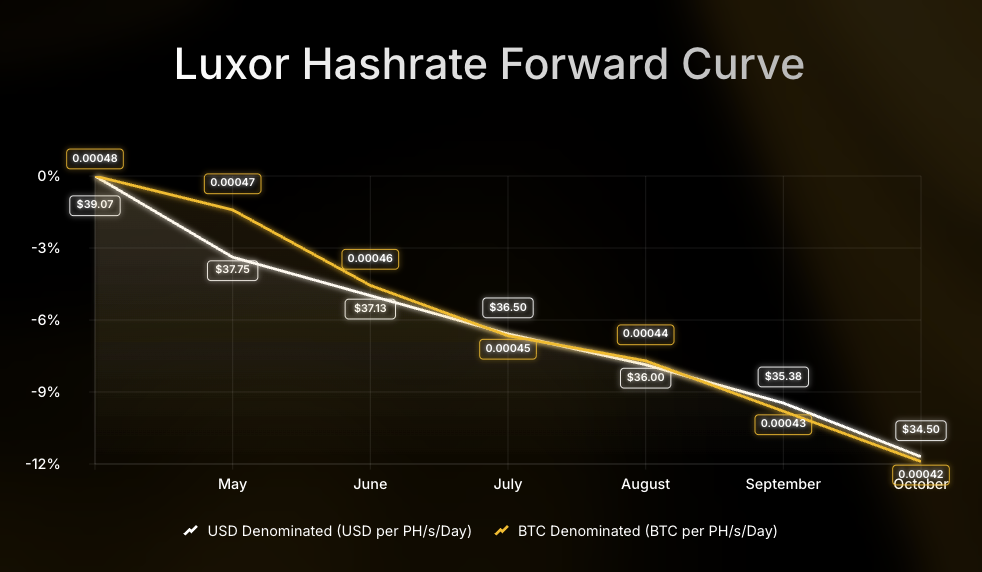
Looking forward, the hashrate forward market is pricing in an average hashprice of $36.21 or 0.00044 BTC over the next six months. This suggests an expectation of slightly lower profitability in the medium term, potentially due to anticipated difficulty increases or a stabilization/decrease in Bitcoin’s price. Miners must strategize their operations, including energy procurement and hardware investments, to align with these forward-looking market indicators.
The Bitcoin mining stock index reflects a positive sentiment in the public markets, with a 17.3% increase over the past week. This indicates investor confidence in the sector’s performance and future prospects, likely driven by the recent price appreciation of Bitcoin and the overall health of the mining network.
Learn more at : hashrateindex.com