

The landscape of generative artificial intelligence is rapidly evolving, with OpenAI’s ChatGPT, once the undisputed leader, now facing significant challenges from emerging rivals. Recent data indicates a notable decline in ChatGPT’s web traffic share, while competitors like Google’s Gemini and Anthropic’s Claude are experiencing substantial growth. This shift is particularly evident in business adoption, where Anthropic has, for the first time, surpassed OpenAI among companies tracked by the Ramp AI Index.
Key Takeaways
- ChatGPT’s global web traffic share has decreased from 77.6% in May 2025 to 53.7% in April 2026, according to SimilarWeb data.
- Anthropic has overtaken OpenAI in business adoption, with 34.4% of companies on the Ramp AI platform using Anthropic’s services compared to OpenAI’s 32.3%.
- Secondary market valuations show Anthropic valued at approximately $1 trillion, exceeding OpenAI’s $880 billion valuation on Forge Global.
- Google’s Gemini has seen significant growth, quadrupling its web traffic share in the generative AI space.
- The fragmentation of the AI market is leading to increased competition, impacting OpenAI’s market dominance.
For a considerable period, “ChatGPT” served as a shorthand for the broader field of artificial intelligence. However, this perception is being challenged as more sophisticated and specialized AI models gain traction. SimilarWeb’s web traffic data reveals a significant drop in ChatGPT’s share of the generative AI website traffic, losing approximately 24% over a twelve-month span ending April 2026. This decline is not attributed to a single competitor but rather to a broader market fragmentation.
Google’s Gemini has shown remarkable growth, increasing its share from 7.27% to 26.7% in the same period, nearly quadrupling its presence. Anthropic’s Claude has also seen substantial gains, jumping from 1.37% to 7.95%, a near sixfold increase. While other AI models like Grok, Perplexity, and DeepSeek have also expanded their user base, the trend underscores a diversifying AI ecosystem where OpenAI is experiencing the most pronounced effects of this competition.
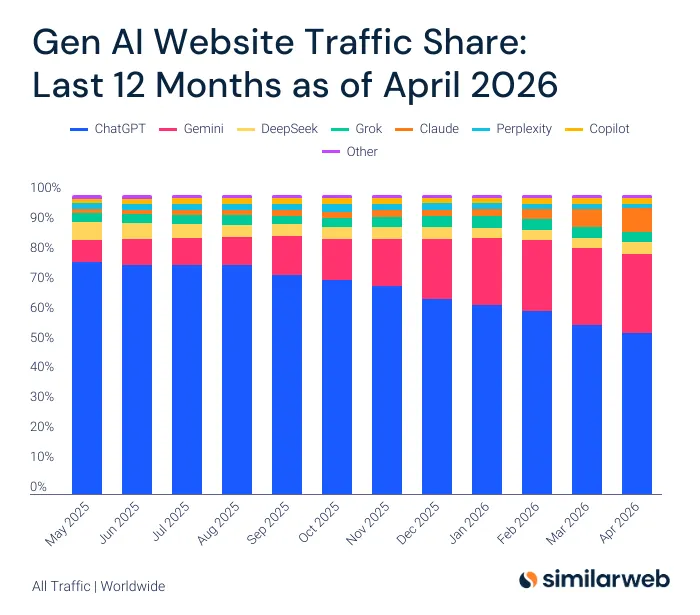
It’s important to understand that web traffic share metrics primarily reflect direct user engagement with chatbot interfaces. This does not encompass API calls, large-scale enterprise deployments, or usage embedded within third-party applications. Therefore, these numbers are a better indicator of consumer mindshare and direct interaction rather than comprehensive revenue or widespread integration into business workflows.
The Ramp AI Index, which monitors paid AI subscriptions across a significant number of U.S. businesses, presents a complementary perspective. Its latest update confirms the shift, showing that more companies are now subscribing to Anthropic’s services than to OpenAI’s. Anthropic’s business adoption rate rose to 34.4% in April 2026, while OpenAI’s share slightly decreased to 32.3%.
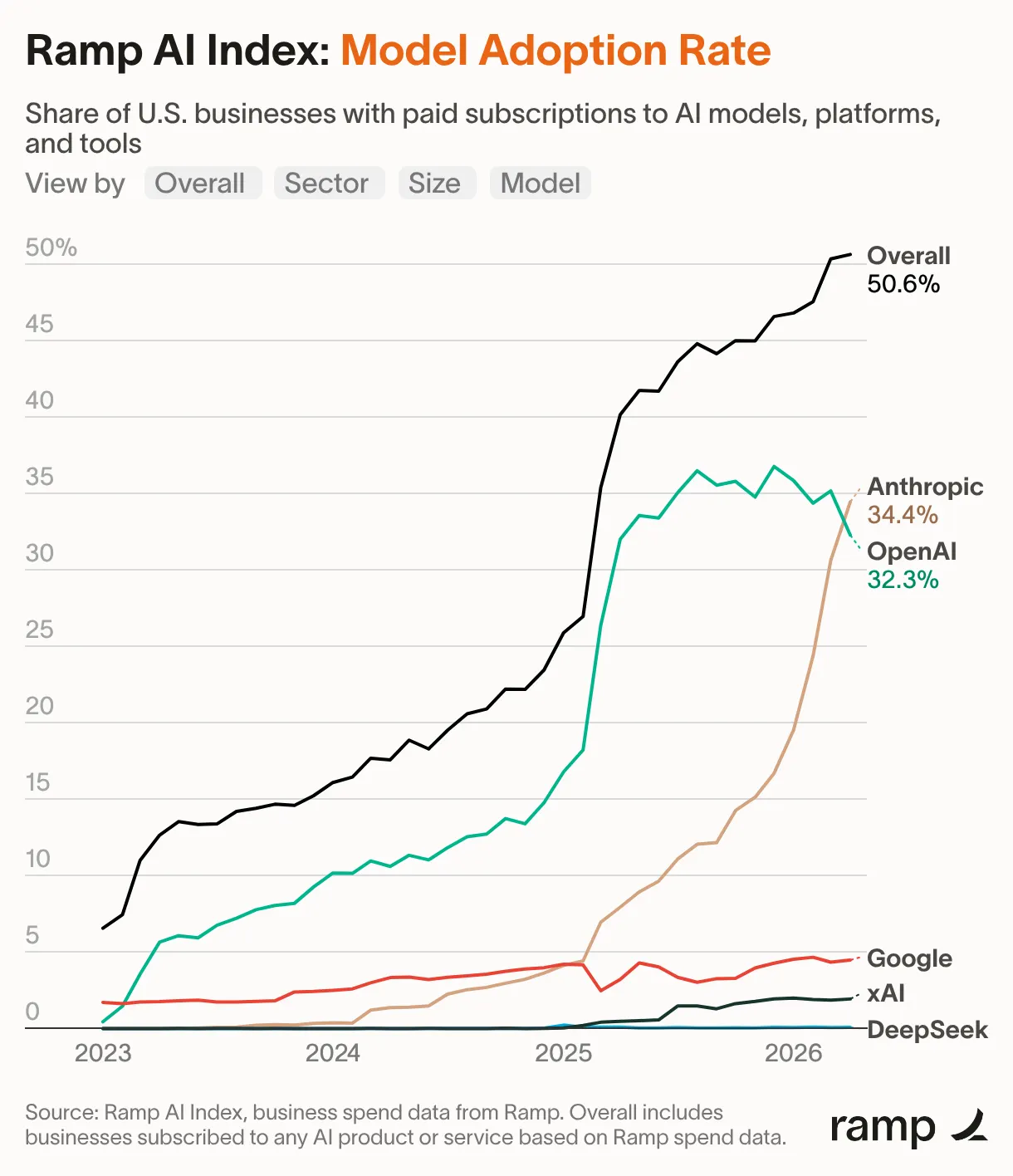
Ara Kharazian, lead economist at Ramp, described this development as a “stunning reversal.” A year prior, only 9% of businesses on the platform utilized Anthropic’s services; this figure has now quadrupled. In contrast, OpenAI’s business adoption grew by a mere 0.3% over the same twelve-month period. A significant driver of Anthropic’s business growth is Claude Code, its agentic coding tool, which has seen rapid adoption among developer teams across various company sizes.
While the Ramp data offers valuable insights, it’s acknowledged that large-scale enterprise deals, often paid through direct contracts rather than corporate cards, might not be fully captured. OpenAI has noted that its substantial enterprise engagements are not reflected in such payment methodologies. Nevertheless, the trend observed by Ramp is considered significant, indicating a shift in business preferences, potentially driven by factors such as the capabilities of Claude Code and the competitive offerings in the market.
The competitive dynamics also extend to secondary markets, where investor sentiment reflects the perceived future value of these AI companies. Anthropic’s valuation on Forge Global has surged to approximately $1 trillion, surpassing OpenAI’s $880 billion. This valuation jump, from $380 billion three months prior, suggests a strong market belief in Anthropic’s current trajectory, even if it’s early in its growth phase.
Long-Term Technological Impact and Web3 Integration
The current competitive surge in the AI space, particularly with the rise of models like Claude and Gemini, signals a maturing market that is moving beyond a single dominant player. For the broader blockchain and Web3 ecosystem, this fragmentation has profound implications. As AI models become more specialized and competitive, we can anticipate increased opportunities for integration with decentralized technologies. Layer 2 scaling solutions, for instance, could become crucial for handling the high volume of API calls and data processing required by advanced AI agents operating on-chain or interacting with decentralized applications (dApps).
The development of agentic AI, as seen with Claude Code, aligns with the principles of decentralized autonomous organizations (DAOs) and smart contract automation. Imagine AI agents that can autonomously manage decentralized finance (DeFi) protocols, participate in decentralized governance, or even contribute to the development of new dApps. This could significantly enhance the efficiency, intelligence, and user experience within Web3. Furthermore, as AI models evolve, their ability to process and interpret complex blockchain data will become invaluable for analytics, security auditing, and the creation of more sophisticated decentralized marketplaces and metaverses.
The increasing demand for AI capabilities also drives innovation in AI model training and inference. This could spur the development of decentralized AI networks and marketplaces, where computing power and AI models are shared and utilized more efficiently, potentially leveraging blockchain for transparent and secure resource allocation. The competition also pushes for more cost-effective AI solutions, which could benefit Web3 developers and users by reducing the operational costs associated with AI integration in decentralized systems. As AI and blockchain technologies continue to converge, we can expect a new wave of innovation that leverages the strengths of both, leading to more powerful, decentralized, and intelligent applications.
Google’s Gemini, with its deep integration into platforms like Android, possesses inherent distribution advantages that rivals lack. This highlights the evolving strategies in the AI market, moving from novelty and first-mover advantages to substance and strategic deployment. OpenAI’s future success will likely depend on its ability to demonstrate tangible value through its own advancements, such as the growth of Codex and the acquisition of significant enterprise contracts, which will be closely monitored indicators of its sustained impact.
According to the portal: decrypt.co