


Recent advancements in artificial intelligence, particularly in large language models (LLMs), have spurred considerable excitement about their potential to automate complex technical tasks. Companies are actively promoting AI agents designed to function as autonomous site reliability engineers (SREs), capable of diagnosing and resolving issues in production systems. However, a new benchmark developed by Datadog and Carnegie Mellon, known as ARFBench, suggests that while AI is improving, it has yet to surpass human expertise in addressing real-world operational challenges.
Key Takeaways
- ARFBench is the inaugural AI benchmark constructed entirely from actual production incidents, providing a realistic testbed for AI capabilities.
- Even advanced models like GPT-5, while achieving 62.7% accuracy, fall short of the 72.7% accuracy demonstrated by human domain experts.
- The benchmark highlights that AI models struggle with complex, cross-metric reasoning, a critical aspect of real-world incident response.
- A hypothetical “Model-Expert Oracle,” combining AI and human judgment, achieved 87.2% accuracy, indicating the significant potential of human-AI collaboration.
- Specialized AI models, like Datadog’s Toto combined with Qwen3-VL 32B, can outperform general-purpose LLMs on specific tasks like anomaly identification.
ARFBench was meticulously crafted using 63 real-world production incidents, drawing directly from engineers’ communications during live emergencies. The benchmark comprises 750 multiple-choice questions, covering 142 monitoring metrics and over 5.38 million data points. Crucially, all questions were hand-verified, ensuring the use of authentic data rather than synthetic or theoretical scenarios. This rigorous approach aims to accurately assess whether current AI can effectively reduce the trillions of dollars lost annually due to system outages.
The benchmark evaluates AI’s ability to answer time-series-related questions that engineers commonly encounter during incident response. These questions are categorized into three tiers: Tier I focuses on anomaly detection within a single chart, Tier II delves into the timing, severity, and type of anomalies, and Tier III requires complex reasoning across multiple metrics to identify root causes. It is in this third tier, where cross-metric correlation is essential, that current AI models show significant limitations. GPT-5, for instance, achieved only a 47.5% F1 score on Tier III questions, a metric that penalizes models for selecting the most frequent answer rather than the correct one.
Long-Term Impact on Blockchain and Web3 Infrastructure
The findings from ARFBench, while focused on site reliability engineering, have profound implications for the blockchain and Web3 space. As decentralized systems grow in complexity, the ability to rapidly diagnose and resolve network issues becomes paramount. This benchmark underscores the current limitations of general-purpose AI in handling nuanced, real-world operational data. However, it also points towards a future where AI will be crucial, not as a complete replacement for human expertise, but as a powerful augmentation tool. For blockchain infrastructure, this means that AI models trained on specific network telemetry, smart contract execution logs, and transaction patterns could become invaluable for maintaining stability and security. Layer 2 scaling solutions, with their intricate interdependencies, stand to benefit significantly from AI systems that can precisely identify bottlenecks or exploits. The development of more specialized AI agents, akin to Datadog’s Toto, tailored for the unique challenges of distributed ledger technology, could unlock new levels of performance and resilience in Web3. Furthermore, the benchmark’s success in demonstrating the power of human-AI collaboration suggests that future Web3 development and maintenance will likely involve hybrid teams where AI assists human operators in analyzing complex data and identifying potential threats or inefficiencies.
In terms of performance, GPT-5 emerged as the leading AI model, scoring 62.7% accuracy, a significant improvement over random guessing (24.5%). Other prominent models also participated: Gemini 3 Pro achieved 58.1%, Claude Opus 4.6 scored 54.8%, and Claude Sonnet 4.5 reached 47.2%. Despite these figures, none of the AI models managed to surpass human baselines. Domain experts attained an average accuracy of 72.7%, while even those with less specialized observability experience, referred to as non-domain experts, scored 69.7%.
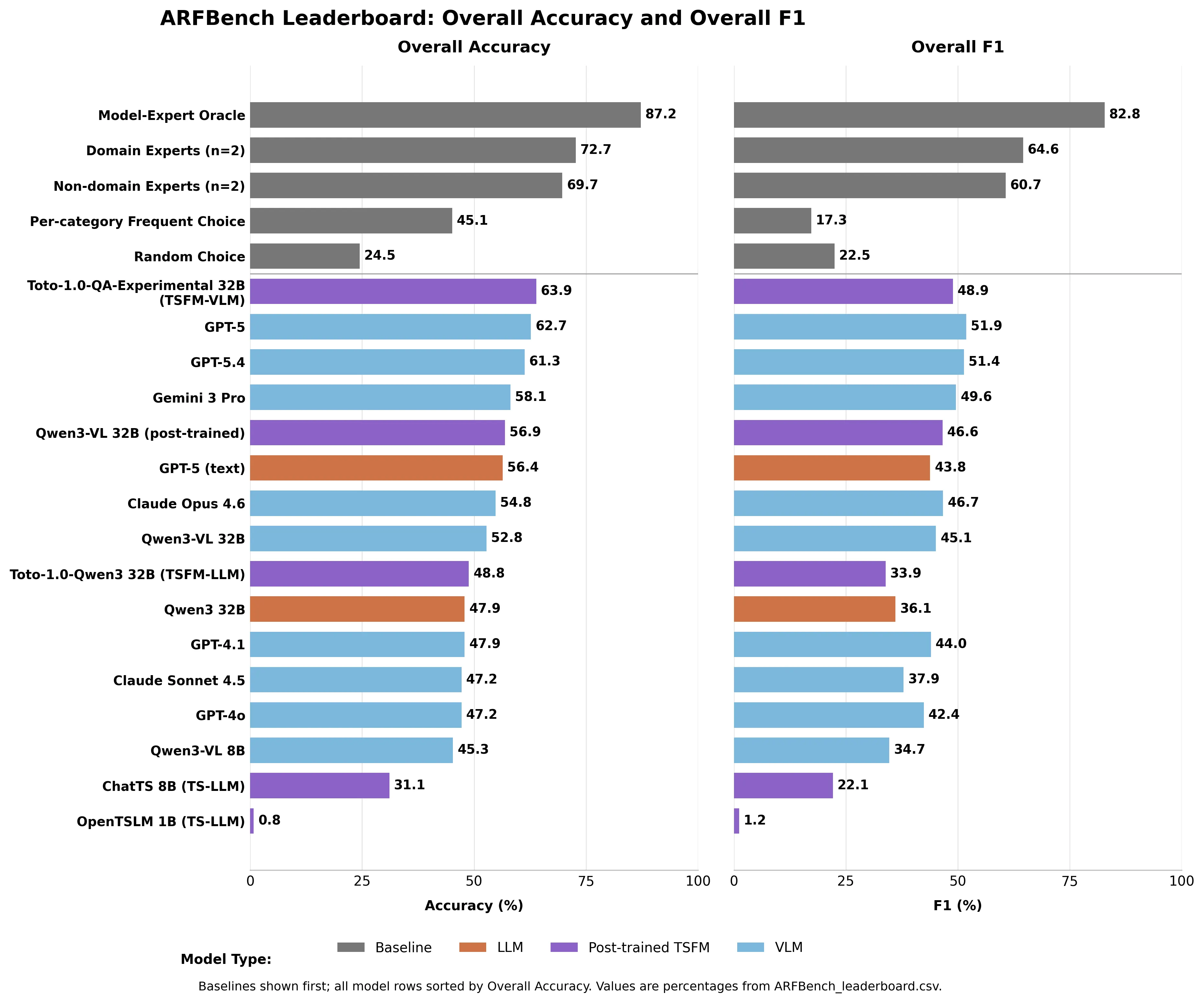
Interestingly, a hybrid model named Toto, developed internally by Datadog and combined with the Qwen3-VL 32B model, achieved the highest overall score on the leaderboard at 63.9% accuracy. This combination, Toto-1.0-QA-Experimental, not only outperformed GPT-5 but did so using significantly fewer parameters. In the specific task of anomaly identification, this specialized model demonstrated superior performance, exceeding all other models by at least 8.8 percentage points in F1 score. This outcome aligns with expectations, as a model purpose-built and trained on observability data is likely to excel over general-purpose AI systems for such specialized tasks.
The most compelling finding from ARFBench is not merely which model performed best, but the observed differences in error patterns between AI and human experts. Researchers noted that AI models tend to “hallucinate,” overlook crucial metadata, and lose context, while human experts may misinterpret precise timestamps or struggle with intricate instructions. The errors made by humans and AI show minimal overlap, suggesting that their capabilities are complementary. When a theoretical “Model-Expert Oracle” was simulated—a perfect arbiter choosing between AI and human responses—the accuracy jumped to 87.2%, with an F1 score of 82.8%, far exceeding the performance of either humans or AI working in isolation. This data-driven insight into the potential of human-AI collaboration provides a tangible target for future AI development in incident response and beyond.
Source: : decrypt.co