

Oppo Unveils X-OmniClaw: On-Device AI Agent Poised to Revolutionize Mobile Interaction
Chinese smartphone giant Oppo has introduced X-OmniClaw, an ambitious open-source AI agent framework for Android devices. This innovative system leverages a device’s native hardware—camera, screen, and microphone—to perform real-world tasks within applications, prioritizing on-device processing with selective cloud utilization for complex reasoning. This approach marks a significant departure from cloud-centric AI models, aiming to create a more integrated and context-aware mobile assistant.
- Edge-Native Architecture: X-OmniClaw runs core logic directly on the Android device, utilizing its sensors and interface for task execution.
- Persistent Memory: The agent builds long-term semantic memory from user photos and session history, enabling continuous, context-aware assistance.
- Behavior Cloning: Users can record and replay app navigation sequences, streamlining multi-step processes via Android deep links.
- Hybrid Reasoning Model: The system employs a hybrid approach, handling most operations locally while offloading intensive reasoning tasks to cloud-based Large Language Models (LLMs).
X-OmniClaw addresses a key limitation in current mobile AI: the disconnect between simulated environments and real-world device interaction. Unlike existing systems that often rely on cloud-based virtual instances of a user’s phone, X-OmniClaw operates directly on the physical device. This allows it to access the user’s actual camera, local files, and real-time screen context, fostering a more genuine and responsive user experience. The framework intelligently uses cloud LLMs as “fuel” for high-level reasoning, analogous to how fuel powers a car’s engine, while the device itself serves as the vehicle for perception and control.
The Technological Pillars of X-OmniClaw
The operational framework of X-OmniClaw is built upon three foundational components: Omni Perception, Omni Memory, and Omni Action, which function in a continuous loop. This architecture ensures that the AI agent can effectively understand, remember, and act upon user requests within the mobile ecosystem.
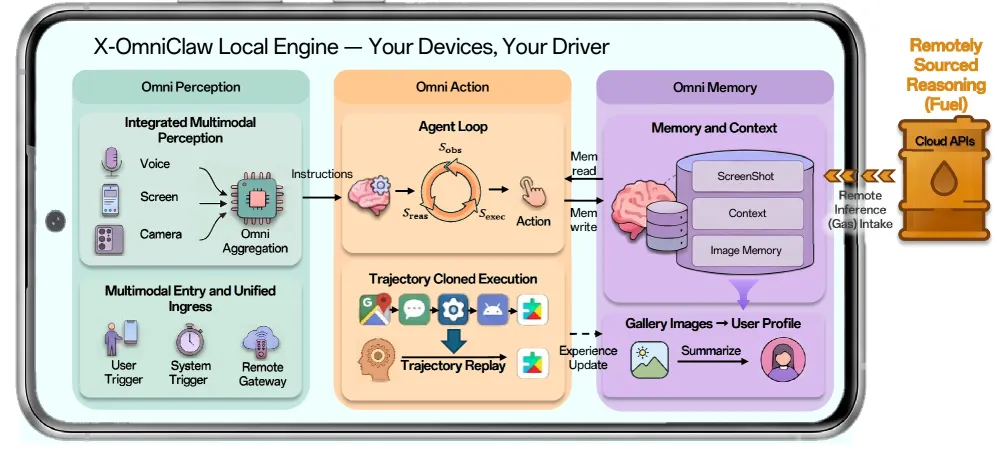
Omni Perception integrates data from the device’s camera, screen content, and microphone into a unified input stream. A vision-language model interprets the visual scene, enabling the agent to understand context. For instance, if a user points their camera at a product and asks about its price, the agent can identify the object, launch the relevant shopping application, and perform a search without manual input.
Omni Memory distinguishes X-OmniClaw from conventional chatbots by maintaining continuity across tasks, application switches, and user sessions. It constructs a persistent semantic memory by analyzing the user’s photo gallery, transforming raw images into structured information about objects, scenes, and events. This capability ensures that the agent functions as an ongoing assistant rather than a stateless query-response system.
Omni Action manages task execution. It combines on-device visual models, Optical Character Recognition (OCR), and XML interface data to enable precise interaction with application elements, even on visually complex screens. The behavior cloning feature allows users to pre-record task sequences, which the agent can then execute instantly via Android deep links, bypassing repetitive manual navigation.
Real-World Applications and Future Potential
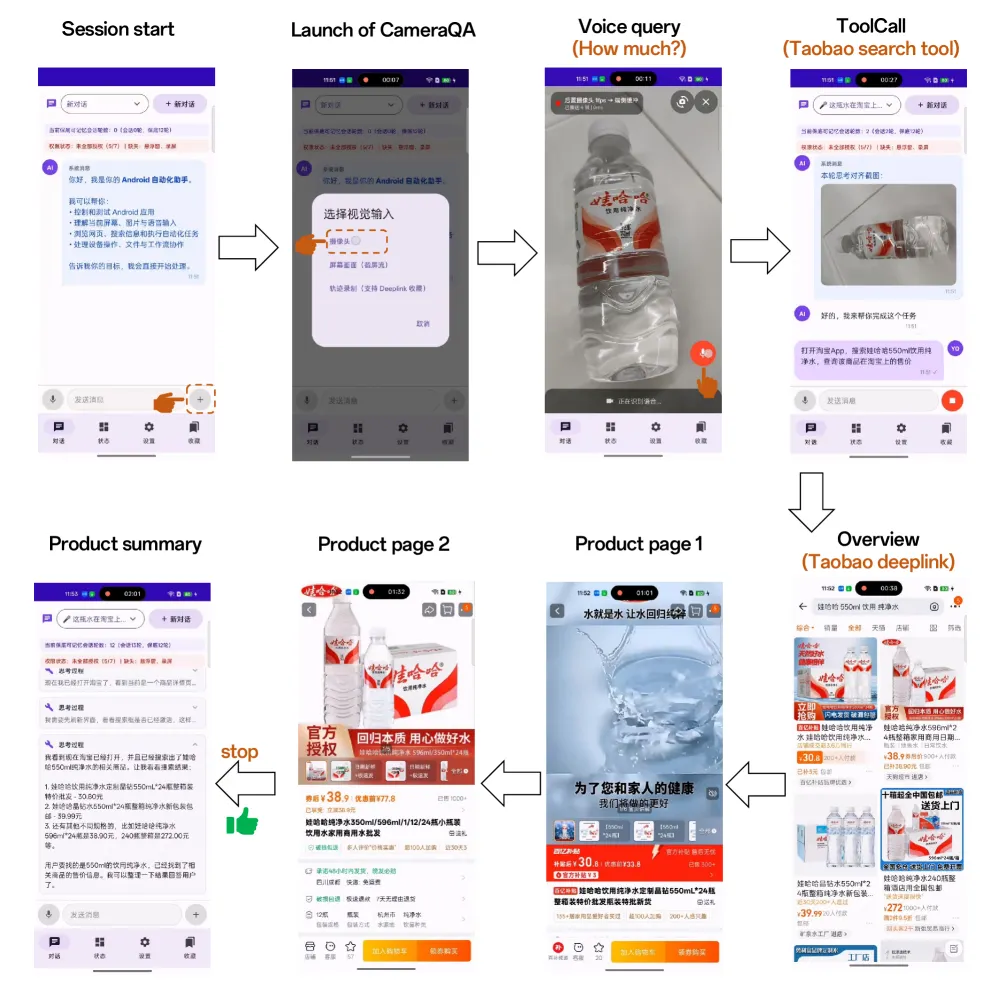
Oppo has demonstrated X-OmniClaw’s capabilities through several practical scenarios. One example shows the agent identifying a physical product via the camera, navigating to an e-commerce app, browsing product listings, and summarizing pricing information—all without user intervention. Another demo illustrated the agent assisting with educational content, autonomously reading math problems from the screen and guiding the user through step-by-step solutions.
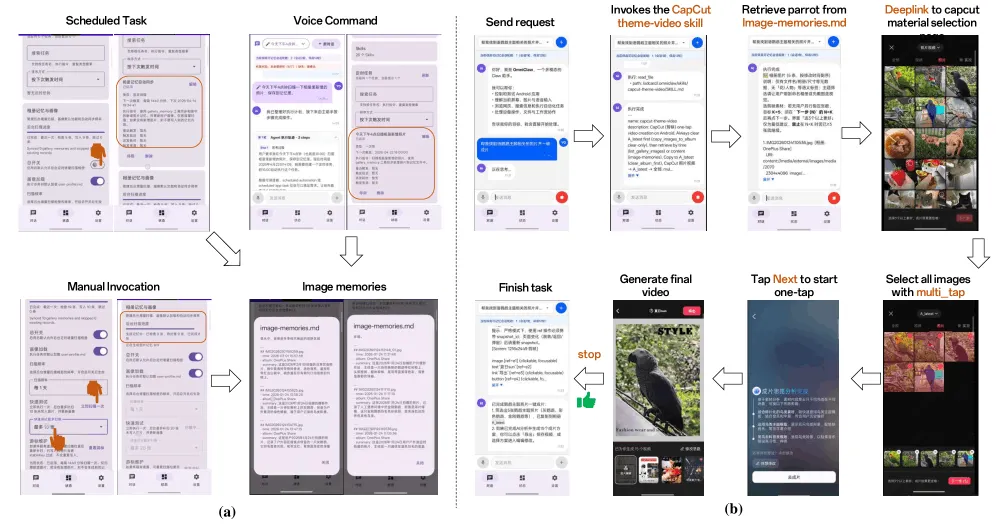
Furthermore, the agent can create highlight videos by scanning the photo gallery for relevant media (e.g., parrot-themed images), utilizing its semantic memory for efficient retrieval. It can then open a video editing application like CapCut via deep link, select the identified files, and automatically generate the video, significantly reducing the time and effort typically required for such tasks.
The Rise of Agentic AI on Mobile Platforms
The emergence of AI agents marks a pivotal moment in the evolution of artificial intelligence, with significant implications for decentralized technologies and Web3 development. The success of open-source frameworks like OpenClaw and Nous Research’s Hermes Agent, which have gained substantial traction and developer support, demonstrates a growing demand for persistent, locally-run AI capabilities. X-OmniClaw builds upon this momentum by extending these advanced agentic architectures to the mobile domain, the primary interface for many users worldwide.
By adapting concepts from desktop agent frameworks for the multimodal and always-on nature of smartphones, Oppo’s X-OmniClaw initiative is at the forefront of this technological shift. The open-source nature of the project, coupled with Oppo’s commitment to continuous updates, suggests a collaborative approach to advancing mobile AI. This development could accelerate the integration of sophisticated AI agents into everyday mobile applications, paving the way for more intuitive, automated, and personalized user experiences and potentially driving innovation in Layer 2 solutions and decentralized applications that can leverage such on-device intelligence.
According to the portal: decrypt.co