

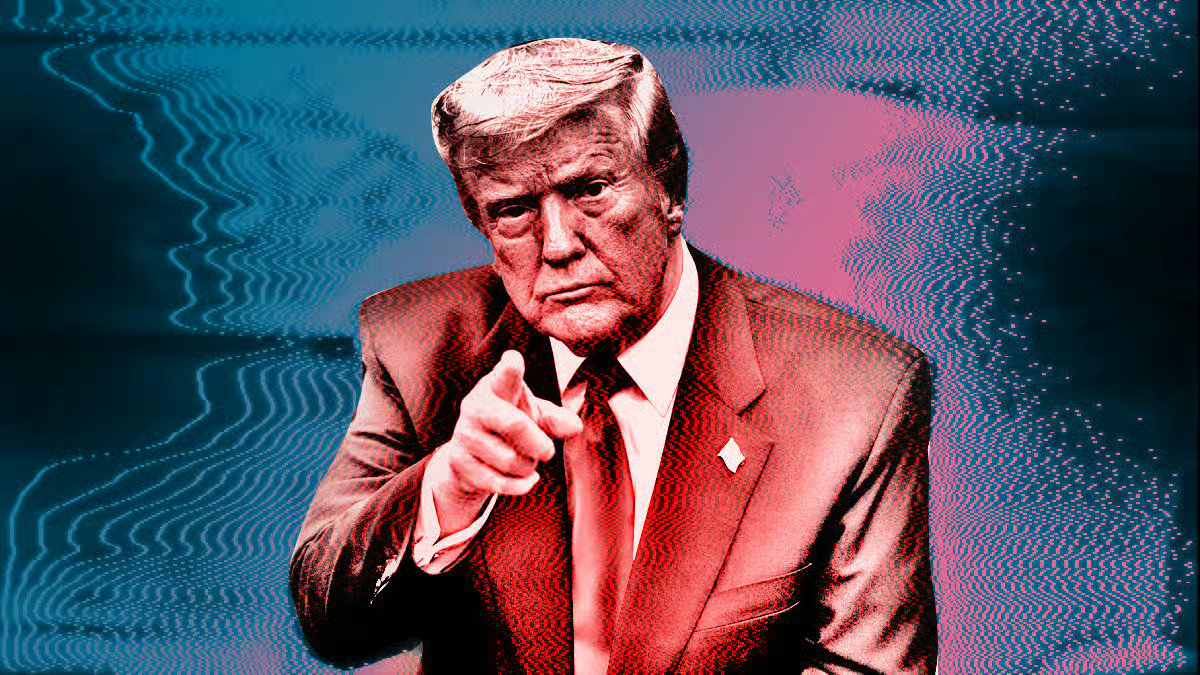
Former U.S. President Donald Trump has declared his intention to champion the establishment of a digital asset market framework designed to be resilient against future regulatory changes. In a public statement, Trump attributed the migration of cryptocurrency innovation and businesses abroad to policies enacted under the former Securities and Exchange Commission (SEC) Chair Gary Gensler, whom he identified as part of an “anti-crypto army.”
Key Takeaways
- Donald Trump has pledged to create a “future-proof” regulatory structure for digital assets.
- He criticized former SEC Chair Gary Gensler for driving crypto innovation out of the U.S.
- The Clarity Act, a bill aimed at establishing a comprehensive digital asset regulatory framework, recently passed the Senate Banking Committee.
- Analysts suggest the Clarity Act faces significant legislative hurdles, including the need for broader bipartisan support and concerns over potential conflicts of interest related to Donald Trump and his family.
- The current political climate may hinder the bill’s passage in the near term.
Trump stated on the social media platform Truth Social that under his potential leadership, efforts will be made to “codify a FUTURE-PROOF Digital Asset Market Structure that cannot be undone by the Crypto Haters.” He expressed a commitment to ensuring that the “new Frontier of Finance is being Built in America” and vowed to support the crypto industry.
This announcement follows the U.S. Senate Banking Committee’s approval of the Clarity Act earlier in May. This legislation seeks to implement a detailed regulatory framework for digital assets. However, the bill’s progression has been marked by considerable debate, particularly concerning stablecoin provisions and disagreements between U.S. banking industry groups and cryptocurrency advocates.
Potential Regulatory Precedent and Legal Stakes
The legislative journey of the Clarity Act, and any subsequent executive actions or policy shifts under a potential Trump administration, carries significant legal weight. The core legal challenge lies in defining the jurisdictional boundaries between different regulatory bodies, such as the SEC and the Commodity Futures Trading Commission (CFTC), in overseeing digital assets. The Clarity Act’s attempt to provide a clear framework addresses the long-standing ambiguity that has led to numerous enforcement actions by the SEC, often on grounds of securities law violations.
For companies operating within the digital asset space, a “future-proof” framework implies a level of regulatory certainty that has been largely absent. This could reduce the risk of unexpected enforcement actions and compliance costs associated with navigating a patchwork of evolving rules. However, the legal stakes are high for the government as well. A well-defined framework must balance investor protection and market integrity with fostering innovation. Failure to do so could result in legal challenges to the regulations themselves or continued outflow of talent and capital to more favorable jurisdictions.
The political commentary from Donald Trump, emphasizing a “future-proof” structure, suggests a desire to preemptively shield the industry from potential future regulatory overhauls. The legal implications of such a move would involve embedding specific definitions and authorities into law, making them more difficult to alter through administrative rulemaking alone. This approach, if enacted, could set a significant precedent for how new financial technologies are regulated in the United States, moving towards a more static, legislatively determined landscape rather than one shaped by ongoing agency interpretation.
Analysts, however, caution that the Clarity Act is far from becoming law. Mark Palmer, a Benchmark analyst, pointed out in early May that the bill requires substantial support from Democratic lawmakers to overcome a potential filibuster in the Senate. The process involves merging the Senate Banking Committee’s version of the legislation with a market structure bill advanced by the Senate Agriculture Committee in January.
Further complicating the path forward, researchers from TD Cowen noted this week that the crypto market structure bill might not pass this year. They cited concerns over potential conflicts of interest involving Donald Trump and his family’s involvement in cryptocurrency and prediction market ventures. Jaret Seiberg, managing director at TD Cowen’s Washington Research Group, suggested that for Democrats to support such a bill, it would need to include stringent conflict-of-interest standards applicable to the President.
These concerns were echoed during the Senate Banking Committee markup session. Democratic Senator Ruben Gallego indicated that while he voted to advance the Clarity Act, he would oppose it on the Senate floor unless the alleged conflicts of interest surrounding the Trump family’s crypto-related activities are adequately addressed.
Details can be found on the website : www.theblock.co