

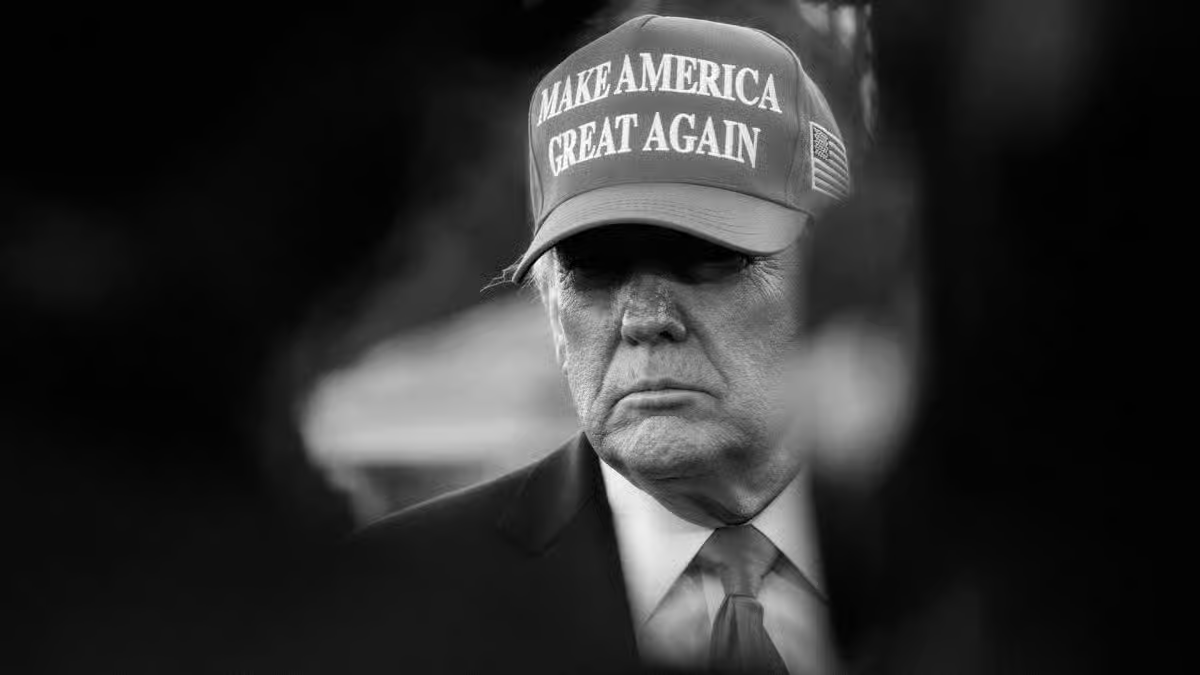
The trajectory of comprehensive cryptocurrency regulation in the United States is facing an unexpected challenge, not from industry opposition or regulatory skepticism, but from the potential conflicts of interest arising from President Donald Trump’s personal involvement in the digital asset space. While Trump’s endorsement of cryptocurrency has been seen as a significant boon for the industry, his expanding financial ties to crypto projects are now complicating the legislative process for the Clarity Act, a landmark bill aimed at establishing a clear regulatory framework for digital assets.
Key Takeaways
- President Trump’s embrace of cryptocurrency was initially viewed as a positive development for the industry, promising a more favorable regulatory environment.
- However, Trump’s personal financial gains from crypto ventures, including a memecoin and other projects, have raised ethical concerns among lawmakers.
- These ethical considerations are now a central point of contention in the debate surrounding the Clarity Act, potentially hindering its passage.
- Some lawmakers, particularly Democrats, are advocating for ethics provisions within the Clarity Act to restrict politicians’ involvement in digital asset transactions.
- The inclusion of these ethics provisions has become a critical hurdle, with potential implications for the bill’s bipartisan support and overall enactment.
The Clarity Act, which has undergone years of development, is currently awaiting a crucial vote in the full Senate. Its potential passage could unlock substantial institutional investment by providing much-needed regulatory clarity. However, the debate has intensified over whether to incorporate ethics provisions that would prohibit elected officials from participating in digital asset ventures. This discussion is largely fueled by President Trump’s significant personal interests in the crypto market.
Trump’s election and his subsequent supportive stance on cryptocurrency were widely perceived as a victory for the sector. Following years of regulatory friction under the previous administration, many in the industry saw his approach as a pathway to more amenable regulations and long-awaited legislative progress.
Beyond his policy support, President Trump has also financially benefited from the digital asset space. Prior to taking office, he launched a $TRUMP memecoin that generated millions. Both he and his sons have reportedly been involved in other ventures, with estimates suggesting the Trump family has earned at least $1.4 billion from crypto-related projects since his inauguration.
While the Clarity Act has faced other obstacles, such as lobbying efforts from banks opposing provisions that would permit crypto platforms to offer rewards on stablecoin deposits, the ethical questions surrounding Trump’s crypto involvement have emerged as a prominent issue. Some lawmakers are now demanding that the Clarity Act include restrictions on how politicians engage with digital assets.
Sources within the crypto industry have largely been hesitant to comment openly on whether Trump’s personal crypto interests are impeding the Clarity Act’s progress. Many appear defensive or reluctant to engage with the topic due to its political sensitivity.
“They don’t want to bite the hand that feeds them,” Mark Hays, a senior policy analyst at Americans for Financial Reform (AFR), stated when asked about the reluctance of some lawmakers to criticize the Trump family’s earnings from crypto.
Hays observed that even staunch advocates for both cryptocurrency and Trump have acknowledged that the president’s growing financial stake in digital assets is “not a good look” during the ongoing legislative debate. He noted that the industry has not taken significant action to address this concern.
The future of the Clarity Act is uncertain, even as federal regulators like the Commodity Futures Trading Commission (CFTC) and the Securities and Exchange Commission (SEC) have taken steps to clarify their positions on the crypto industry, actions generally viewed favorably by the sector. However, these regulatory actions lack the permanence that comprehensive legislation like the Clarity Act aims to provide.
Reeve Collins, co-founder of WeFi, commented that while regulatory sentiment is currently favorable, the turmoil surrounding Donald Trump is likely slowing down legislative progress, including the Clarity Act.
Capitol Hill’s Stance on Ethics in Crypto Legislation
Lawmakers, predominantly from the Democratic party, are advocating for the inclusion of ethics provisions in the Clarity Act. These provisions would aim to prevent the President, Vice President, other federal officials, and their families from engaging in certain financial transactions involving digital assets.
The Republican-led Senate Banking Committee recently advanced its version of the bill. This move sends the legislation to be reconciled with the Senate Agriculture Committee’s version before proceeding to a full Senate vote, where a 60-vote majority is required for passage. This necessitates bipartisan support.
During the Senate Banking Committee vote, two Democrats, Senators Angela Alsobrooks and Ruben Gallego, voted in favor of advancing the bill but with the explicit condition that ethics language be included. Industry sources interpret Gallego’s vote as a strong indicator that discussions surrounding ethics are making significant progress.
Senator Alsobrooks has reiterated her insistence on reaching an agreement on ethics. “To get to a bipartisan vote on the floor, I am demanding an agreement on ethics—that would apply not just to the President and Vice President but to all of us,” Alsobrooks stated. “The American people—especially my constituents—expect that from us.”
The Clarity Act’s objective is to establish federal-level regulation for the cryptocurrency industry for the first time, define disclosure requirements, and delineate jurisdictional authority between the CFTC and the SEC.
Initially, with a Republican-controlled Senate and House, alongside a pro-crypto president, the likelihood of the new legislation passing seemed favorable. This was particularly true after the House passed its version of the Clarity Act with bipartisan backing, notably without significant ethics language.
President Trump recently took a more assertive public stance, posting on Truth Social a vow to “codify a FUTURE-PROOF Digital Asset Market Structure that cannot be undone by the Crypto Haters.”
In response, White House spokesperson Davis Ingle highlighted the administration’s commitment to fostering innovation in the digital asset sector. “Through executive actions, supporting legislation like the GENIUS Act, and other common-sense policies, the administration is fulfilling the President’s promise to make the United States the crypto capital of the world by driving innovation and economic opportunity for all Americans,” Ingle stated.
Regarding Trump’s statement, Senate Banking Committee Chairman Tim Scott expressed his support. A post on X stated, “Chairman @SenatorTimScott stands with @POTUS in the fight to make America the crypto capital of the world. The Clarity Act delivers clear rules of the road, protects consumers, and ensures the future of finance is built here at home.”
When questioned about ethics, a spokesperson for Senator Scott referred to his earlier comments on Fox Business, where he stated, “Ethics is something that’s really outside of a banking jurisdiction, but it’s still a really important issue.”
Senator Elizabeth Warren, the ranking Democrat on the Senate Banking Committee and a consistent critic of Trump’s crypto interests and the industry, emphasized the importance of legislative accuracy during a recent committee vote. “Our job is not to advance a pro-industry crypto bill that will grease the skids for the President of the United States, crypto grift while tens of millions of Americans can’t afford the basics,” Warren remarked.
A Senate Democratic spokesperson indicated that any bill lacking safeguards to prevent federal officials, including the president, from profiting from crypto “undermines the legitimacy of the crypto industry.”
Furthermore, a Senate staff member familiar with the negotiations suggested that the failure to pass the Clarity Act could be attributed to President Trump. “If Republicans can’t meet Democrats on an ethics compromise because of their loyalty to the President and his open corruption, CLARITY is unlikely to pass,” the source stated.
Nic Puckrin, CEO at CoinBureau, highlighted the difficulty in securing Democratic support without ethics provisions. “I think getting enough Democratic senators to support this bill without any sort of ethics provisions so that Trump can’t get involved in crypto through these kinds of ventures is going to be slim,” Puckrin told The Block.
Attributing Blame for Legislative Stoppages
Some within the crypto community contend that the ethics debate is a political issue rather than a core cryptocurrency concern. When asked about potential blame for the Clarity Act’s failure to pass this year, one industry source pointed to other factors.
This source argued that the ethics provision is misplaced within a crypto market structure bill. They added that industry participants have largely remained neutral in the debate, focusing instead on matters like decentralized finance. “You could argue that this is maybe a way for Democrats to try to get their kind of flesh, or at least get some of their political hit points on the Trump administration, while also being seen as pro-business, which is kind of a very tough line for Democrats to put themselves in the middle of,” the source explained.
The source further suggested that Democrats could place the blame for the bill’s failure on Trump and his administration. Alternatively, fault could be placed on the Senate for not adopting the House’s version of the bill, as the Senate has a history of revising House-passed legislation on various topics, including crypto and stablecoins.
This pattern of legislative revision has led to frustration. “So this is kind of a larger macro issue, where the Senate takes a lot of the House’s work, and then they either, quote, improve on it, or they change it or they tweak it — and they tell the House to stomach it,” the source elaborated.
Concerns also exist within the crypto industry about the entanglement of political issues within regulatory bills.
Jaret Seiberg, managing director at TD Cowen’s Washington Research Group, noted in a recent research note that the Clarity Act’s chances of passing this year are diminishing due to the worsening political climate. Developments such as a deal barring the IRS from auditing past tax returns of the Trump family and a New York Times report examining the influence of prediction markets and crypto interests on the CFTC are not improving the bill’s prospects, Seiberg argued.
“It makes it politically hard for a Democrat to back a crypto bill unless it contains conflicts of interest standards that apply to the President,” Seiberg concluded.
According to the portal: www.theblock.co