

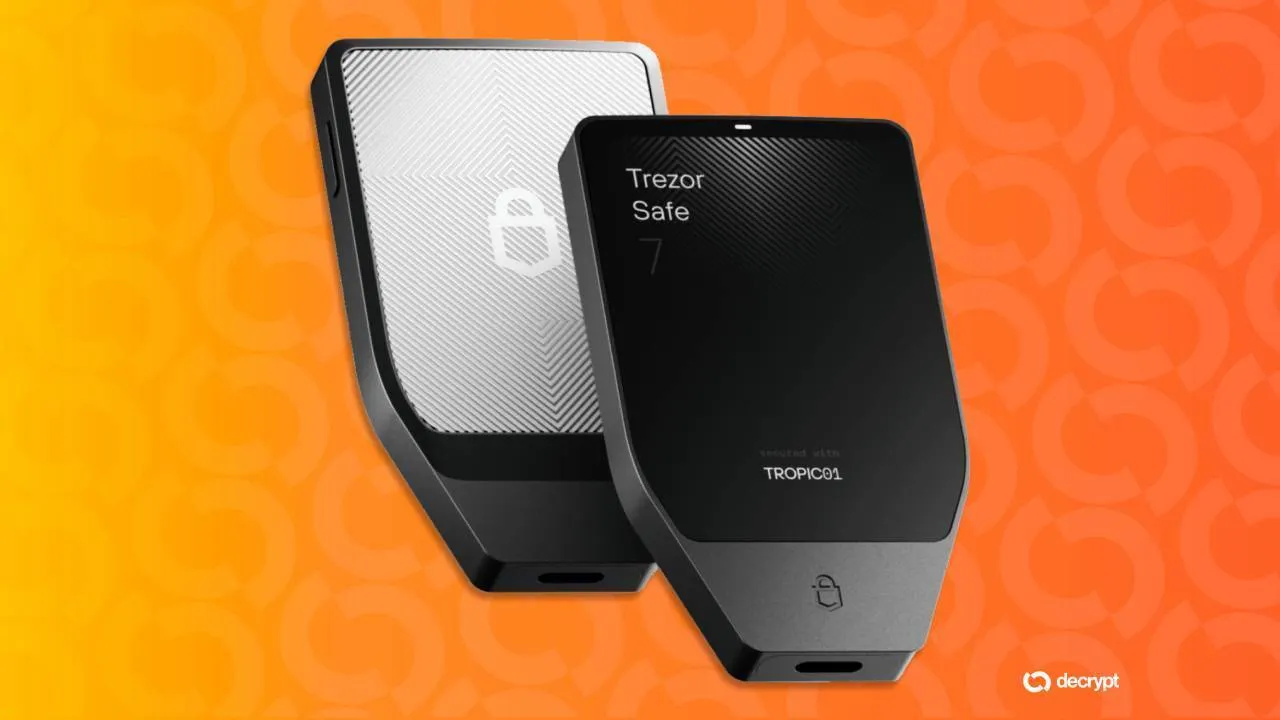
Trezor has acknowledged a hardware vulnerability affecting its Safe 7 model, specifically within the TROPIC01 Secure Element chip. Despite the discovery, the company asserts that user funds remain secure due to the sophisticated and physically demanding nature of the exploit. The vulnerability was identified by the Ledger Donjon team during an independent security audit, which successfully demonstrated a “laser fault injection attack.” This type of attack can compromise one of the three “secrets” protecting a user’s PIN, reducing the wallet’s protection layers from three to two.
Key Takeaways
- A hardware vulnerability was discovered in Trezor’s TROPIC01 Secure Element chip by the Ledger Donjon team.
- The exploit targets one of three “secrets” protecting the user’s PIN, reducing security layers from three to two.
- Executing the attack requires physical access to the wallet, disassembly, and specialized laboratory equipment.
- Trezor states that user funds remain protected as the PIN, the final security layer, is not compromised by this specific exploit, and private keys are not stored on the vulnerable chip.
- The hardware-based nature of the vulnerability prevents a fix via a firmware update.
The vulnerability specifically targets the TROPIC01 Secure Element chip, which is one of three distinct physical security layers integrated into the Trezor Safe 7. Trezor emphasizes that compromising this chip alone is insufficient to bypass the PIN, which acts as the final safeguard for user funds. Furthermore, the exploit cannot lead to the device being tampered with or having persistent malicious firmware installed.
Tropic Square disclosed a vulnerability in the TROPIC01 Secure Element chip used in Trezor Safe 7. It has been identified based on findings from the Ledger Donjon team’s independent audit. Important: Your funds remain safe and secure. Trezor Safe 7 has not been hacked, and you…
— Trezor (@Trezor) June 3, 2026
The company further clarified that successful execution of this attack necessitates physical possession of the hardware wallet, its subsequent disassembly, and the use of advanced laboratory equipment. Consequently, Trezor continues to view the TROPIC01 chip as an “effective barrier” that demands significant resources and effort to exploit, reinforcing their stance that user assets are secure.
Security firm Cyvers corroborated Trezor’s assessment, describing the attack as “highly impractical” and confirming the safety of user funds. Hardware wallets, often referred to as “cold” wallets, secure private keys offline on a dedicated physical device, contrasting with “hot” wallets like MetaMask which rely on software or cloud-based storage. Crucially for the Trezor Safe 7, user private keys are not stored within the TROPIC01 chip, mitigating the impact of this specific vulnerability.
Given that the vulnerability is hardware-related, it cannot be rectified through a standard firmware update. Trezor has not yet commented on its policy regarding refund requests from affected customers. Experts suggest that the broader security landscape for most users still presents greater risks from phishing, seed phrase theft, malicious decentralized applications (dApps), and inadvertently signing unintended transactions.
Long-Term Technological Impact Analysis
This incident highlights a critical aspect of blockchain and Web3 security: the inherent complexities and potential vulnerabilities within hardware components themselves. While software vulnerabilities are common and often patched with updates, hardware-level exploits, particularly those involving sophisticated physical attacks like laser fault injection, present a more persistent challenge. The reliance on specialized Secure Element chips, while intended to enhance security, introduces a single point of failure if not rigorously tested and architected with defense-in-depth principles. This event underscores the ongoing need for robust, multi-layered security strategies in hardware design, potentially driving innovation in chip manufacturing, tamper-detection mechanisms, and secure multi-party computation (MPC) solutions for private key management. As AI continues to advance, its application in security audits and vulnerability detection will become increasingly vital, not only for identifying known attack vectors but also for predicting and mitigating novel threats. For Layer 2 solutions and broader Web3 development, the focus will likely shift towards greater decentralization of security, reducing reliance on single points of hardware trust, and exploring more resilient cryptographic methods that are inherently resistant to physical side-channel attacks.
Information compiled from materials : decrypt.co