

 src=”https://storage.ghost.io/c/5f/b9/5fb98cf7-67da-41b5-a184-b1b39752525f/content/images/size/w1384/2026/06/Hashrate-Index-Weekly-Roundup@2x–42–1.png”>
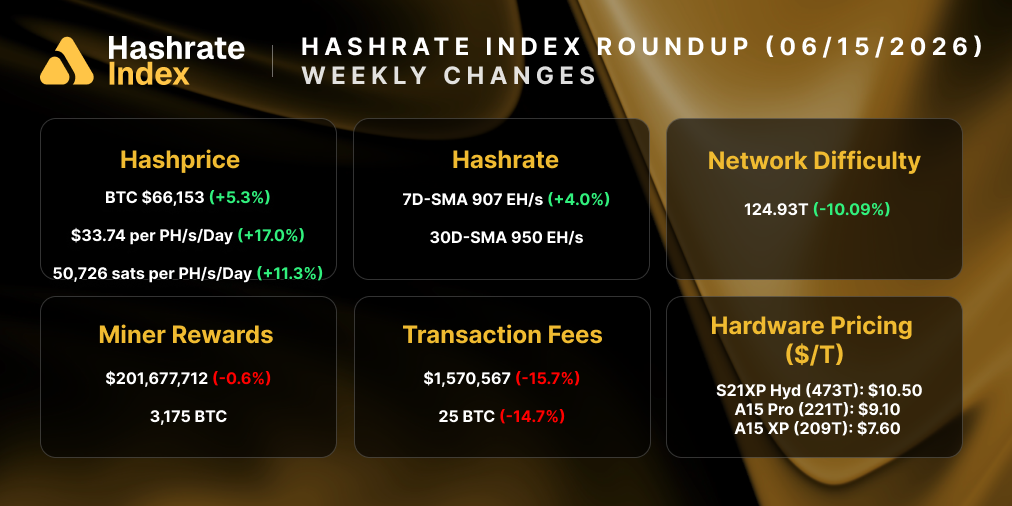
The recent mining landscape report indicates a week of divergent trends for Bitcoin miners. While the price of Bitcoin saw a notable increase, the hashprice experienced a slight decline. Concurrently, the network’s total hashrate surged, and the mining difficulty adjusted downwards. Transaction fees represented a small but significant portion of the total miner revenue.
Key Takeaways
- Total miner revenue for the week reached approximately $201 million, primarily from block rewards.
- Transaction fees accounted for 0.79% of miner revenue, totaling about $1.57 million.
- The network hashrate increased by 4.73% to a 7-day average of 930 EH/s.
- Network difficulty saw a minor decrease of 0.45%.
- Despite a 1.05% drop in USD hashprice, miner rewards in BTC increased by 6.51% to 3,251 BTC.
- Bitcoin’s market price rose by 5.3%, trading around $66,153.
- Hardware pricing remained stable, with the S21XP model quoted at $25.70 per terahash (TH).
The past week saw Bitcoin’s market price appreciate by 5.3%, moving from approximately $62,840 to $66,153. This price action is a significant factor for miners, influencing the fiat value of their mined rewards. However, the Year-to-Date (YTD) performance for Bitcoin remains in negative territory at -24.3%, suggesting a volatile market environment for the digital asset.
Network Hashrate and Difficulty Dynamics
The Bitcoin network has demonstrated a substantial increase in computational power, with the total hashrate rising by 4.73% to a 7-day average of 930 Exahashes per second (EH/s). This growth in hashrate is a key indicator of the network’s expanding security and the competitive environment among miners. Despite this surge in hashrate, the network’s mining difficulty experienced a slight decrease of 0.45%. This downward adjustment in difficulty is typically observed following a period of hashrate fluctuation or to re-calibrate the block target times, ensuring blocks are found approximately every ten minutes. The interplay between hashrate and difficulty directly impacts the rate at which new blocks are discovered and, consequently, miner profitability.
The aggregate miner rewards saw a notable increase of 6.51%, amounting to 3,251 BTC for the week. This rise in BTC rewards, coupled with the increase in Bitcoin’s fiat price, contributed to an overall revenue of approximately $201 million. However, the hashprice, which represents the value generated per unit of hash power, decreased by 1.05% in USD terms. This suggests that while the total rewards increased in BTC, the efficiency of mining operations, when measured against the total network hashrate, saw a marginal dip in fiat terms. Transaction fees, which are generated from users paying to have their transactions included in blocks, contributed 25 BTC, equating to roughly $1.57 million, or 0.79% of the total block rewards. This indicates that while block subsidies remain the dominant revenue stream, transaction fees are a consistent, albeit smaller, contributor.
Impact on Mining Operations and ROI
The current market conditions present a mixed outlook for different scales of mining operations. For large-scale industrial mining farms, the increased hashrate signifies a more competitive environment. Efficiency in energy consumption and the utilization of the latest generation ASIC hardware become paramount. The slight decrease in hashprice, even with rising BTC rewards, means that operational expenditures, particularly electricity costs, must be meticulously managed to maintain profitability. Miners with access to low-cost energy and high-efficiency machines are better positioned to weather these fluctuations.
Small-scale miners, often operating with older or less efficient hardware and potentially higher energy costs, may find it increasingly challenging to remain profitable. The rising hashrate and the slight dip in hashprice can squeeze margins significantly. The stability in hardware pricing, with the S21XP model at $25.70/TH, suggests that new, efficient hardware is maintaining its valuation. However, the cost of such hardware remains a significant barrier for smaller operators. The minor decrease in network difficulty offers a small reprieve, potentially increasing the share of rewards for individual miners with a fixed hashrate, but this effect is likely offset by the overall increase in network hashrate. The economic viability for small miners is heavily dependent on Bitcoin’s price performance and their ability to secure competitively priced electricity.
Bitcoin mining hashrate up 4.73% to 930 EH/s, difficulty down 0.45%. Miner rewards are up 6.51% to 3,251 BTC, but USD hashprice is down 1.05%. Bitcoin price is up 5.3% to $66,153. Hardware prices are stable.
Original article : hashrateindex.com