

Alibaba Unveils Comprehensive Embodied AI Suite for Robotics
Alibaba’s Qwen team has introduced the Qwen-Robot Suite, a trio of advanced AI models designed to provide a unified software stack for robot navigation, manipulation, and physics-based world simulation. This development represents a significant step towards more intelligent and adaptable robotic systems, aiming to create an “Android moment” for the robotics industry by providing foundational operating system-like capabilities.
- Unified Robotics AI: Alibaba’s Qwen-Robot Suite comprises Qwen-RobotNav (mobility), Qwen-RobotManip (manipulation), and Qwen-RobotWorld (physics simulation), forming a cohesive system for embodied intelligence.
- Benchmark Performance: The company claims its models surpass multiple robotics benchmarks, leveraging extensive training data from millions of samples and tens of thousands of hours of open-source robot data.
- Future Deployment: While the technology shows considerable promise, widespread real-world robot deployment is still anticipated to be several years away.
Unlike typical AI agents that rely on Large Language Models (LLMs) for decision-making, Alibaba’s new suite addresses the unique challenges of physical agents. These agents must contend with the complexities of physics, spatial reasoning, and real-world consequences, which differ significantly from prompt-based interactions. The Qwen-Robot Suite aims to bridge this gap by providing specialized models that understand and interact with the physical world.
📣 Introducing the Qwen-Robot Suite — Qwen-RobotNav, Qwen-RobotManip, Qwen-RobotWorld, three foundation models, a full stack for embodied intelligence.
🧭 Qwen-RobotNav — the gateway to mobility.
• Unifies 5 navigation tasks in one model: instruction following, point-goal,…— Qwen (@Alibaba_Qwen) June 16, 2026
Alibaba’s strategic advantage lies in its integrated ecosystem, spanning from semiconductor development and cloud infrastructure to AI models and application platforms. This end-to-end control allows for a more cohesive development of embodied AI, where robotics serves as a critical physical manifestation of their broader AI ambitions. The company’s decision to train models on open-source data, rather than proprietary datasets, also positions them uniquely against competitors.
The Qwen-Robot Suite is comprised of distinct yet complementary components:
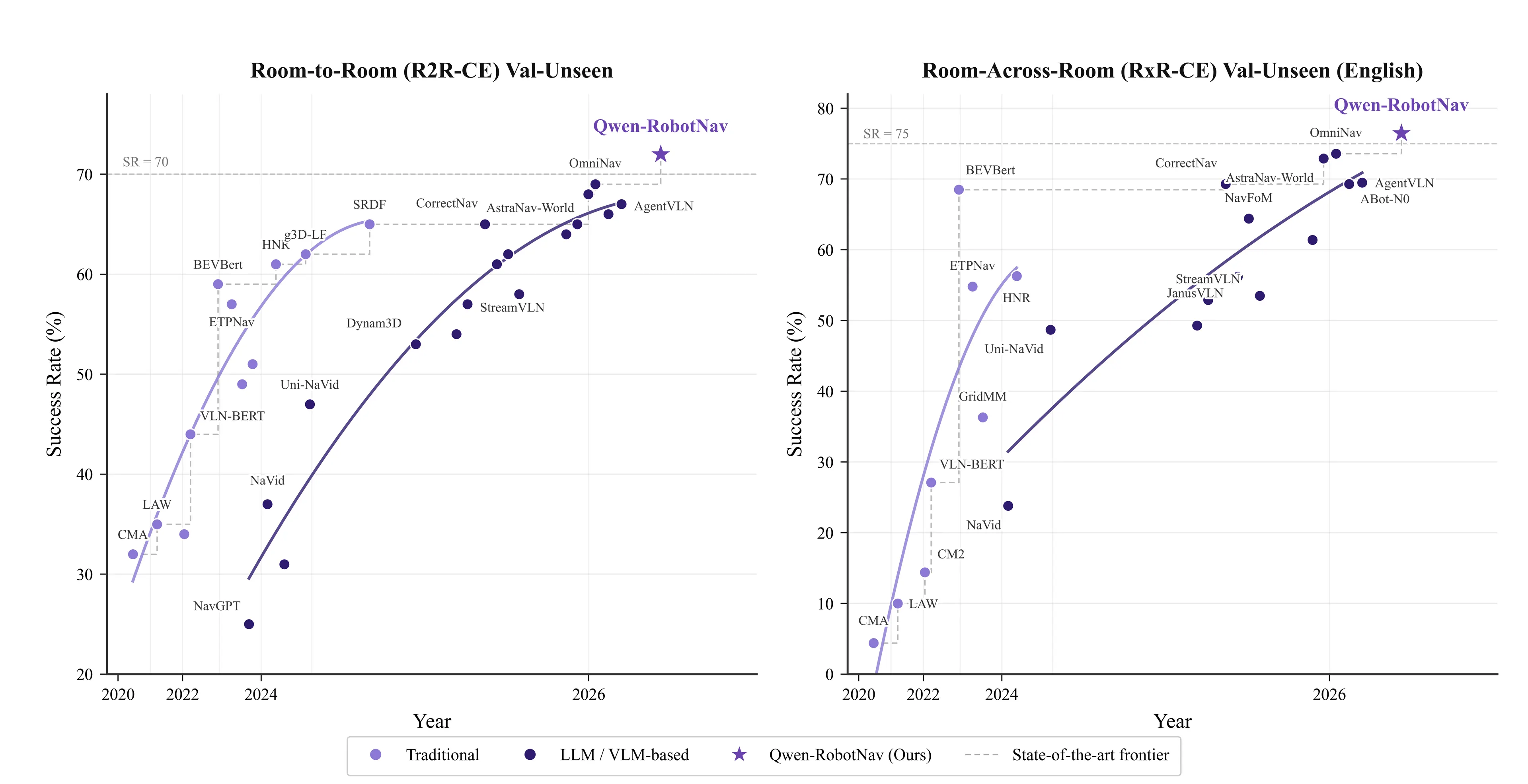
Qwen-RobotNav is engineered to handle complex navigation tasks, unifying five distinct capabilities: instruction following, point-goal navigation, object search, target tracking, and autonomous driving. Unlike many existing models that employ a single, hardcoded strategy, Qwen-RobotNav offers a flexible, parameterized interface. This allows planners to dynamically reconfigure parameters such as token budget, temporal decay, and per-camera weights mid-task, adapting to changing environmental conditions. Its training involved 15.6 million randomized samples, resulting in a 76.5% success rate on the VLN-CE RxR benchmark for real-world visual-language navigation and 90% accuracy on the EVT-Bench for consistent target tracking.
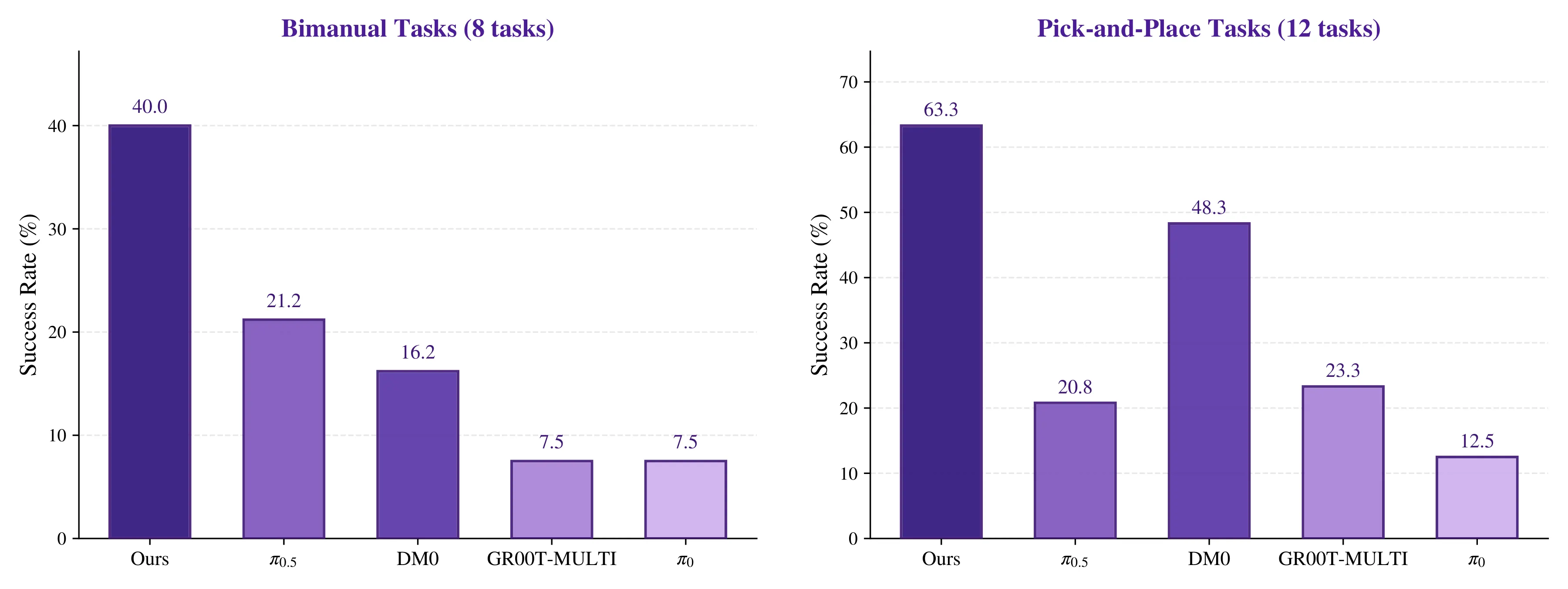
Qwen-RobotManip addresses the significant challenge of disparate action spaces across different robotic platforms. Robots like the Franka arm use joint angles, while the ALOHA robot operates on end-effector poses, and humanoids introduce whole-body coordinates. To harmonize these variations, Alibaba synthesized approximately 38,100 hours of training data from open-source datasets and human videos, bypassing the need for proprietary data collection. This model achieves a first-place ranking on the RoboChallenge Table30-v1, outperforming prior methods by 20%.
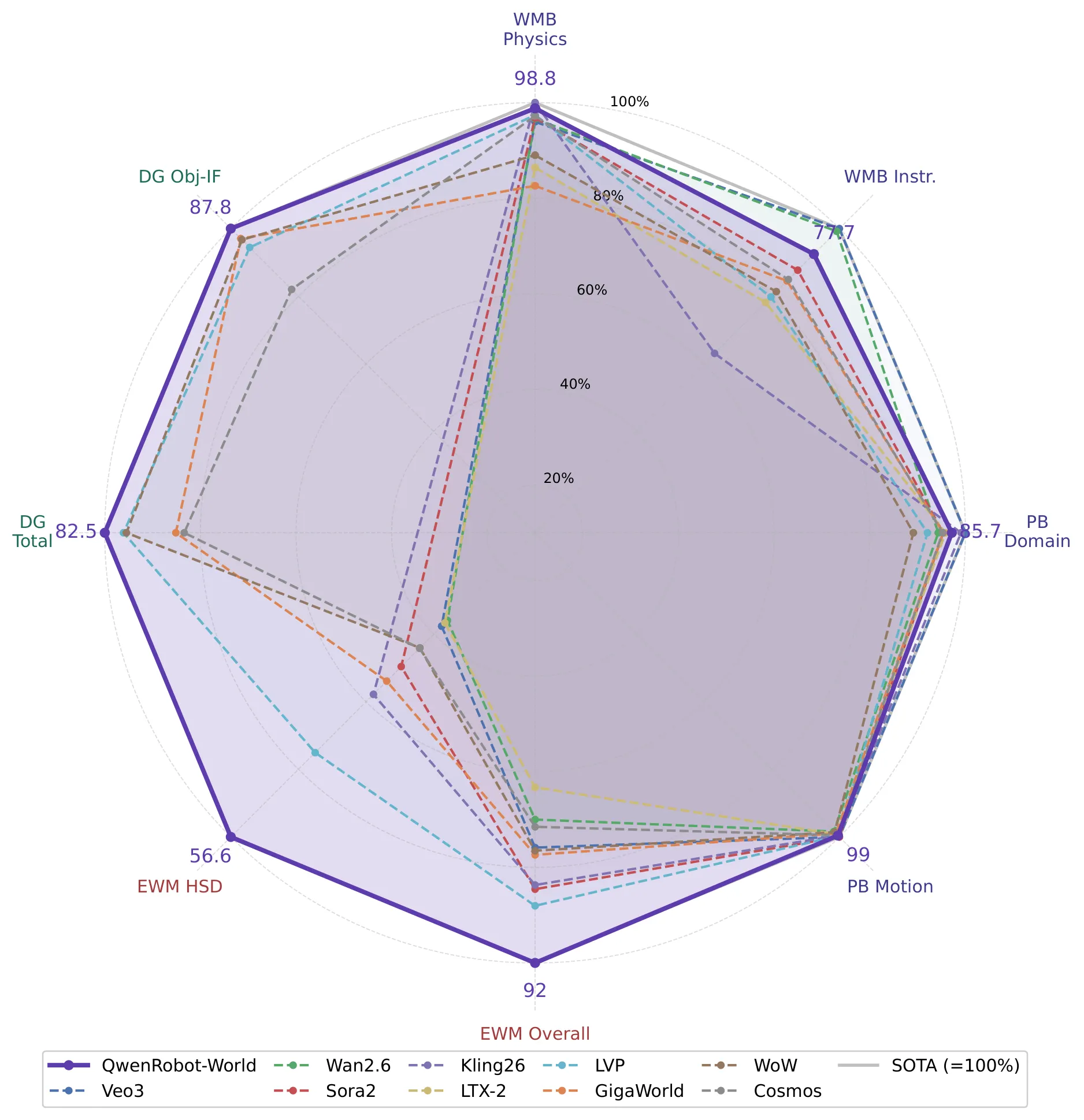
Qwen-RobotWorld represents the most ambitious component, acting as a language-conditioned video world model. It treats natural language as a universal interface for actions, enabling instructions like “Pick up the red cup and pour water on the flower” to be executed by various agents, from robotic grippers to autonomous vehicles. The training data, known as the Embodied World Knowledge corpus, consists of 8.6 million video-text pairs (200 million frames) covering manipulation, autonomous driving, indoor navigation, and human-to-robot skill transfer. This model excels in predicting and generating realistic physical environments, topping benchmarks like EWMBench and DreamGen Bench, and demonstrating perfect adherence to fundamental physics principles.
Long-Term Technological Impact: Towards General-Purpose Robotics
Alibaba’s Qwen-Robot Suite represents a significant stride towards the concept of general-purpose robotics, moving beyond task-specific automation to create adaptable and intelligent agents. While Western research labs are exploring similar avenues, Alibaba’s integrated approach, from hardware to foundational models, and their commitment to open-source data, differentiates their strategy. This suite offers a glimpse into a future where robots can perform a wider array of tasks in dynamic environments, akin to how LLMs have revolutionized natural language processing.
It is crucial to distinguish that the Qwen-Robot Suite consists of sophisticated AI models—the “brains” of robots—rather than the physical hardware itself. These models are designed to interface with a variety of robotic platforms from different manufacturers. Furthermore, these are not mere language models; they possess a deeper understanding of physical dynamics. While a standard LLM might predict that a glass breaks when dropped, Qwen-RobotWorld can predict the specific manner of breakage, including patterns and secondary impacts, and Qwen-RobotManip can plan a grasp to prevent the drop altogether.
Despite these advancements, the practical application of these models in real-world scenarios, such as domestic robots, remains a long-term prospect. The leap from controlled simulation benchmarks to the unpredictable nature of home environments—marked by sensor noise, actuator drift, and countless edge cases—is substantial. Alibaba acknowledges this challenge, emphasizing that widespread deployment is still years away.
The technical innovations within the suite are noteworthy. Qwen-RobotManip’s “alignment-first” methodology offers a compelling solution to cross-embodiment training bottlenecks. Qwen-RobotNav’s adaptable parameterization addresses context-strategy challenges in navigation, and Qwen-RobotWorld’s vision of language as a universal action interface provides a powerful abstraction for cross-domain world modeling. Alibaba has not yet revealed pricing, deployment timelines, or specific customer access details beyond initial pilot programs.
Details can be found on the website : decrypt.co