

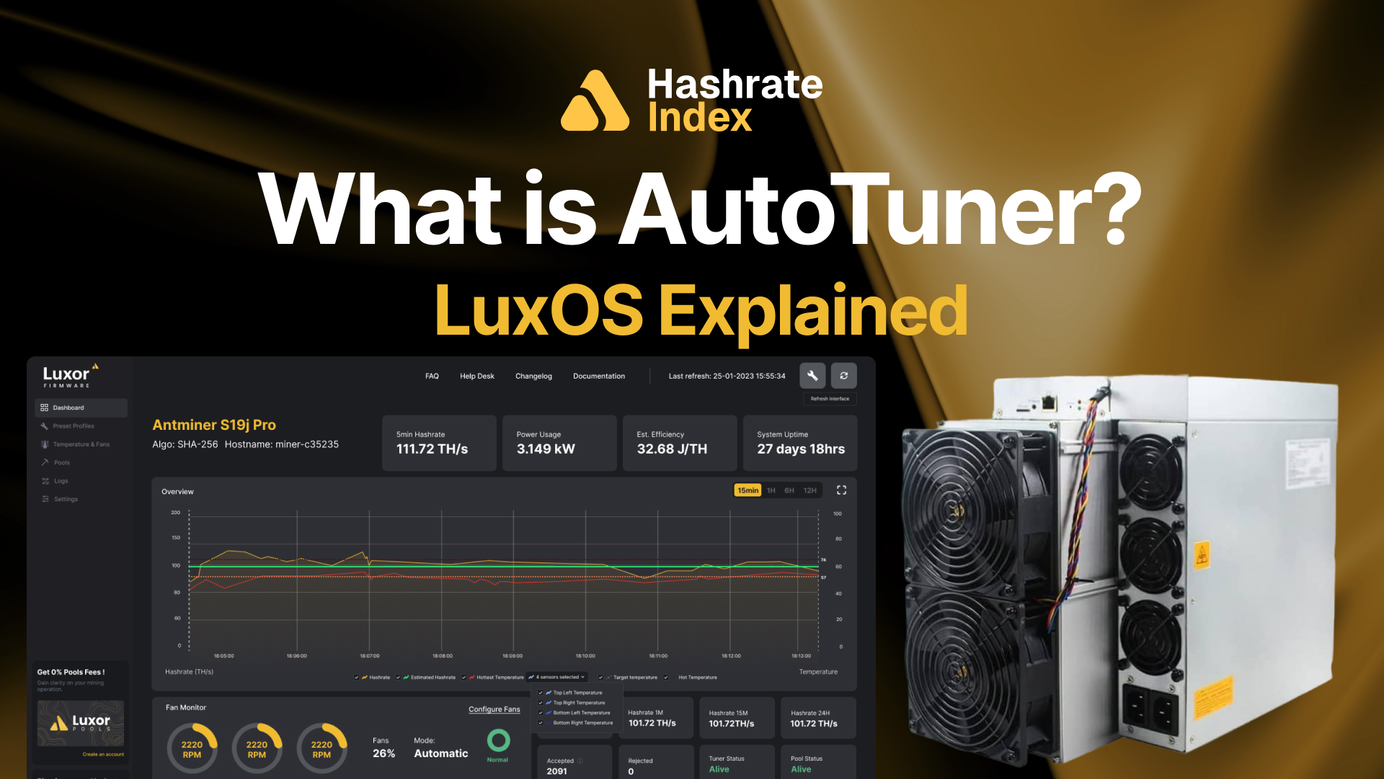
This post is part of Luxor’s Firmware Features Series, which covers the core Bitcoin mining concepts behind the flexible firmware features that give operators custom control over performance and profitability. Every ASIC ships from the factory with more voltage than necessary. That cushion is a stability margin, but it is also wasted power. LuxOS’ AutoTuner is how you reclaim that wasted energy.
Key Takeaways
- AutoTuner is a firmware feature designed to optimize ASIC performance by dynamically adjusting voltage and frequency.
- It aims to maintain a target hashrate at the lowest possible stable power draw, effectively reducing energy consumption per unit of computation (J/TH).
- The tuning process occurs in real-time without interrupting mining operations or causing hashrate loss.
- AutoTuner can operate in two modes: maintaining a fixed hashrate by adjusting voltage, or maintaining a fixed power target (watts) by adjusting hashrate.
- The feature is accessible via Commander, Web UI, or API and is compatible with select Bitmain Antminer and MicroBT Whatsminer models.
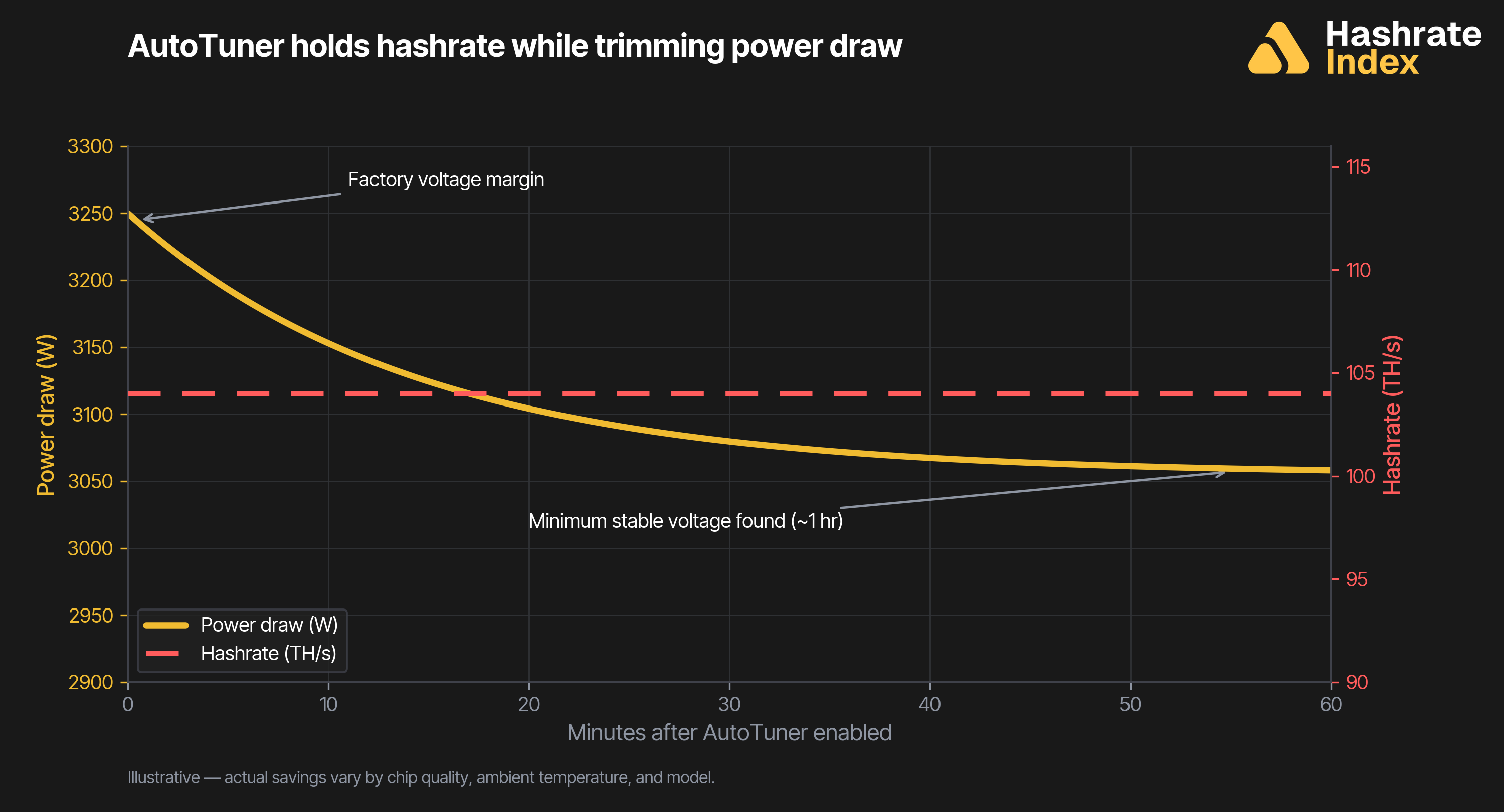
AutoTuner functions as a control loop within the ASIC firmware, continuously monitoring and adjusting the voltage and frequency parameters. The frequency directly correlates to the hashrate output of the ASIC; for instance, a specific frequency on an Antminer S19j Pro yields approximately 104 TH/s. Voltage, conversely, is critical for maintaining operational stability at a given frequency, with higher frequencies generally requiring increased voltage. Factory-set firmware typically applies a voltage margin to ensure consistent performance across diverse environmental conditions and to account for variations in chip manufacturing. LuxOS’ AutoTuner capitalizes on this headroom by identifying the minimum voltage required for a board to operate stably at a specified frequency. This process allows for a reduction in power consumption without a commensurate decrease in hashrate.
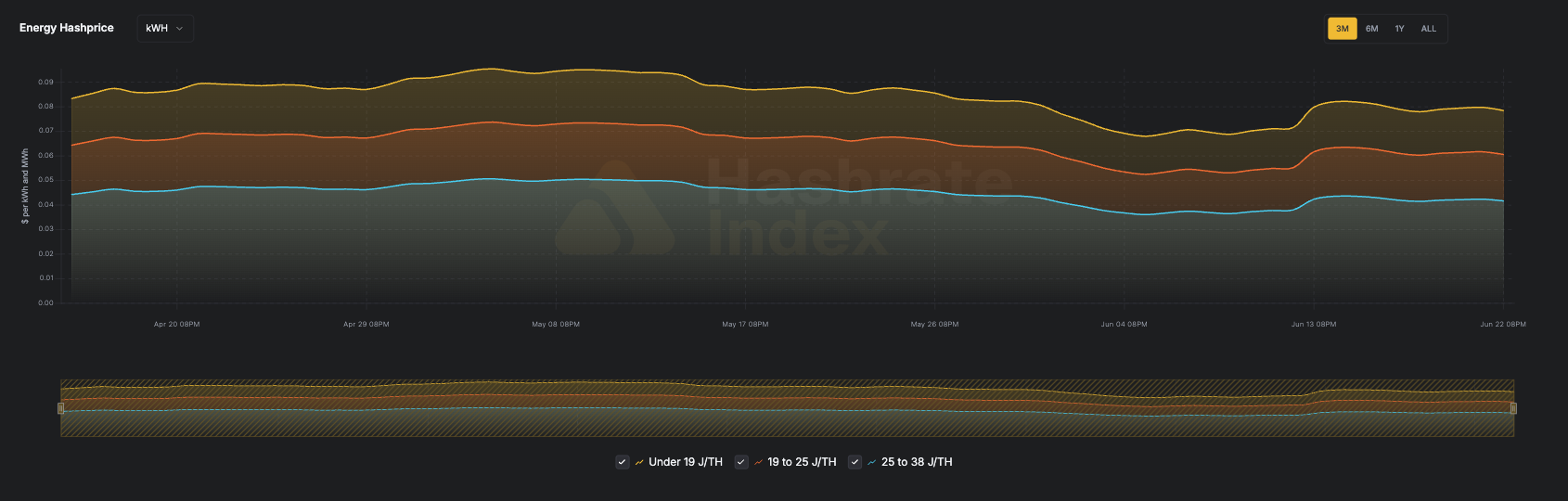
The significance of AutoTuner lies in its ability to enhance mining efficiency. By lowering the energy consumed per terahash (J/TH) while maintaining a consistent hashrate, miners can increase their Bitcoin mined per kilowatt-hour. This improved efficiency directly impacts profitability, amplifying gains during periods of high hashprice and providing a crucial operational margin to sustain operations during downturns in market value.
- Continuous Operation: AutoTuner operates in the background, dynamically recalibrating to changes in ambient temperature and operational conditions without requiring miner restarts or causing downtime.
- No Compromise on Hashrate: The tuning process occurs while the miner is actively hashing. Optimal settings are typically achieved within an hour, and the hashrate is maintained throughout the process.
- Enhanced Hardware Longevity: Lower operating voltages translate to reduced operating temperatures, which can contribute to fewer hardware failures and extend the lifespan of the ASICs.
- Compatibility: AutoTuner functions seamlessly with other firmware features such as Advanced Thermal Management (ATM) and preset profiles, allowing for integrated control over efficiency and thermal protection.
The AutoTuner feature can be integrated into an ASIC’s operation through several methods:
- During LuxOS Installation: When installing LuxOS, operators can select the “Configure Installation” option and enable AutoTuner before firmware deployment.
- Via Commander Software: Within the Commander interface, users can select specific miners or groups of miners, navigate to the “Configure Miners” section, access the “Power” tab, set the AutoTuner Mode to “Enable,” and then apply the configuration across their fleet.
- Through the API: For automated provisioning, the `autotunerset` command can be utilized via the API to enable tuning as part of a larger script.
It is important to note that AutoTuner does not override user-defined custom profiles where specific voltage and frequency settings have been manually established. On models supporting power targeting, the AutoTuner’s power target mode and custom profiles cannot be active simultaneously; the system prioritizes the enabled function. Furthermore, significant changes in the miner’s operating environment or physical location may necessitate a reset and re-tuning process to allow AutoTuner to recalibrate effectively.
Impact on Network Security and Miner ROI
The widespread adoption of efficiency-enhancing firmware features like AutoTuner has a dual impact on the Bitcoin network. For industrial-scale mining farms, the ability to consistently reduce energy consumption per terahash directly translates to lower operational expenditures and a higher Return on Investment (ROI). This optimization is crucial in a competitive landscape where energy costs represent a significant portion of mining expenses. By achieving lower J/TH, large operators can maintain profitability even when Bitcoin prices fluctuate or network difficulty increases, thereby ensuring a stable and predictable hash rate contribution to the network. This sustained hash rate is fundamental to Bitcoin’s security model, making it more computationally expensive to mount an attack. For small-scale miners, AutoTuner offers a more accessible pathway to improved profitability without requiring significant capital investment in new hardware or renegotiating power contracts. By optimizing the efficiency of existing ASICs, smaller operations can better compete with larger farms, encouraging broader decentralization of mining power. However, the effectiveness of AutoTuner is model-dependent, and its benefits are most pronounced on newer generations of ASICs. The continued development and adoption of such firmware capabilities will likely lead to a more energy-efficient global mining network, indirectly bolstering Bitcoin’s long-term security and economic viability by lowering the cost basis for miners.
Frequently Asked Questions
Does autotuning lower my hashrate? No. AutoTuner’s primary function is to maintain your target frequency, and consequently your hashrate, by finding the minimum stable voltage required for operation.
How long does AutoTuner take to optimize? The convergence period for AutoTuner typically lasts around an hour, though this can vary based on factors such as ambient temperature, the health of the ASIC’s chips, and the specific hardware model.
Is autotuning the same as overclocking? No. Overclocking aims to increase hashrate by raising the operating frequency. AutoTuner, conversely, focuses on optimizing voltage efficiency at a given, selected frequency.
Which miners are supported by AutoTuner? AutoTuner is compatible with select models from Bitmain’s Antminer series and MicroBT’s Whatsminer series. Users should consult the LuxOS compatibility list for precise model information.
Most mining operations can achieve significant efficiency gains by leveraging AutoTuner, as factory default voltage settings are often conservative. This firmware feature offers a low-cost, high-impact operational improvement that enhances a mining fleet’s competitiveness.
Flexible firmware solutions represent a substantial leverage point for operational improvements, requiring no additional hardware purchase, renegotiation of power contracts, or infrastructure upgrades. Installing LuxOS and activating AutoTuner can immediately boost the efficiency and competitiveness of an existing mining fleet.
To implement AutoTuner, download LuxOS Commander and follow the simple steps to enable the feature.
For further information on Luxor’s comprehensive Bitcoin mining services, please contact [email protected] or visit the official website.
About Luxor Technology Corporation
Luxor Technology Corporation is a provider of hardware, software, and financial services integral to the global compute and energy sector. Their offerings include Bitcoin Mining Pools, ASIC Firmware solutions, Hardware trading services, Hashrate Derivatives, Energy services, a Miner Management platform known as Commander, and the Bitcoin mining data platform, Hashrate Index.
Source: : hashrateindex.com