

In early June 2026, a batch of Bitmain Antminer Z15 Pro units encountered a critical operational failure, repeatedly logging an “extranonce1 len is not 8” error and failing to connect to mining pools. This issue, impacting the critical handshake phase of the Stratum protocol, prevented the ASICs from participating in the Zcash network, despite hardware self-checks and network connectivity appearing normal. The problem stemmed from a mismatch between the pool’s extranonce1 (en1) value and the strict, hard-coded validation within specific Z15 Pro firmware versions.
Key Takeaways
- A critical firmware bug in certain Antminer Z15 Pro units prevents mining by enforcing a strict 8-character (4-byte) length for extranonce1, deviating from the Zcash Stratum protocol specification (ZIP-301) which only mandates a maximum length of 32 bytes.
- This rigid validation causes connection failures with mining pools that provide en1 values of different lengths, such as the 6-byte (12 hex characters) value used by Luxor’s ZEC pool.
- A significant challenge arises as different Z15 Pro firmware versions exhibit varied en1 length requirements, meaning a fix for one firmware version can break compatibility with others.
- This situation highlights the potential for firmware inconsistencies to disrupt mining operations and impact network hash rate, particularly for large-scale farms managing diverse hardware.
- The discrepancy between protocol specifications and specific hardware implementation underscores the need for robust testing and flexible design in mining firmware to accommodate varied pool configurations.
The Stratum protocol, particularly as defined in Zcash’s ZIP-301, details how mining pools and miners negotiate nonce values for block submissions. The 32-byte block header nonce is split into two parts: NONCE_1 (extranonce1, provided by the pool) and NONCE_2 (managed by the miner). ZIP-301 stipulates that the pool must provide an en1 strictly less than 32 bytes, and the miner must use the remaining space for en2. However, the specification does not mandate a minimum length for en1, only an upper bound.
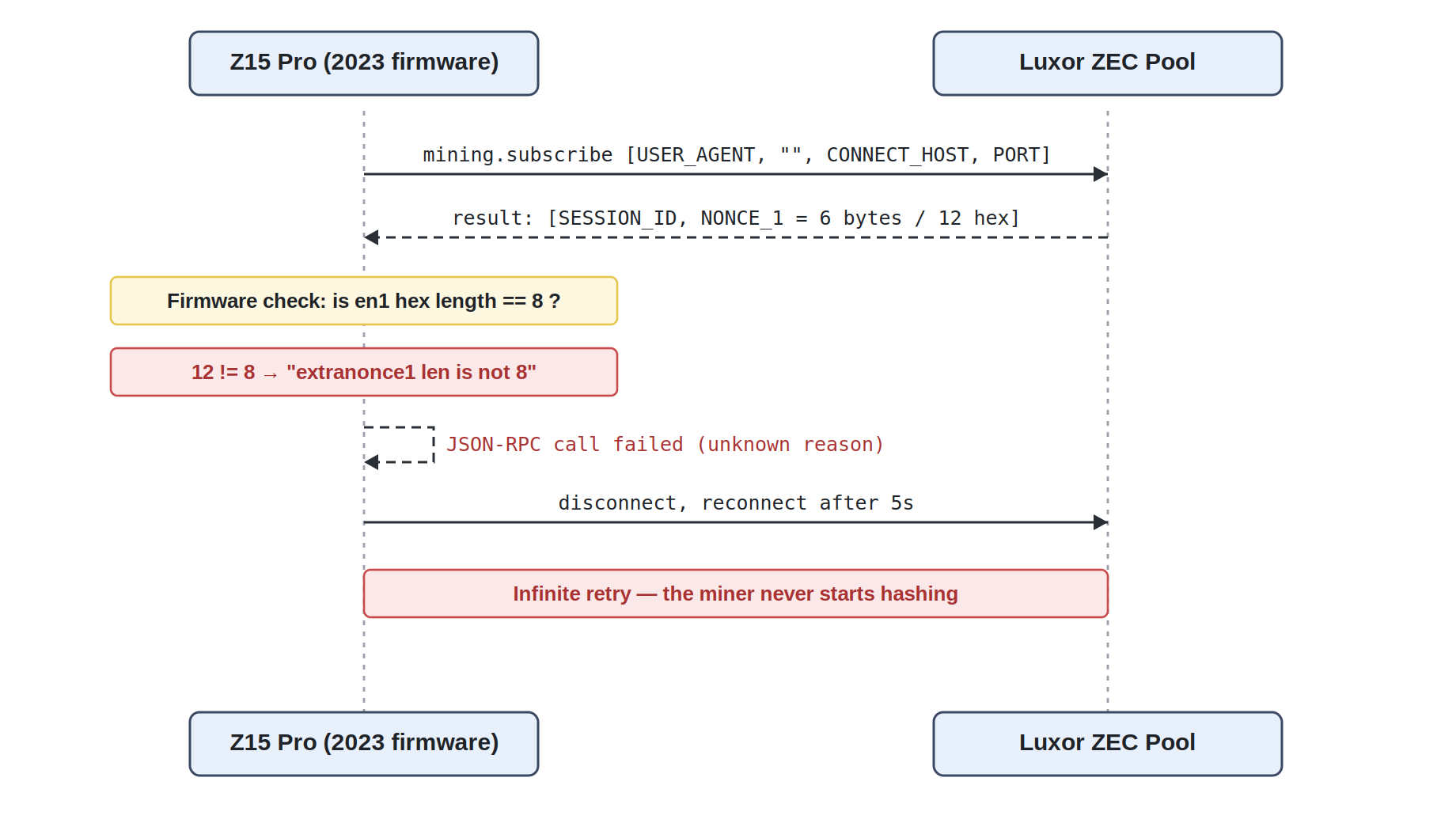
In the case of the affected Z15 Pro units, the firmware’s validation logic was found to be exceptionally strict, expecting the provided en1 to be precisely 8 hexadecimal characters (equivalent to 4 bytes). When the Luxor pool supplied a 6-byte (12 hex characters) en1, the firmware treated this valid value under ZIP-301 as an error, leading to repeated connection attempts and failures. This indicates a firmware implementation that is more rigid than the established protocol standard.
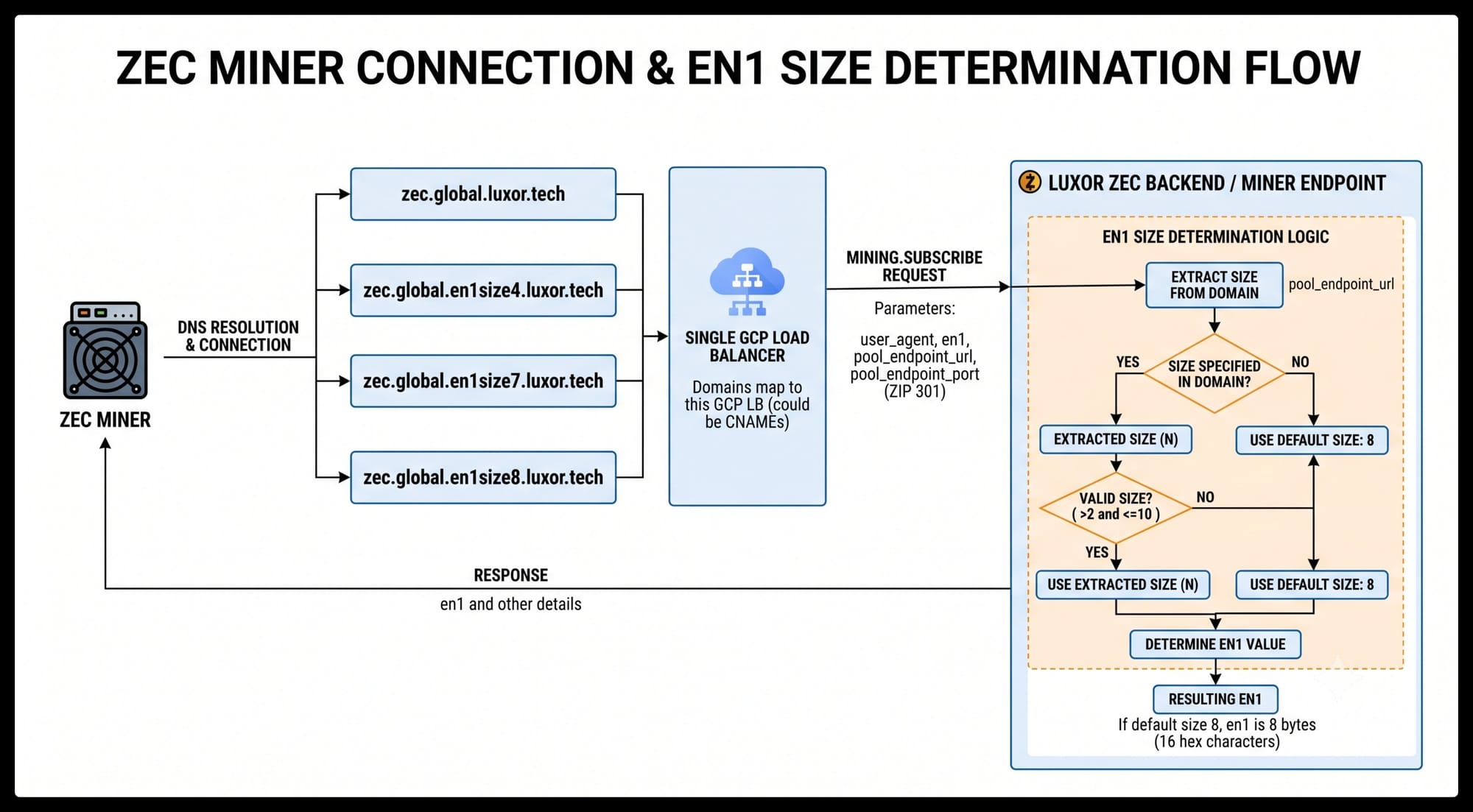
The immediate solution of adjusting the pool’s en1 to precisely 4 bytes (8 hex characters) resolved the issue for the 2023 firmware version. However, this proved to be a short-sighted fix. Community investigations revealed that different firmware revisions of the Z15 Pro exhibit disparate en1 length preferences: some require 4 bytes, while others, such as firmware FR-1.9, expect 8 bytes. This fragmentation means that a configuration optimal for one set of ASICs would render others inoperable.
This situation presents a significant challenge for industrial mining operations that deploy large fleets of ASICs. Managing firmware versions across thousands of units to accommodate a single, non-standardized parameter like en1 length is operationally complex and costly. For smaller-scale miners, this can mean being locked out of profitability if their specific firmware version is incompatible with the prevailing pool configurations. The economic impact is direct: non-operational ASICs cease to generate revenue, while the energy consumed by the misconfigured hardware represents a pure loss.
Impact on Network Security and Miner ROI
The observed firmware inflexibility has direct implications for both the economic viability of mining operations and the overall security of the Zcash network. For individual miners, whether operating at scale or as hobbyists, a firmware-induced inability to connect to mining pools translates directly to a negative Return on Investment (ROI). ASICs that cannot mine are idle assets that continue to incur electricity costs, diminishing profitability. This issue also creates a fragmented mining landscape where different firmware versions require distinct pool configurations, complicating operations and potentially reducing the total accessible hash rate if compatibility is not broadly addressed.
From a network security perspective, while this specific issue does not directly compromise the cryptographic integrity of Zcash blocks, it can indirectly affect network security by reducing the diversity and distribution of miners. If a significant portion of Z15 Pro ASICs are rendered temporarily inoperable due to firmware-related connectivity problems, the hash rate contributed by these machines is lost. While Zcash’s Proof-of-Work algorithm is designed to be robust against such fluctuations, a widespread issue affecting a popular ASIC model could theoretically lead to periods of lower overall network hash rate, making it marginally easier for potential malicious actors to concentrate hashing power. However, the primary impact remains on the economic front, affecting miner profitability and operational efficiency.
Information compiled from materials : hashrateindex.com