

OpenAI’s latest cybersecurity-focused artificial intelligence model, GPT-5.5-Cyber, has surged to the top of the CyberGym leaderboard, outperforming Anthropic’s advanced models. This development occurs while Anthropic’s flagship AI, Mythos, remains offline due to a U.S. government export ban, highlighting significant shifts in the AI cybersecurity landscape.
Key Takeaways
- OpenAI has launched GPT-5.5-Cyber, a specialized AI model designed to accelerate the identification and remediation of software vulnerabilities.
- GPT-5.5-Cyber demonstrates superior performance on the CyberGym benchmark compared to Anthropic’s Mythos model.
- Anthropic’s Mythos and Fable models were taken offline following a U.S. export control directive citing national security concerns related to potential “jailbreaks.”
- OpenAI is rolling out GPT-5.5-Cyber to a select group of trusted cybersecurity partners and government agencies, emphasizing controlled access.
- The incident underscores the complex regulatory environment surrounding advanced AI models and their potential dual-use capabilities.
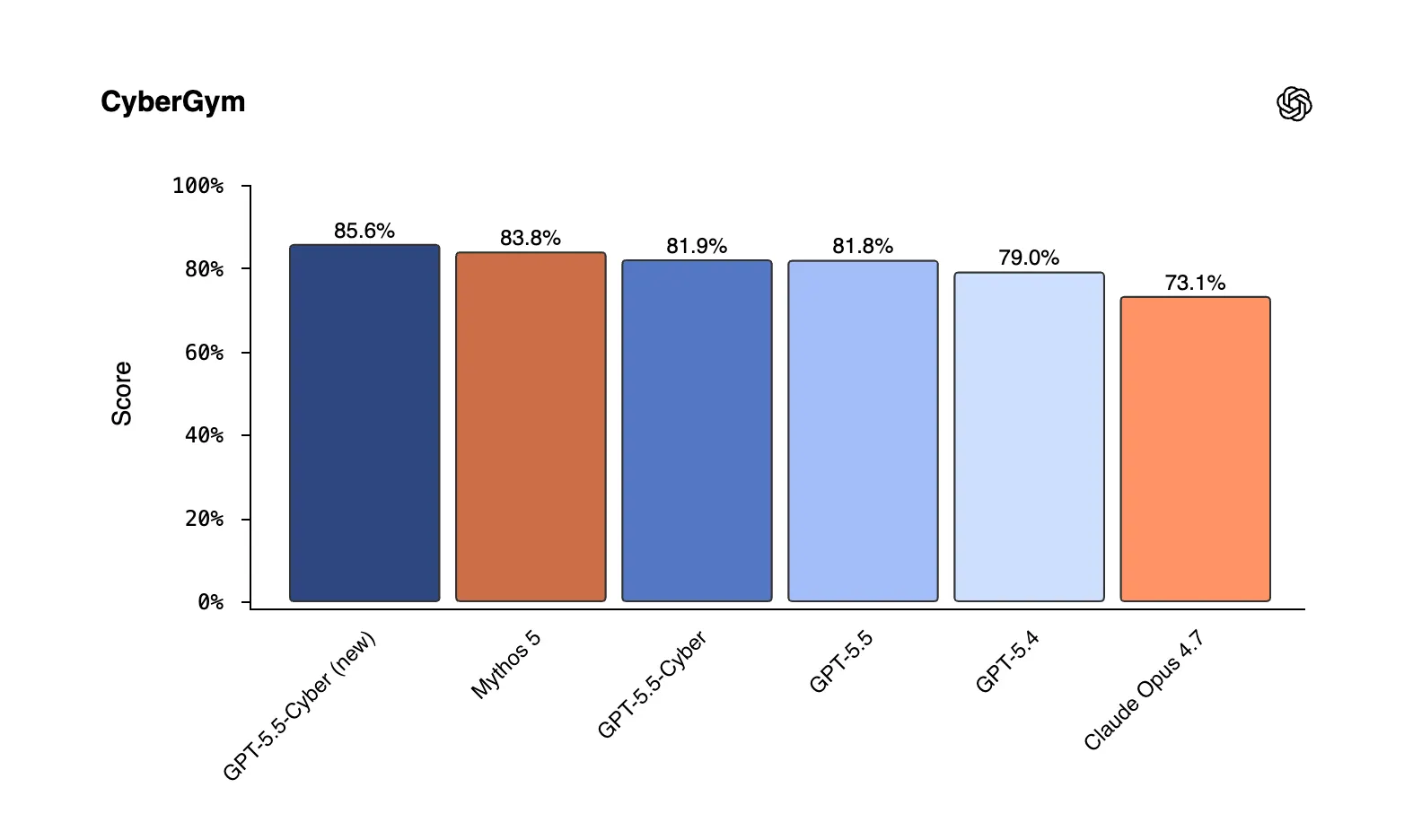
GPT-5.5-Cyber’s successful debut on the CyberGym benchmark, a platform designed to test AI agents against known software vulnerabilities, marks a significant milestone. The model achieved an 85.6% success rate in reproducing vulnerabilities across 1,507 known exploits from 188 open-source projects. This performance surpasses Anthropic’s Mythos 5, which scored 83.8% on the same benchmark, and Claude Opus 4.7, scoring 73.1%. The context of this achievement is particularly noteworthy, as Anthropic’s advanced models were recently subjected to a U.S. government export ban.
The U.S. government’s action against Anthropic’s models, specifically Mythos 5 and Fable 5, was triggered by concerns over national security, particularly related to the potential for “jailbreaking” – circumventing safety protocols. Anthropic’s decision to disable these models globally, due to an inability to reliably verify user nationality, highlights the challenges of managing powerful AI technologies in a sensitive geopolitical climate. This situation is compounded by prior controversies surrounding Anthropic, including criticism for its own documentation warning about the potent, potentially harmful cybersecurity capabilities of Mythos and a hidden filter in Fable 5 that degraded outputs for suspected competitors.
Strategic Differentiation in AI Deployment
In contrast to Anthropic’s current regulatory challenges, OpenAI is actively expanding its cybersecurity AI initiatives through strategic partnerships. The company’s Daybreak cyber defense program has secured collaborations with governments in Australia, Canada, France, Germany, Japan, South Korea, and various EU institutions, including ENISA. Furthermore, OpenAI has established a Cyber Partner Program, integrating GPT-5.5-Cyber into the offerings of 28 leading cybersecurity firms such as CrowdStrike, Cisco, and Cloudflare for vetted clients.
OpenAI’s Codex Security tool has already demonstrated significant impact, scanning over 30 million code commits and identifying more than 500,000 vulnerabilities since its March launch. The company is also fostering open-source security through its “Patch the Planet” initiative, aimed at addressing vulnerabilities in widely used projects. This approach contrasts with the blanket disabling of models seen with Anthropic, emphasizing a phased and controlled release strategy.
While GPT-5.5-Cyber is not intended for public use, its deployment is restricted to verified security professionals. OpenAI has proactively engaged with U.S. federal agencies, including the Center for AI Standards and Innovation and the Office of the National Cyber Director, for pre-deployment assessments. This collaborative and transparent approach with regulatory bodies appears to be a key differentiator in how OpenAI is managing the rollout of its advanced AI capabilities, particularly in sensitive sectors like cybersecurity.
As of June 23, Anthropic’s Fable 5 and Mythos 5 remain unavailable, with no clear timeline for their reinstatement, underscoring the ongoing complexities and potential disruptions in the rapidly evolving field of advanced AI development and deployment.
According to the portal: decrypt.co