

Maintaining optimal operating temperatures is a critical consideration for Bitcoin mining operations, directly impacting hardware longevity and hashrate stability. Advanced Thermal Management (ATM) firmware offers a dynamic solution to the challenges posed by fluctuating ambient heat, differentiating between the blunt approach of stock firmware and a more nuanced, adaptive strategy.
Key Takeaways
- Advanced Thermal Management (ATM) dynamically adjusts miner frequency and voltage based on real-time temperature data, providing granular control.
- Unlike stock firmware’s flat 25% underclock in Low-Power-Mode (LPM), ATM applies only the necessary reduction based on current thermal conditions.
- ATM leverages multiple sensor inputs, including hashboard, on-die chip, and water-inlet temperatures where available, for comprehensive thermal monitoring.
- The system operates autonomously, requiring no external integrations or human intervention to manage thermal loads.
- By mitigating extreme temperature events, ATM contributes to extending the operational lifespan of ASIC mining hardware.
Thermal management encompasses all actions taken to maintain ASIC mining hardware within its specified operating temperature range. This includes facility-level controls such as airflow and fan curves, as well as firmware-level responses to increasing temperatures. Traditional stock firmware typically employs a binary approach: operate normally until a critical shutdown temperature is reached, at which point the unit powers off, resulting in a complete loss of hashrate production. Luxor’s LuxOS firmware introduces Advanced Thermal Management (ATM), which replaces this abrupt shutdown mechanism with a controlled, incremental performance scaling.
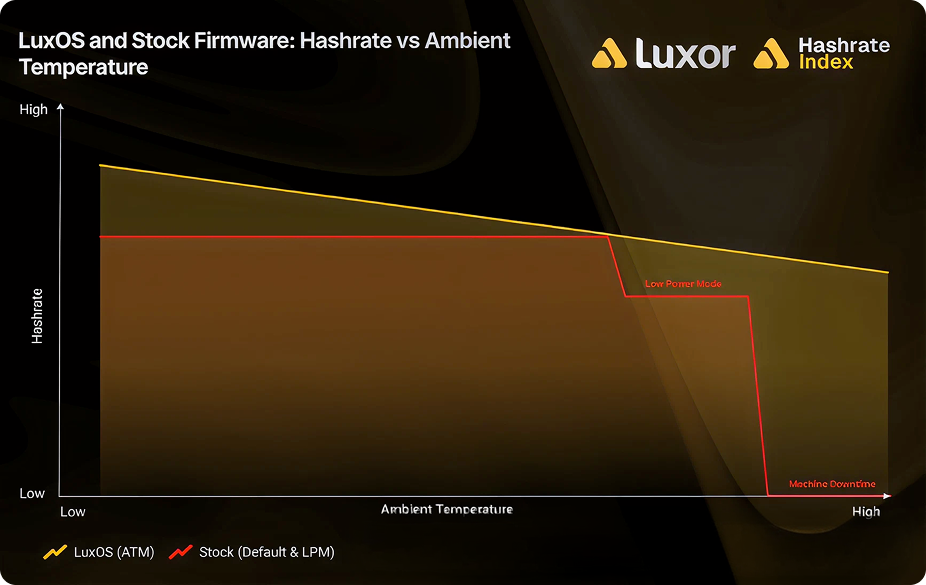
When operating with LuxOS and ATM enabled, a miner automatically adjusts its performance profile in response to ambient temperature. During cooler periods, the miner can operate at stock settings or even be overclocked to maximize hashrate. As temperatures rise, ATM progressively reduces the miner’s performance (frequency and voltage) to prevent overheating. This adaptive strategy ensures the machine remains online and continues to contribute to the network, albeit at a reduced hashrate. Conversely, as temperatures decrease, ATM gradually restores performance, potentially even exceeding stock settings if overclocking is permitted. This allows miners to capture additional hashrate during cooler periods while minimizing downtime during heat spikes.
Stock firmware, by contrast, offers limited options: a default operating mode and a Low-Power-Mode (LPM) that imposes a fixed 25% underclock. This binary approach means that during hot periods, machines may overheat and shut down, leading to significant hashrate loss. Furthermore, stock firmware cannot leverage cooler periods for overclocking, leaving potential hashrate on the table.
How ATM Makes Decisions
ATM’s decision-making process relies on a hierarchy of temperature sensor inputs:
- Hashboard Temperature: This is the primary input for all supported models, with ATM responding to the highest reading across all hashboard sensors.
- Chip Temperature: For hardware equipped with on-die chip temperature sensors, these readings are incorporated into ATM’s calculations. A high reading from either hashboard or chip sensors can trigger a performance step-down.
- Water-Inlet Temperature: On hydro-cooled mining rigs, water-inlet temperature serves as an additional input. It is important to note that inlet-based ATM adjustments affect the entire cooling loop. Consistent configuration across all miners sharing the same loop is crucial to prevent uneven performance.
Two key user-configurable settings fine-tune ATM’s operation: the maximum profile sets the upper performance limit during cool conditions, and the temperature buffer (typically set 8°C below the critical heat threshold) determines when it is safe to increase performance, thereby preventing rapid oscillations. By leaving the minimum profile unbounded, ATM can aggressively underclock to avoid forced shutdowns during extreme heat.
Impact on Network Security and Miner ROI
The implementation of sophisticated thermal management like ATM has a direct bearing on both the overall network security and the individual miner’s Return on Investment (ROI). For network security, consistent hashrate contribution is paramount. By keeping miners online during periods that would otherwise force them offline, ATM contributes to a more stable and robust network hashrate. This stability can be particularly crucial during periods of network stress or volatility. For individual miners, the impact on ROI is multifaceted. On the one hand, by preventing downtime, ATM ensures continuous operation, maximizing the opportunity to earn block rewards and transaction fees. On the other hand, the ability to dynamically adjust performance means that energy consumption is more closely aligned with actual hashrate output. During cooler periods, higher performance can be achieved, increasing revenue potential. During hotter periods, while hashrate is reduced, the energy expenditure is also curtailed, thus optimizing the energy cost per terahash. This balance between uptime, performance, and energy efficiency directly contributes to improved profitability and a faster ROI, especially in environments with variable ambient temperatures or fluctuating energy costs. For small-scale miners operating with less sophisticated cooling infrastructure, ATM can be particularly beneficial, offering a cost-effective way to improve operational efficiency and hardware longevity without significant capital expenditure on advanced facility upgrades.
Enabling ATM
ATM can be activated through several methods:
- Commander Software: Select the desired miners, navigate to ‘Configure Miners’, access the ‘ATM’ tab, enable the feature, and set the maximum performance profile. This setting can be applied across an entire fleet simultaneously.
- Web User Interface (Web UI): Within the ‘Temperature & Fans’ section, toggle ‘Advanced Thermal Management’ to the ‘ON’ position and save the changes.
- API: The `atmset` command allows for programmatic enabling and configuration of ATM.
It is essential to recognize that while firmware-level controls are powerful, they are not a substitute for sound facility design. Adequate airflow remains critical for efficient heat dissipation. When ATM is implemented in conjunction with proper airflow management, it can significantly mitigate the economic impact of high ambient temperatures, preventing lost production days or weeks.
About Luxor Technology Corporation
Luxor Technology Corporation provides a comprehensive suite of services for the global compute and energy industry, encompassing Bitcoin mining pools, ASIC firmware, hardware trading, hashrate derivatives, energy services, and miner management software (Commander). Their data platform, Hashrate Index, is also a key offering.
Information compiled from materials : hashrateindex.com