

DeepReinforce, a notable AI research laboratory recognized for its contributions to CUDA-L1 and the IterX code-agent optimization loop, has launched Ornith-1.0. This new family of open-source coding models is available under the permissive MIT license, with no geographical restrictions. The models are offered in four sizes, distinguished by their parameter counts: 9 billion, 31 billion, a 35 billion mixture-of-experts (MoE), and a flagship 397 billion MoE model. These models are specifically engineered for “agentic coding tasks,” distinguishing them from general-purpose AI systems.
Key Takeaways
- DeepReinforce has released Ornith-1.0, a suite of open-source AI models designed for autonomous coding tasks.
- The models are available in various sizes, from 9 billion to 397 billion parameters, all under the MIT license.
- Ornith-1.0 models excel in environments that mimic real-world developer workflows, such as terminal and repository operations.
- The 9B variant achieves a 69.4 score on SWE-bench Verified, surpassing larger models like Google’s Gemma 4-31B.
- The models are specialized for coding and may underperform on general conversational AI tasks.
Parameters in AI models represent the number of adjustable configurations, directly influencing a model’s capability. While a 9-billion-parameter model is considered relatively small, capable of running on high-end smartphones, larger models like the 397-billion-parameter variant possess significantly greater reasoning power, though they demand substantial computational resources typically beyond consumer hardware.
Aloha! 🌺 Meet Ornith-1.0, a family of open-source LLMs specialized for agentic coding.
Ornith-1.0 spans the full parameter sizes including 9B Dense, 31B Dense, 35B MoE, and 397B MoE. It achieves state-of-the-art performance among open-source models of comparable size on…
The term “agentic” is central to understanding Ornith-1.0’s purpose. Unlike conversational AI, which responds to direct prompts, agentic AI is designed to receive a task and autonomously execute a series of actions to achieve its objective without continuous human oversight. In a development context, this translates to an AI that can read files, execute tests, diagnose errors, modify code, and iterate until the task is successfully completed. This capability is crucial for advancing commercially viable AI applications, particularly those that can manage complex, multi-step development workflows unsupervised.
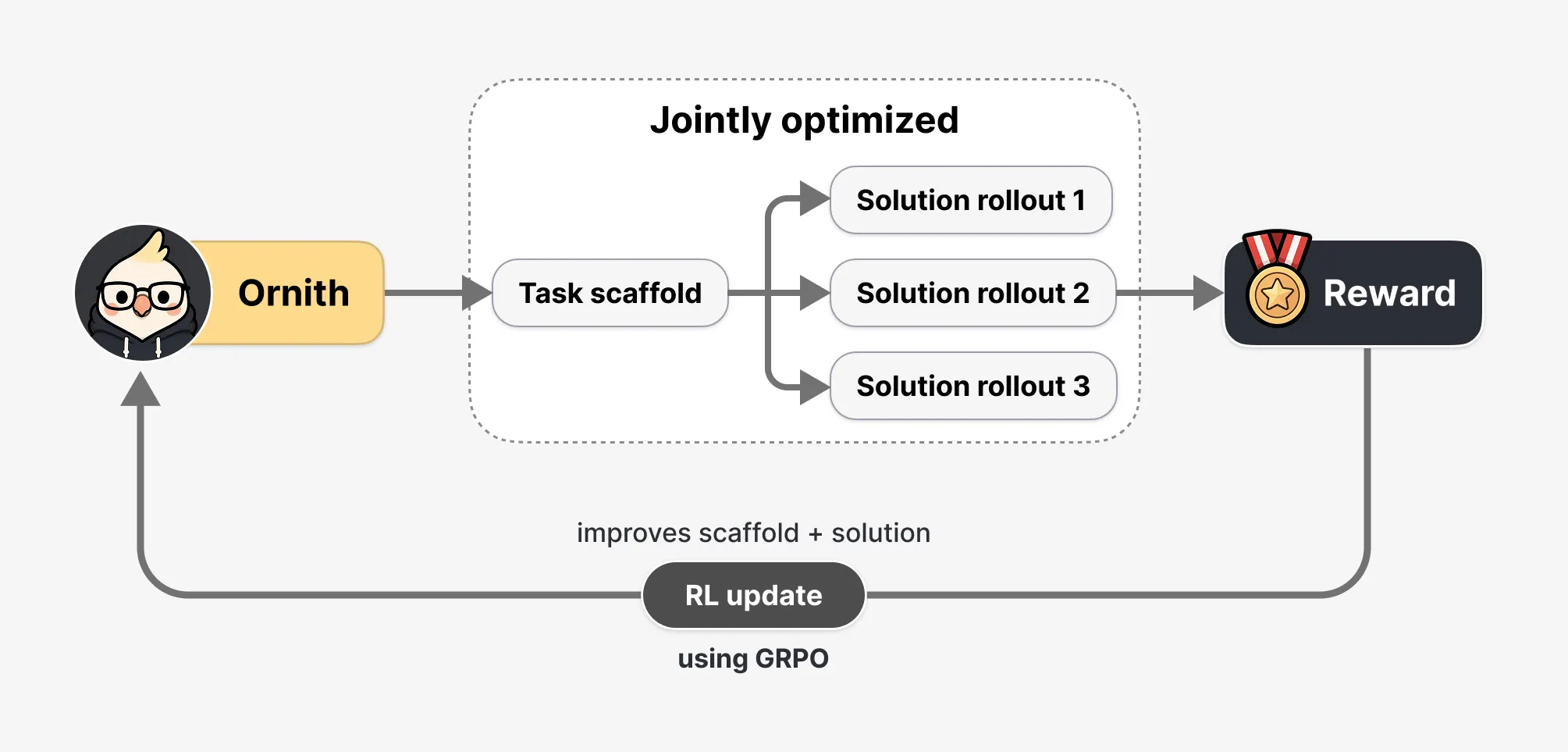
A significant distinction of Ornith-1.0 lies in its approach to agentic behavior. While many AI coding agents rely on pre-defined human-engineered frameworks for task execution, error handling, and problem decomposition, Ornith models are designed to treat these operational scaffolds as learnable components. During reinforcement learning, the model progresses through two stages: first, it analyzes the task and formulates a strategic approach, and second, it generates a solution based on that strategy. The rewards derived from task completion are applied to both stages, fostering optimization for both strategy development and code generation.
DeepReinforce has also implemented robust measures against “reward hacking,” where an AI might manipulate its training process to appear successful without genuinely completing tasks. Ornith-1.0 employs a multi-layered defense system: the execution environment and test suites are immutable, a deterministic monitor detects unauthorized access or modifications, and a frozen judge model acts as a final arbiter on automated verification outcomes.
Long-Term Technological Impact
The development of specialized AI models like Ornith-1.0 signifies a crucial evolution in artificial intelligence, moving beyond general-purpose assistants towards highly capable, task-specific agents. This shift has profound implications for various industries, particularly software development. By enabling AI to autonomously manage complex coding tasks within real development environments, such models can drastically accelerate development cycles, enhance code quality, and reduce the burden on human developers. This could lead to more sophisticated decentralized applications (dApps) on blockchains, more efficient AI-driven smart contracts, and novel Layer 2 scaling solutions that are developed and tested with unprecedented speed. Furthermore, the open-source nature of Ornith-1.0 promotes broader adoption and further innovation in the Web3 space, allowing developers to integrate advanced AI capabilities into their projects and contribute to the collective advancement of the ecosystem.
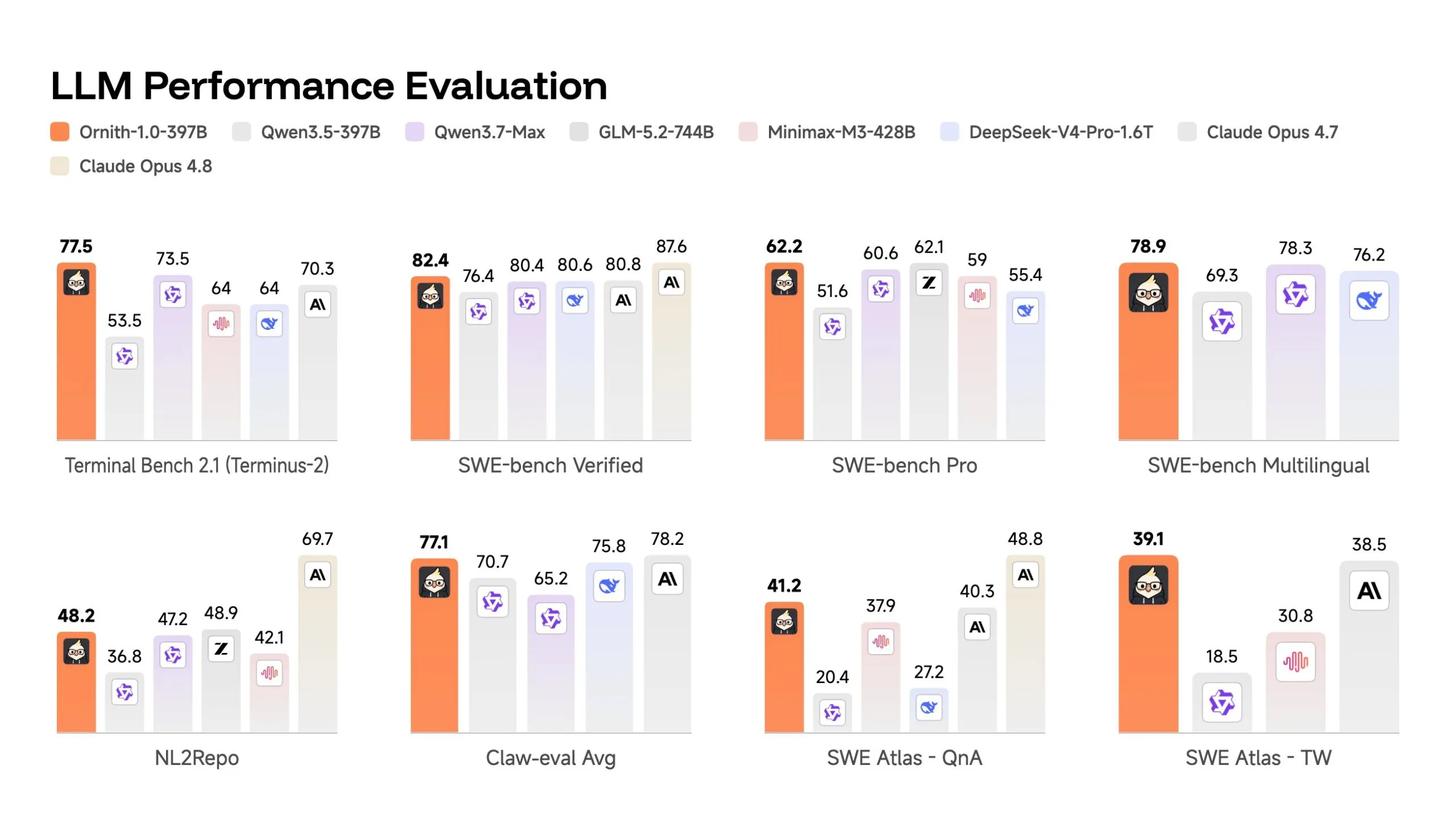
In terms of performance, the 397 billion parameter Ornith-1.0 model scores an impressive 82.4 on SWE-bench Verified, a benchmark measuring an AI’s ability to fix real-world bugs in open-source GitHub repositories without access to the test suite. This score surpasses prominent models like Claude Opus 4.7 (80.8) and DeepSeek-V4-Pro (80.6). On Terminal Bench 2.1, which assesses AI performance across 89 tasks within containerized terminal environments, Ornith-1.0 achieves a 77.5 completion rate, outperforming Claude Opus 4.7’s 70.3.
Addressing concerns about potential benchmark contamination, Ornith also reports strong results on SWE-bench Pro, a more rigorous version using less leaked codebases. The 397 billion model scores 62.2 on this benchmark, maintaining competitiveness with other leading models.
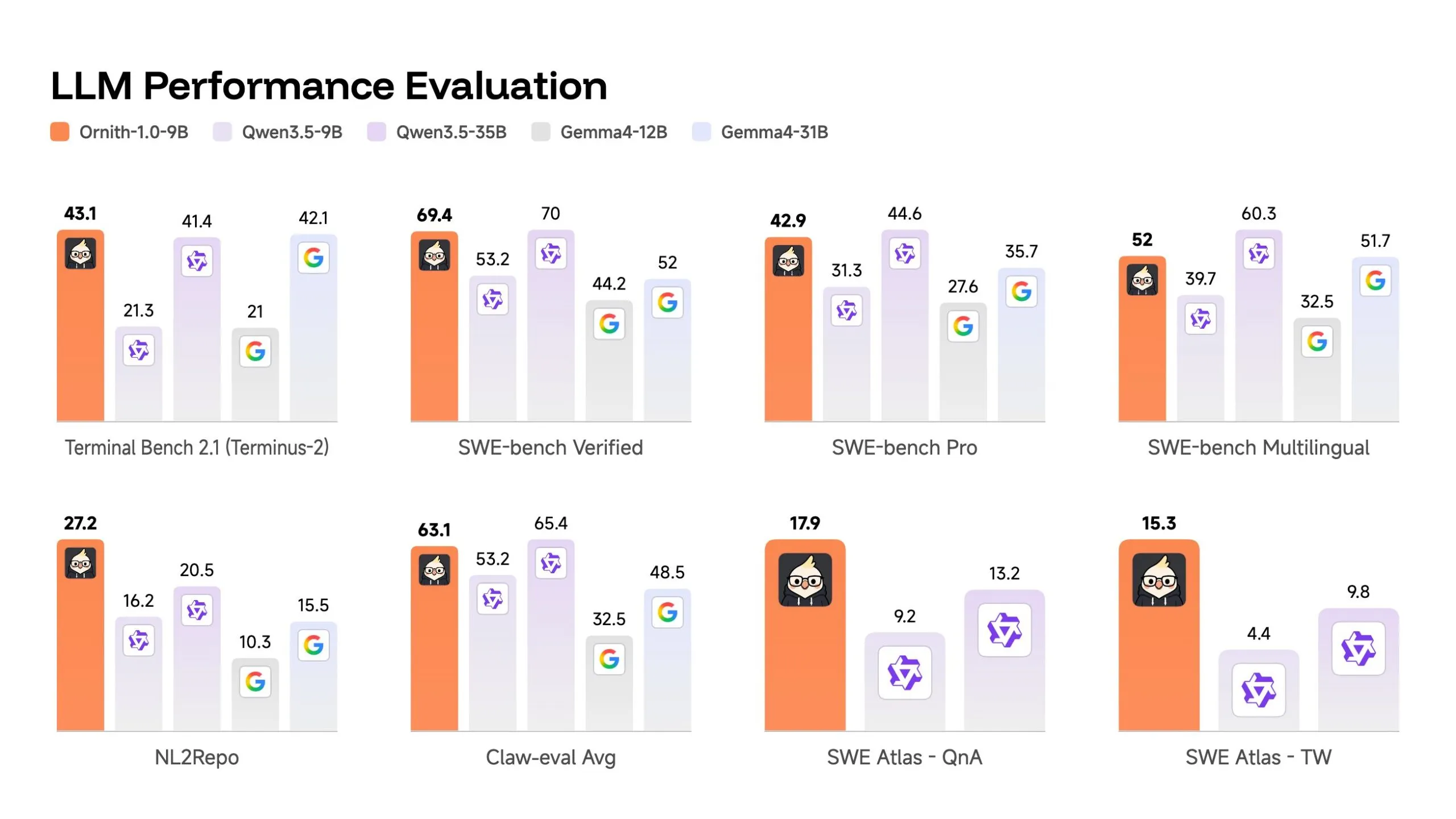
The 9 billion parameter model is particularly noteworthy, achieving a 69.4 on SWE-bench Verified. This score is higher than Gemma 4-31B’s 52 and is competitive with Qwen 3.5-35B’s 70, despite being significantly smaller. This efficiency suggests potent capabilities even in smaller model sizes.
Ornith-1.0 is explicitly designed for developers and teams already operating sophisticated agent infrastructure or building specialized coding pipelines. Its optimization is geared towards autonomous execution within code repositories and terminal sessions, making it less suitable for general-purpose AI applications like document summarization or content creation. While the models demonstrate superior performance on coding benchmarks compared to many closed-source alternatives, it’s important to note that comparisons are most relevant within the open-source domain and for coding-specific agentic tasks. For developers focused on building self-hosted coding solutions and agentic infrastructure, the smaller and medium-sized Ornith models may offer substantial utility, potentially even running effectively on edge hardware.
Based on materials from : decrypt.co